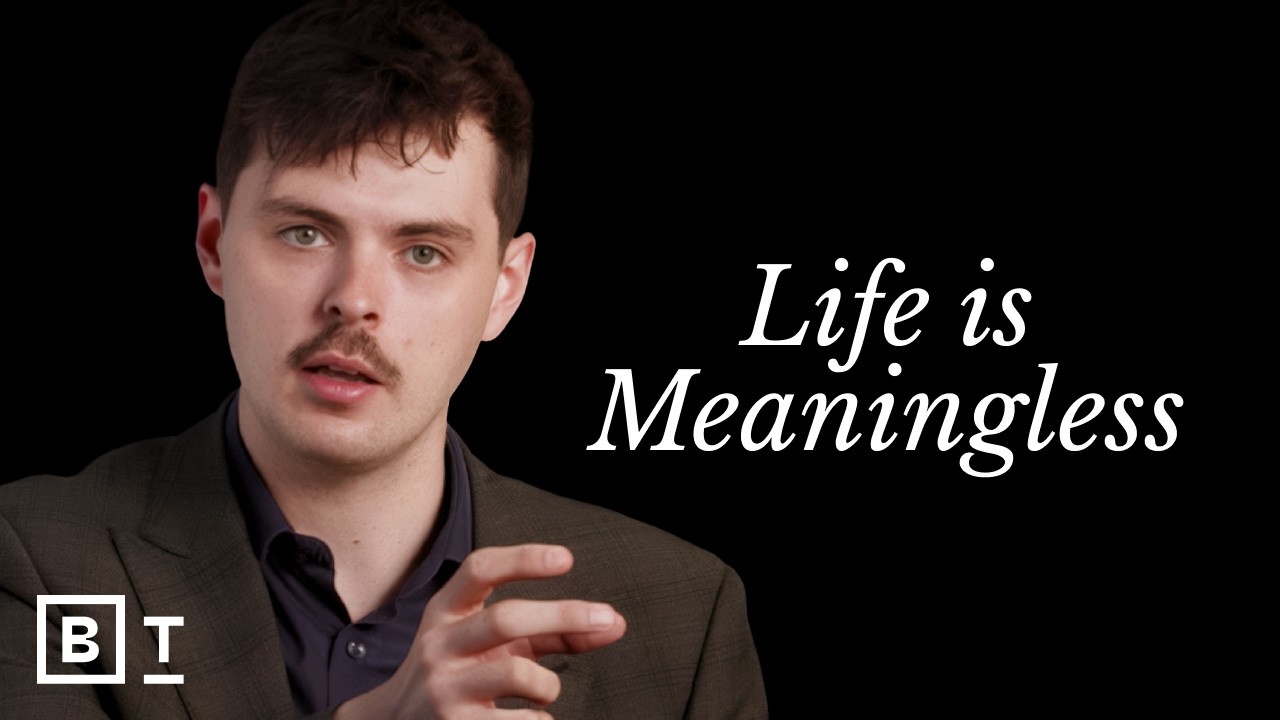
The hidden problem at the heart of nihilism | Alex O'Connor
Keywords
Summary
173 words
Critical Evaluation
Value of the Information & Strength of the Argument
The video offers a valuable and nuanced philosophical analysis of nihilism, clearly distinguishing between descriptive and normative aspects of meaning. O’Connor’s argument is logically coherent, building from the regress of reasons to the concept of a self-justifying principle, and he effectively uses relatable examples (thirst, child-rearing) to illustrate abstract ideas. He also engages with historical sources, such as Ecclesiastes and Camus, adding depth to the discussion. The argumentation is solid, though it remains within the realm of personal philosophical reflection rather than empirical or systematic analysis. O’Connor is honest about his own agnosticism, which strengthens the credibility of his perspective.
Scientific Rigor, Source Quality, Title Accuracy
O’Connor demonstrates philosophical rigor by referencing canonical texts (Ecclesiastes, Camus’s Myth of Sisyphus, Nietzsche) and clearly explaining his conceptual framework. However, he does not cite specific academic sources or empirical studies, relying instead on his own expertise and interpretation. The title accurately reflects the content, which focuses on the philosophical problem of grounding meaning in a nihilistic worldview. The video is well-structured and the argument is presented clearly, but the lack of external references limits its scholarly depth. The comments show a generally positive reception, with many viewers finding the discussion accessible and thought-provoking.
209 words
Title / Content Match
The title accurately reflects the content, which focuses on the philosophical problem of grounding meaning and purpose in a nihilistic worldview.
Quality & Reliability
8/10
The video presents a well-structured philosophical argument from an established philosopher and content creator. It engages with historical sources (Ecclesiastes, Camus, Nietzsche) and offers a clear conceptual framework, but relies on personal interpretation and lacks empirical or peer-reviewed backing.
Key Moments
Markers derived by PSI from the transcript: the creator did not define chapters.
- Introduction to nihilism and the problem of objective purpose.
- Discussion of the regress of reasons and the concept of a self-justifying principle.
- Distinction between values and purpose, and the subjective nature of meaning.
- Exploration of objective meaning and its difficulty without supernatural or teleological assumptions.
- Historical and literary perspectives on nihilism, including Ecclesiastes and Camus.
- Discussion of the narrative nature of nihilistic literature and the personal dimension of the problem.
- O'Connor's personal agnosticism as a source of consolation and conclusion.
Cited Sources
- Big Think Membership — Description link to Big Think membership, not directly related to content.
Concurring Sources
- Nihilism (Stanford Encyclopedia of Philosophy) — Academic overview of nihilism, consistent with O'Connor's discussion.
Dissenting Sources
- The Myth of Sisyphus — Camus's absurdism offers a different response to meaninglessness, focusing on revolt rather than acceptance.
Contribution & Novelties
The video provides a clear and accessible philosophical analysis of nihilism, distinguishing between values and purpose and introducing the concept of a ‘self-justifying principle’ as a way to understand how people ground meaning in their lives. It also highlights the historical depth of nihilistic thought, tracing it back to Ecclesiastes, and emphasizes the narrative, personal nature of the problem.
Pour aller plus loin :
- Nihilism (Stanford Encyclopedia of Philosophy) — Comprehensive academic overview of nihilism.
- The Myth of Sisyphus (Wikipedia) — Overview of Camus’s essay and its themes.
- Ecclesiastes (Wikipedia) — Background on the biblical book and its nihilistic themes.
100 words
Radar Profile
The radar profile shows high scores in information quality and technical level, indicating a well-argued and intellectually substantive video. The lower score in information quantity reflects the focus on a single philosophical topic rather than a broad survey. Overall, the video is a strong contribution to philosophical discourse on nihilism.
💬 Positive. Sur les 30 commentaires analysés, la majorité exprime une appréciation de la clarté et de la profondeur de l'analyse, certains partageant leurs propres perspectives sur le nihilisme, avec quelques débats sur la nature du sens.