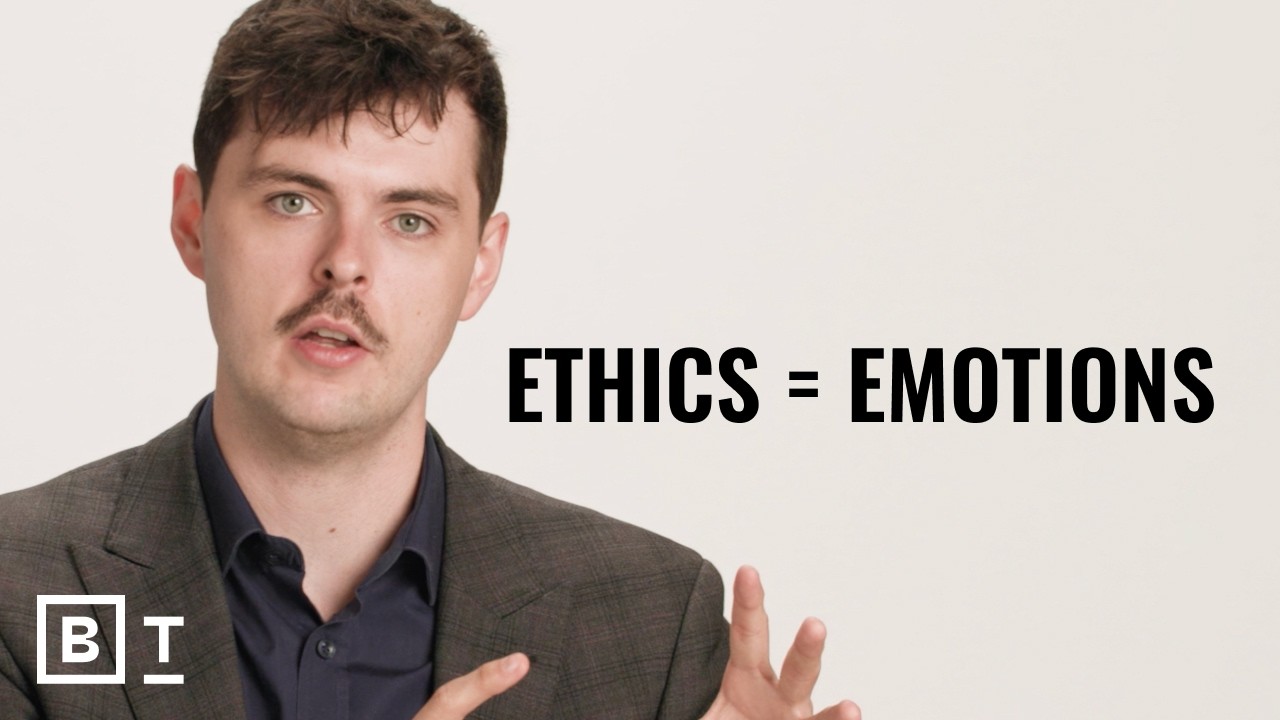
Why people mistake feelings for moral insight | Alex O'Connor
Keywords
Summary
161 words
Critical Evaluation
Value of the Information & Strength of the Argument
The video provides a valuable and accessible introduction to emotivism, a position often misunderstood. O’Connor’s argumentation is clear and logically structured, effectively distinguishing emotivism from related views and addressing common objections. He uses vivid examples, such as the Wetherspoons analogy and the incest taboo, to illustrate abstract points. The discussion of the Frege-Geach problem is particularly valuable, as it highlights a significant challenge to the theory. However, the argumentation is primarily expository and defensive; O’Connor does not engage deeply with alternative metaethical frameworks or the latest philosophical literature, which limits the depth of the analysis.
Scientific Rigor, Source Quality, Title Accuracy
The video demonstrates a solid understanding of the philosophical landscape, correctly attributing emotivism to A.J. Ayer and referencing the work of Simon Blackburn and the Frege-Geach problem. The title accurately reflects the content, which is a focused exploration of the emotivist perspective. The video is an expert opinion piece rather than a rigorous academic lecture, but it maintains a high level of intellectual honesty by acknowledging the theory’s limitations and potential counterarguments. The description provides a link to Big Think membership, but no direct sources are cited within the video itself.
201 words
Title / Content Match
The title accurately reflects the content, which explores the emotivist view that moral judgments are expressions of emotion rather than statements of fact.
Quality & Reliability
8/10
The video presents a clear, well-structured exposition of emotivism, grounded in the philosophical tradition (Ayer, Blackburn, Geach). The argument is logically coherent and acknowledges counterarguments, though it remains a personal expert opinion rather than a peer-reviewed study.
Key Moments
Markers derived by PSI from the transcript: the creator did not define chapters.
- Introduction to emotivism: moral statements as expressions of emotion.
- Distinction between emotivism and subjectivism.
- Explanation of truth value and why emotivist statements lack it.
- Non-cognitivism vs. cognitivism in ethics.
- Prescriptivism as another non-cognitivist theory.
- Moral debate often reduces to disputes over descriptive facts.
- Fundamental value conflicts and the possibility of shared emotional foundations.
- Discussion on emotions vs. attitudes, referencing Simon Blackburn's quasi-realism.
- Incest taboo as a case study for emotivism.
- Language and ethical expressions: the father and gay son example.
- Logical positivism and A.J. Ayer's verification principle.
- The Frege-Geach problem (embedding problem) and its challenge to emotivism.
- Recommended readings and concluding remarks.
Cited Sources
- Big Think Membership — Link in the video description for Big Think membership, not a direct source for the content.
Concurring Sources
- Emotivism (Stanford Encyclopedia of Philosophy) — Academic source that aligns with the video's presentation of emotivism.
Dissenting Sources
- Moral Objectivism (Internet Encyclopedia of Philosophy) — Presents a contrasting view that moral truths exist independently of individual attitudes, challenging the emotivist position.
Contribution & Novelties
The video offers a clear and engaging synthesis of emotivism, making complex metaethical ideas accessible to a general audience. O’Connor’s personal reflections and examples add a relatable dimension, but the core ideas are well-established in the philosophical literature. The video’s contribution lies in its pedagogical clarity rather than novel arguments.
Pour aller plus loin :
- Emotivism (Stanford Encyclopedia of Philosophy) — Comprehensive academic overview of emotivism.
- A.J. Ayer (Stanford Encyclopedia of Philosophy) — Biography and philosophical contributions of A.J. Ayer.
- Frege-Geach Problem (Internet Encyclopedia of Philosophy) — Detailed explanation of the embedding problem.
- Non-cognitivism (Wikipedia) — Overview of non-cognitivist theories in ethics.
- Simon Blackburn (Wikipedia) — Information on the philosopher who developed quasi-realism.
113 words
Radar Profile
The radar profile shows high scores in quantity and quality of information, reflecting the video's comprehensive and well-structured content. The technical level is moderately high, indicating a sophisticated discussion that remains accessible. Overall reliability is strong, as the video accurately represents the philosophical positions it discusses.
💬 Positif. Sur les 30 commentaires analysés, le public est majoritairement engagé et apprécie la clarté de l'explication, avec des discussions constructives sur les implications de l'émotivisme.