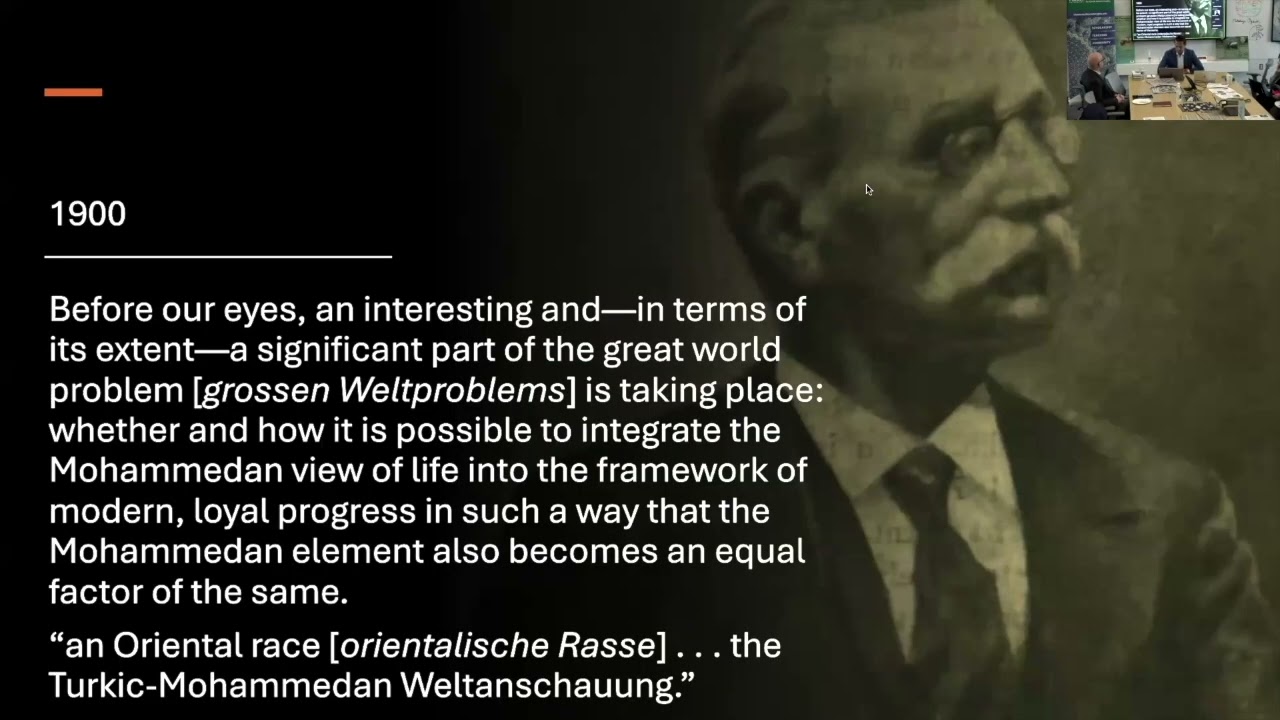
The Colonial Legacy of Europe's Islam Policies: The Cases of Austria and Germany
Keywords
Summary
151 words
Critical Evaluation
Value of the Information & Strength of the Argument
The talk provides valuable insights by connecting historical colonial governance to contemporary Islam policies, offering a novel perspective that bridges political science, history, and postcolonial theory. The argument is well-supported with specific historical examples and theoretical frameworks. The speaker’s expertise and the depth of the analysis contribute to the value of the presentation.
Scientific Rigor, Source Quality, Title Accuracy
The speaker references his own book and several scholarly works, including those by Fetzer and Soper, and postcolonial theorists. The sources are credible and relevant. The title accurately reflects the content. The talk is a scholarly presentation, and the argument is presented with academic rigor.
113 words
Title / Content Match
The title accurately reflects the content, which focuses on the colonial legacy of Islam policies in Austria and Germany.
Quality & Reliability
8/10
The talk is based on the author's book, which is a scholarly work grounded in historical and political science research. The speaker is an established academic with numerous publications. The argument is well-structured and supported by historical examples, though it is a single perspective and not peer-reviewed in this format.
Key Moments
Markers derived by PSI from the transcript: the creator did not define chapters.
- Introduction of the book and its main argument.
- Discussion of historical institutionalism and its limitations.
- Introduction of the concept 'coloniality of Islampolitik'.
- Episode 1: Benjamin Kallay and the Austro-Hungarian governance of Bosnia.
- Episode 2: Carl Heinrich Becker and the German colonial Islampolitik.
- Episode 3: The Nazi era and the use of Islam for war efforts.
- Contemporary examples: 2015 Austrian Islam Act and German Islam Conference.
- Theoretical framework: racialization and the flexibility of Islampolitik.
- Discussion of colonial amnesia and the need for historical perspective.
- Conclusion and Q&A session begins.
Cited Sources
- Governing Islam in Austria and Germany: From Colonial Times to the Present — The book by Dr. Hafez that this talk is based on.
- Muslims and the State in Britain, France, and Germany — Referenced as a key work on historical institutionalism.
- The Rise of Global Islamophobia in the War on Terror: Coloniality, Race, and Islam — Another publication by Dr. Hafez mentioned in the introduction.
Concurring Sources
- The Coloniality of Power — Theoretical framework referenced by the speaker.
- Islamophobia Studies Yearbook — Journal edited by the speaker, relevant to the topic.
Contribution & Novelties
The talk offers a novel contribution by applying the concept of ‘coloniality of Islampolitik’ to the European metropole, showing how colonial governance practices returned to Austria and Germany. It bridges historical and contemporary analyses, addressing a gap in the literature. The speaker’s emphasis on the flexibility and functionality of racialized policies provides a nuanced understanding.
Pour aller plus loin :
- Coloniality of power — Concept by Aníbal Quijano that underpins the theoretical framework.
- Islamophobia — Related concept discussed in the talk.
- Austro-Hungarian rule in Bosnia and Herzegovina — Historical context for the Austrian case.
94 words
Radar Profile
The radar profile shows high scores in information quantity, quality, and reliability, with a slightly lower technical level, indicating a well-researched and credible presentation that is accessible to a general academic audience.