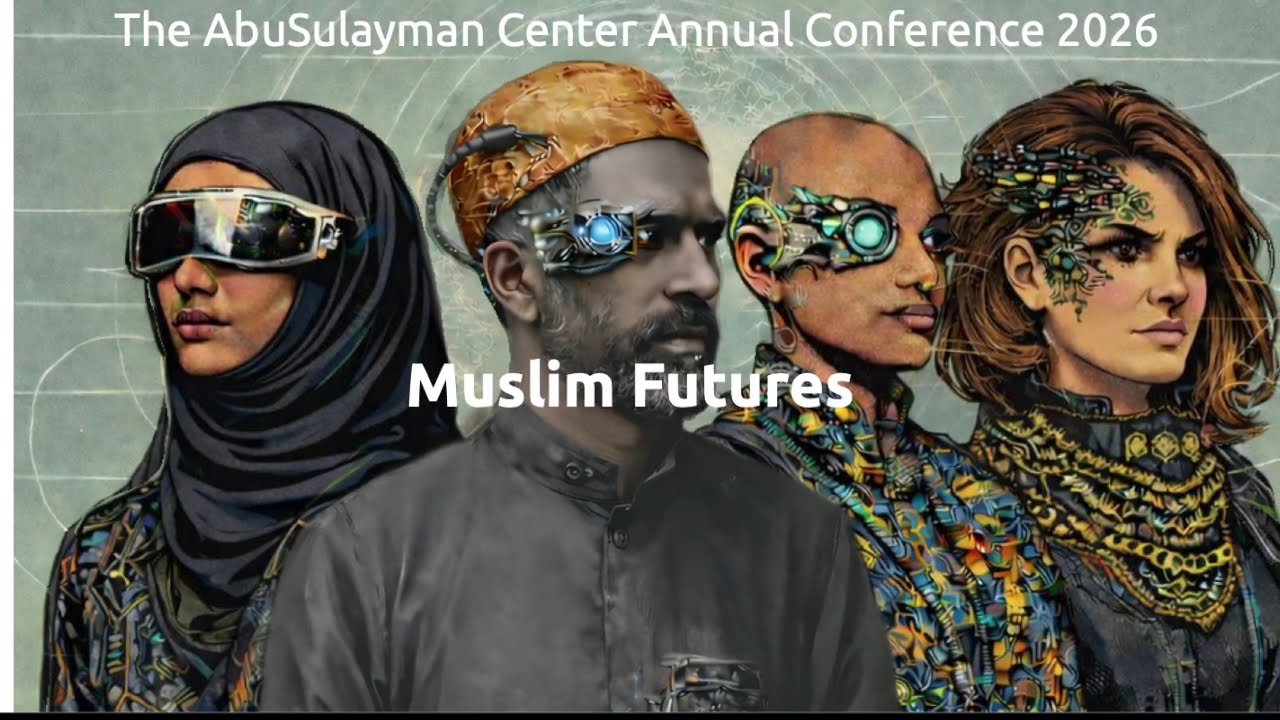
Muslim Futures: Abdul-Rehman Malik's Closing Remarks
Keywords
Summary
209 words
Critical Evaluation
Value of the Information & Strength of the Argument
The talk offers valuable insights into the intersection of Islam, technology, and futurity, drawing on a wide range of cultural and artistic references. Malik argues that the future is not a distant abstraction but is being actively constructed in the present, and he emphasizes the importance of imagination and speculative fiction in shaping possible futures. He critiques the erasure of memory and trauma in AI-generated visions of Muslim futures, and he highlights the role of decolonial and Black Atlantic perspectives. The argumentation is coherent and persuasive, though it is more of a synthesis of ideas than a rigorous academic analysis. Malik’s personal engagement with the material and his passion for the subject enhance the value of the talk.
Scientific Rigor, Source Quality, Title Accuracy
The talk is a closing keynote, so it is not a formal academic presentation with citations. However, Malik references numerous works and projects, including Sultana’s Dream, Sun Ra’s music, the Gaza Phoenix Project, and novels like Frankenstein in Baghdad. These references are credible and relevant, but they are not systematically cited. The title accurately reflects the content, as it is indeed the closing remarks of the conference. The talk is well-structured and the speaker’s expertise is evident, but the lack of formal citations and the subjective nature of the content limit its scientific rigor.
227 words
Title / Content Match
The title accurately reflects the content: it is the closing remarks of the conference 'Muslim Futures' by Abdul-Rehman Malik.
Quality & Reliability
7/10
The speaker is an academic affiliated with Yale, and the talk is a closing keynote at a university conference. It is an opinion piece grounded in scholarly discourse, but it is not a peer-reviewed study. The speaker references specific works and projects, but does not provide detailed citations or data. The content is reflective and synthesizes conference discussions, which limits its empirical reliability.
Key Moments
Markers derived by PSI from the transcript: the creator did not define chapters.
- Introduction and opening remarks
- Critique of AI-generated images of Muslim futures
- Discussion of the present as the site of future-making
- Reference to Sultana's Dream and Islamic futurism
- Black Atlantic thread and Malcolm X
- Sun Ra and the intersection of Islam and jazz
- Gaza dystopias and the Gaza Phoenix Project
- Everything for Everyone and post-collapse New York
- Morehshin Allahyari and decolonial art
- Larissa Sansour and speculative Palestinian futures
- Leila Suker and generative AI in scholarship
- Conclusion and call to action
Cited Sources
- Muslim Futures Conference — The conference for which this talk is the closing remarks.
Concurring Sources
- Muslim Futures Conference — The conference itself, which aligns with the themes discussed in the talk.
Contribution & Novelties
The talk provides a rich synthesis of perspectives on Muslim futures, emphasizing the importance of imagination and speculative fiction in shaping possible futures. It highlights the intersection of Islam, technology, and decolonial thought, and calls for scholars to engage in world-building as a method of knowledge production. The speaker’s personal reflections and cultural references offer a unique perspective that goes beyond typical academic discourse.
Pour aller plus loin :
- Sultana’s Dream — A 1905 feminist utopian novella by Rokeya Sakhawat Hussain, referenced as an early example of Muslim futurism.
- Sun Ra — Jazz musician and Afrofuturist pioneer, whose work intersects with Islam and speculative thought.
- Frankenstein in Baghdad — A novel by Ahmed Saadawi, which imagines a composite Iraqi citizen, relevant to discussions of identity and future.
- Gaza Phoenix Project — A participatory initiative to reimagine Gaza’s future, mentioned in the talk.
142 words
Radar Profile
The radar profile shows high scores in quantity and quality of information, reflecting the rich synthesis of cultural and academic references. The technical level is moderate, as the talk is accessible but assumes some familiarity with the topics. The overall reliability is high for an opinion piece, but not as high as a peer-reviewed study.
💬 No comments were provided for analysis.