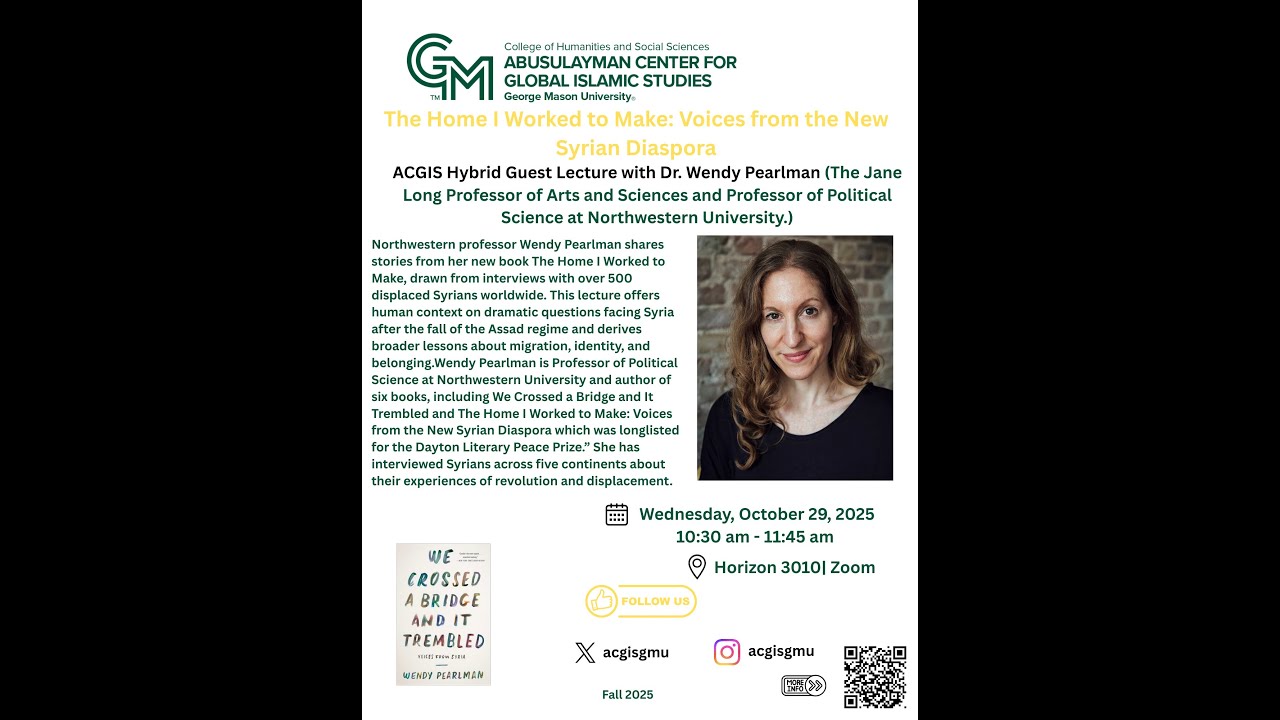
What is the Meaning of Home? With Dr. Wendy Pearlman
Keywords
Summary
192 words
Critical Evaluation
Value of the Information & Strength of the Argument
The lecture provides valuable insights into the lived experiences of Syrian refugees, drawing on extensive qualitative research. Pearlman’s argument that refugees have a unique perspective on home is compelling and well-supported by the testimonies she shares. She effectively challenges common stereotypes of refugees as passive victims or burdens, instead highlighting their agency and resilience. The use of personal narratives adds depth and emotional resonance, making the abstract concept of home tangible. However, the argumentation is primarily based on anecdotal evidence and the author’s interpretation, which may not be generalizable. The speaker acknowledges this limitation and the diversity of refugee experiences, but the lack of systematic analysis or comparison with other refugee groups could be seen as a weakness. Overall, the value lies in its humanizing and thought-provoking approach, though it may not offer rigorous empirical evidence.
Scientific Rigor, Source Quality, Title Accuracy
The speaker demonstrates scientific rigor by grounding her talk in her published work and extensive fieldwork. She cites specific sources, including her own books and the work of cultural geographer Yi-Fu Tuan, which adds credibility. The title accurately reflects the content, focusing on the meaning of home for Syrian refugees. The lecture is well-structured, with clear context and transitions. However, the talk is primarily based on the author’s own research, and while she mentions other scholars, she does not provide a comprehensive literature review. The sources cited are relevant and authoritative, but the reliance on personal testimonials may introduce bias. The title is appropriate and not misleading. Overall, the scientific rigor is high, but the subjective nature of the topic and the qualitative methodology limit the generalizability of the findings.
281 words
Title / Content Match
The title accurately reflects the content: the lecture explores the meaning of home through the lens of Syrian refugees, addressing displacement, diaspora, and return.
Quality & Reliability
8/10
The speaker is a recognized academic (Professor of Political Science at Northwestern University) with extensive publications on the Syrian conflict. The talk is based on her book 'The Home I Work to Make', which is a collection of testimonials from Syrian refugees. The content is well-structured, contextualized, and includes personal narratives that are presented as such. The speaker acknowledges the limitations of her perspective and the diversity of experiences. The information is reliable within the scope of qualitative research and expert opinion.
Key Moments
Markers derived by PSI from the transcript: the creator did not define chapters.
- Introduction and welcome by the moderator, Yasmin, introducing Dr. Wendy Pearlman.
- Dr. Pearlman asks the audience to reflect on the meaning of home and introduces the topic.
- Political context of the Syrian conflict, from the 2011 uprising to the fall of the Assad regime.
- Explanation of why home is a central concept for understanding refugee experiences.
- Testimony of Fatima, a Syrian refugee in Jordan, on her attachment to home and faith.
- Testimony of Nour, a Syrian refugee in Denmark, on identity and home as self.
- Discussion on the return of refugees after the fall of the regime and the complexity of the question.
- Conclusion and final thoughts on the meaning of home.
Cited Sources
- The Home I Work to Make: Voices from the New Syrian Diaspora — Book by Dr. Pearlman, basis of the talk, containing testimonials from Syrian refugees.
- We Crossed a Bridge and It Trembled: Voices from Syria — Previous book by Dr. Pearlman, also based on interviews with Syrian refugees.
- Yi-Fu Tuan — Cultural geographer whose concept of rootedness is referenced in the talk.
Concurring Sources
- UNHCR Syria Emergency — UNHCR provides data and reports on Syrian refugees, aligning with the talk's context.
Dissenting Sources
- No specific discordant sources found — The talk is based on qualitative research and personal narratives, which may not align with quantitative studies or policy perspectives, but no direct contradictions were identified.
Contribution & Novelties
The lecture offers a unique perspective on the meaning of home by centering the voices of Syrian refugees. It challenges conventional narratives by emphasizing the active work refugees do to create a sense of belonging, rather than viewing them as passive victims. The inclusion of diverse testimonials highlights the complexity and individuality of the refugee experience. The talk also addresses the recent political changes in Syria and their implications for refugees, providing timely insights.
Pour aller plus loin :
- Refugee Studies Centre — Academic center focusing on forced migration, relevant for further research.
- Syrian refugee crisis — Overview of the crisis, providing context.
- Diaspora studies — Academic field examining diaspora communities, relevant to the topic.
115 words
Radar Profile
The radar profile shows high scores in quality of information and reliability, reflecting the speaker's expertise and the depth of the content. The quantity of information is moderate, as the talk focuses on a specific aspect of the refugee experience. The technical level is moderate, making it accessible to a general audience while still providing scholarly insights.
💬 No comments were provided for analysis.