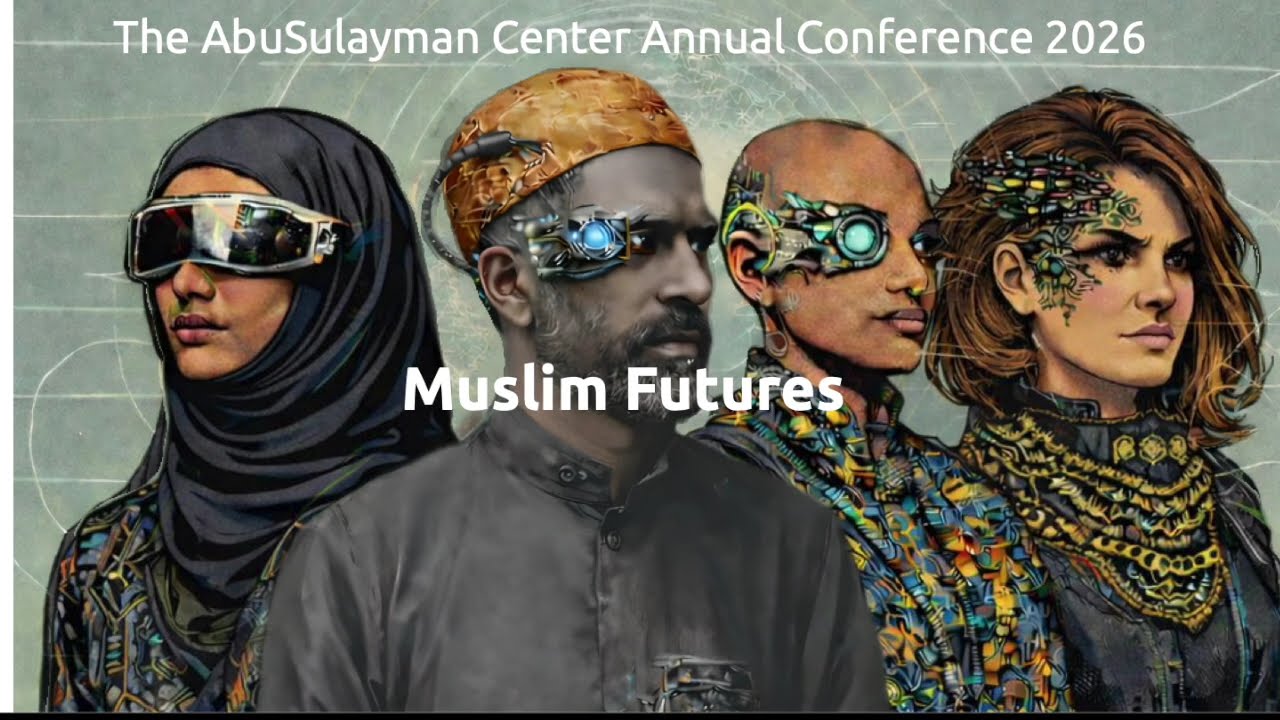
Muslim Futures : Dean Recep Senturk, Rami el Samahy and Arda Bilgen.
Keywords
Summary
181 words
Critical Evaluation
Value of the Information & Strength of the Argument
The panel offers valuable insights into sustainability from Islamic, design, and political ecology perspectives. Senturk’s argument for a ‘rooted revival’ based on Islamic principles provides a compelling alternative to both Westernization and isolationism, though it remains largely theoretical. El Samahy’s presentation is rich with concrete examples, demonstrating how design can be a tool for speculation and future-making, but it lacks a critical analysis of the political and economic contexts of these projects. Bilgen’s contribution is particularly strong, grounding the discussion in empirical research on water governance, highlighting the power dynamics and social implications of infrastructure. The argumentation is generally solid, with each speaker drawing on relevant literature and case studies, but the limited time per speaker prevents deep engagement with counterarguments.
Scientific Rigor, Source Quality, Title Accuracy
The panel demonstrates scientific rigor through the use of established scholarly frameworks (Ibn Khaldun, maqasid) and specific case studies. Senturk references Ibn Khaldun and Toynbee, while El Samahy cites design precedents and Bilgen draws on his research. The sources are appropriate for the topics, though not all are explicitly cited in the transcription. The title accurately reflects the content, which is a panel on sustainable futures within the broader theme of Muslim futures. The discussion is well-structured, with each speaker addressing a distinct aspect of sustainability.
222 words
Title / Content Match
The title accurately reflects the panel's focus on sustainable futures within the broader theme of Muslim futures, covering civilizational sustainability, design, and water governance.
Quality & Reliability
7/10
The panel features academic experts in Islamic studies, architecture, and water governance, providing a multidisciplinary perspective. The arguments are grounded in scholarly frameworks (e.g., Ibn Khaldun's cyclical theory) and specific case studies, but the format is a conference panel with limited time for each speaker, which may limit depth. The content is largely opinion and analysis rather than original research.
Key Moments
Markers derived by PSI from the transcript: the creator did not define chapters.
- Dean Recep Senturk begins his talk on 'Civilizational Sustainability of Islam'.
- Senturk outlines Ibn Khaldun's five stages of civilization.
- Senturk discusses the concept of 'open civilization' and multiplex ontology.
- Rami el Samahy begins his talk on 'Micro, Meso, Macro: Design as a Means of Predicting the Future'.
- El Samahy presents examples of design speculation, including Minority Report and vertical forests.
- El Samahy discusses projects in the Muslim world, such as Masdar City and NEOM's 'The Line'.
- Arda Bilgen begins his talk on 'Exploring Water Futures'.
- Bilgen discusses hydro-social governance and techno-developmentalism in the Middle East.
- Discussant Yasemin Ipek provides commentary and the panel opens for Q&A.
Cited Sources
- Muslim Futures Conference — Official conference page providing context for the panel.
Concurring Sources
- Ibn Khaldun's Muqaddimah — Supports Senturk's discussion of civilizational cycles.
- Masdar City — El Samahy's example of a sustainable city project.
Dissenting Sources
- Critique of NEOM's The Line — El Samahy presents The Line as an ambitious idea, but it has faced criticism regarding feasibility and environmental impact.
Contribution & Novelties
The panel contributes to the discourse on sustainable futures by integrating Islamic civilizational thought, design speculation, and water governance. Senturk’s proposal for a ‘rooted revival’ offers a novel framework for sustainability that goes beyond the UN’s SDGs, emphasizing moral and epistemic dimensions. El Samahy’s presentation highlights the role of design in imagining futures, particularly within Muslim contexts, and Bilgen’s research brings attention to the often-overlooked hydro-social dynamics in the Middle East.
Pour aller plus loin :
- Ibn Khaldun’s Muqaddimah — Foundational text for understanding civilizational cycles.
- Maqasid al-Sharia — Concept of objectives in Islamic law, relevant to Senturk’s argument.
- Masdar City — Example of a sustainable urban project discussed by El Samahy.
- Hydro-social cycle — Concept relevant to Bilgen’s analysis of water governance.
123 words
Radar Profile
The radar profile shows high scores in information quality and reliability, reflecting the academic expertise of the speakers. The moderate score in technical level indicates that while the content is intellectually rigorous, it is accessible to a general audience. The lower score in information quantity is due to the limited time per speaker, which restricts the depth of each presentation.
💬 No comments were provided for analysis.