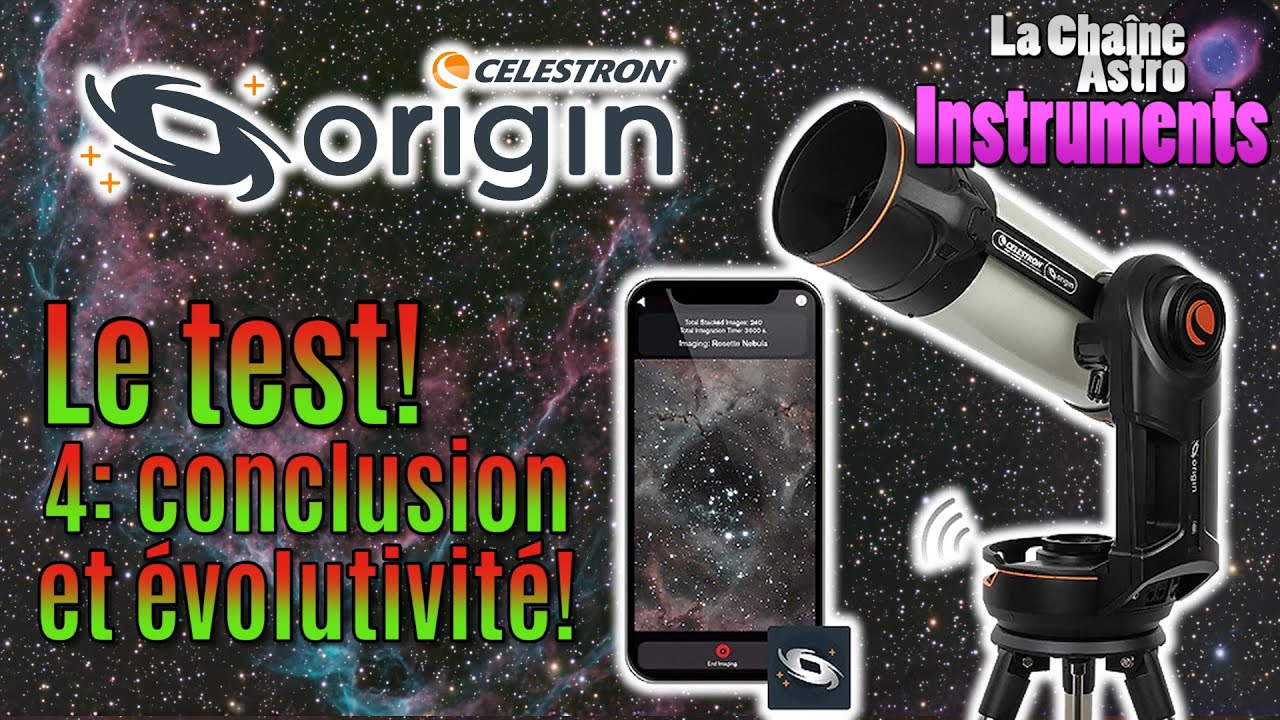
Celestron Origin : Conclusion et Evolutivité! (le test - partie 4)
Keywords
Summary
164 words
Critical Evaluation
Value of the Information & Strength of the Argument
The video provides substantial value through hands-on testing and demonstration of the telescope’s capabilities. The author presents concrete examples of image quality with different exposure times, and he explains the practical aspects of using the telescope in various conditions (cold, wind, urban). His argumentation is solid, based on his direct experience and supported by visual evidence. He also addresses potential drawbacks (Wi-Fi, wind sensitivity) and provides practical tips. The discussion of evolutivity is well-argued, showing how the telescope can be upgraded and adapted for more advanced use, which justifies the higher price point.
Scientific Rigor, Source Quality, Title Accuracy
The review is rigorous in its methodology: the author tested the telescope under real observing conditions and provides specific details about performance. He is transparent about the loan of the equipment and the lack of sponsorship. The sources cited are primarily product pages from the retailer Medas Instruments, which are relevant for verifying specifications and availability. The title accurately reflects the content, focusing on the conclusion and evolutivity. The author also mentions the Celestron tutorial for camera replacement, but no direct link is provided. Overall, the scientific rigor is good for a product review, though it remains subjective and based on a single unit.
212 words
Title / Content Match
The title accurately reflects the content: the video concludes the test series and focuses on the evolution/upgradability of the Celestron Origin.
Quality & Reliability
8/10
The review is based on hands-on testing under real observing conditions (Saint-Véran observatory, 3000m altitude, cold temperatures) and includes specific performance metrics (exposure times, image quality, filter performance). The author transparently discloses the loan of equipment and the absence of sponsorship. However, the evaluation is subjective and lacks quantitative comparisons with other equipment, and the sample size is limited to one unit.
Key Moments
Markers derived by PSI from the transcript: the creator did not define chapters.
- Introduction: the author presents the Celestron Origin as a game changer and outlines the test conditions at Saint-Véran.
- Discussion of the telescope's performance in cold temperatures and wind, noting the effective heating and sensitivity to wind.
- Wi-Fi connectivity issues are discussed, with tips for reconnecting.
- The author demonstrates the impressive image quality from short exposures (10 seconds) and longer integrations.
- Showcase of images taken with the nebula filter in urban conditions, highlighting its effectiveness.
- Discussion of the image processing workflow and the ease of use for beginners.
- Introduction of the evolutivity: the wedge for equatorial use and the Starsense autoguider.
- Explanation of the camera upgrade path (IMX678) and the announcement of the Mark II version at the same price.
- Conclusion: the author summarizes the value proposition and recommends the telescope for those with the budget who want high-quality astrophotography without complexity.
Cited Sources
- Celestron Origin Mark II — Product page for the Celestron Origin Mark II, confirming the IMX678 camera and price.
- Camera 678c — Product page for the replacement camera (IMX678) for the Celestron Origin.
- Transport bag — Product page for the padded transport bag for the Celestron Origin.
- Nebula filter — Product page for the nebula filter for the Celestron Origin, used in urban conditions.
Concurring Sources
- Celestron Origin Mark II — Confirms the availability of the Mark II with IMX678 camera at the same price.
External References
Contribution & Novelties
This video provides a comprehensive hands-on review of the Celestron Origin, focusing on its evolutivity—a feature not commonly highlighted in other reviews. The author demonstrates the telescope’s performance in real-world conditions and explains how it can be upgraded with a wedge, autoguider, and new camera, making it a long-term investment. The review is valuable for potential buyers, offering practical insights and realistic expectations.
Pour aller plus loin :
- Smart telescope — Overview of smart telescopes and their features.
- Schmidt–Cassegrain telescope — Background on the optical design used in the Celestron Origin.
- Autoguider — Explanation of autoguiding technology used in astrophotography.
100 words
Radar Profile
The radar profile shows high scores in information quantity, quality, and technical level, with a slightly lower but still good score in global reliability. This indicates a well-balanced review that is both informative and technically sound, with minor limitations in objectivity.
💬 Sur les 0 commentaires analysés, aucune tendance n'a pu être dégagée.