📌 REPASO Pre TP Evaluativo - INGRESO 2026
Keywords
Summary
244 words
Critical Evaluation
Value of the Information & Strength of the Argument
The video provides a clear and structured summary of the historical and conceptual content, making it valuable for students preparing for the exam. The argumentation is solid, as it explains the reasoning behind historical events and models, helping viewers understand the material rather than just memorizing facts. The host effectively connects historical developments to contemporary issues, such as the influence of market demands on education, which enriches the discussion. However, the video is a review and does not introduce new information beyond the texts, and the argumentation is sometimes informal, with personal anecdotes and asides.
Scientific Rigor, Source Quality, Title Accuracy
The video is based on the official texts for the course, and the host accurately presents the key concepts. The sources are not explicitly cited within the video, but the content aligns with standard historical accounts. The title accurately reflects the content, as it is a review session for the evaluative practical work. The video does not provide external references, but it is a tutorial meant to complement the official materials. The presentation is rigorous in its adherence to the curriculum, though it simplifies some complex historical debates.
198 words
Title / Content Match
The title accurately reflects the content: a review session for the evaluative practical work of the 2026 admission process.
Quality & Reliability
7/10
The video is a review session by a student group, providing a structured overview of key concepts from official texts. It is didactic and accurate in its presentation of historical facts and models, but it is not an academic source itself and may contain simplifications.
Key Moments
Markers derived by PSI from the transcript: the creator did not define chapters.
- Introduction and overview of the review session, including the structure and importance of the topics.
- Explanation of the official history of the university, focusing on the University of Bologna and its role in transmitting knowledge.
- Discussion of the alternative history, mentioning earlier institutions in Morocco, Egypt, and Iraq.
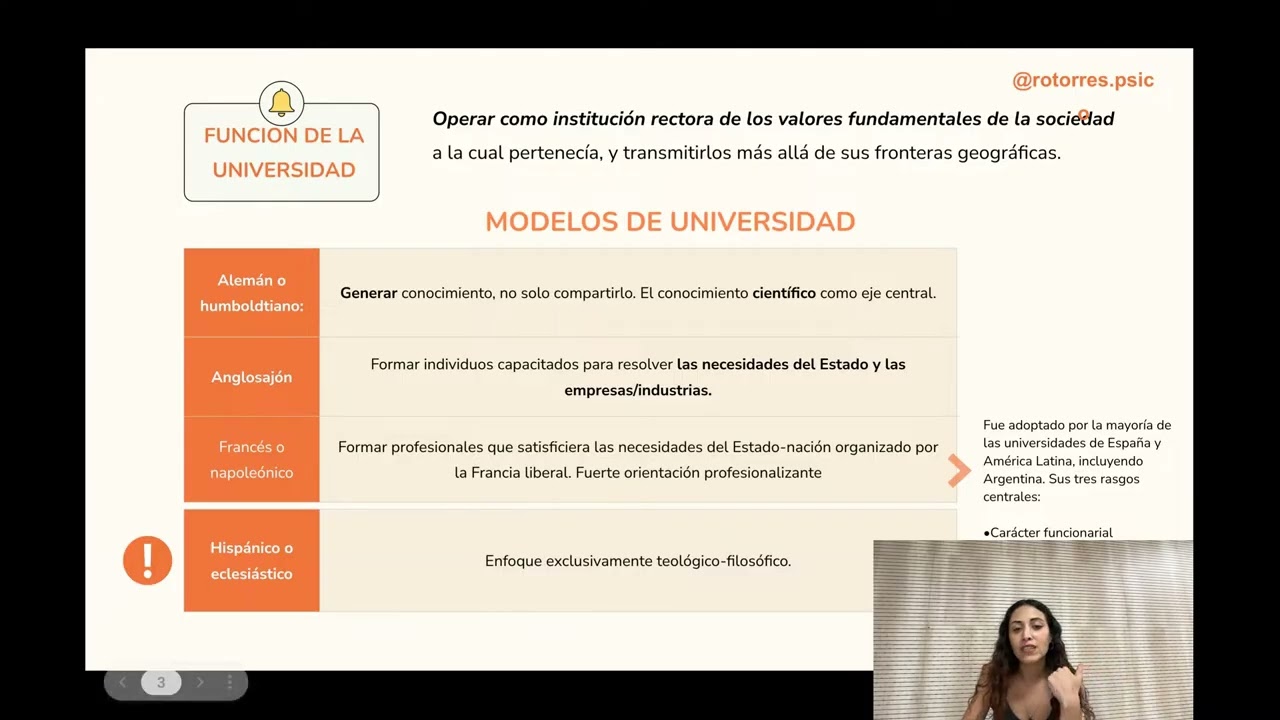
- Introduction of the four university models: German, Anglo-Saxon, French, and Hispanic-ecclesiastical.
- Detailed explanation of the German (Humboldtian) model and its emphasis on generating knowledge.
- Comparison between the Anglo-Saxon and French models, highlighting their focus on state and industry needs.
- Historical context of Argentina, including the coexistence of French and Hispanic models in Buenos Aires and Córdoba.
- Explanation of the Ley Avellaneda and its impact on national universities and social mobility.
- Discussion of the Reform of 1918, its antecedents, and the demands for autonomy and co-governance.
- Overview of the Ley de Educación Superior of 1995, its scope, and the debates it generated.
Cited Sources
- Historia de la institución universitaria — Referenced as the first text for the history of the university, covering official, alternative, and modern histories.
- Manifiesto Liminar — Mentioned as a key document from the Reform of 1918, outlining student demands.
- Ley Avellaneda — Discussed as the first law regulating national public universities in Argentina.
- Ley de Educación Superior (24.521) — Mentioned as the 1995 law regulating the entire higher education system.
Concurring Sources
- Historia de la universidad argentina — The video's account aligns with standard historical narratives of Argentine universities.
Dissenting Sources
- Alternative histories of universities — The video mentions that some institutions in Morocco, Egypt, and Iraq predate Bologna, which is a debated point in historiography.
Contribution & Novelties
The video provides a structured and accessible review of the historical and conceptual content required for the exam, emphasizing interpretation over memorization. It offers a clear comparison of university models and their relevance to Argentina’s context. The session also includes practical advice for the exam, such as attention to wording in multiple-choice questions.
Pour aller plus loin :
- Reforma universitaria de 1918 — Context and significance of the reform movement.
- Universidad Nacional de Córdoba — Official site of the university, relevant for understanding its history and current structure.
- Ley de Educación Superior Argentina — Official text and information about the law.
101 words
Radar Profile
The radar profile shows high scores in quantity of information and reliability, reflecting the comprehensive coverage and accurate presentation of the material. The technical level is moderate, suitable for an introductory audience, and the overall quality is strong for a review session.
💬 Sur les 0 commentaires analysés, aucune tendance n'a pu être dégagée.