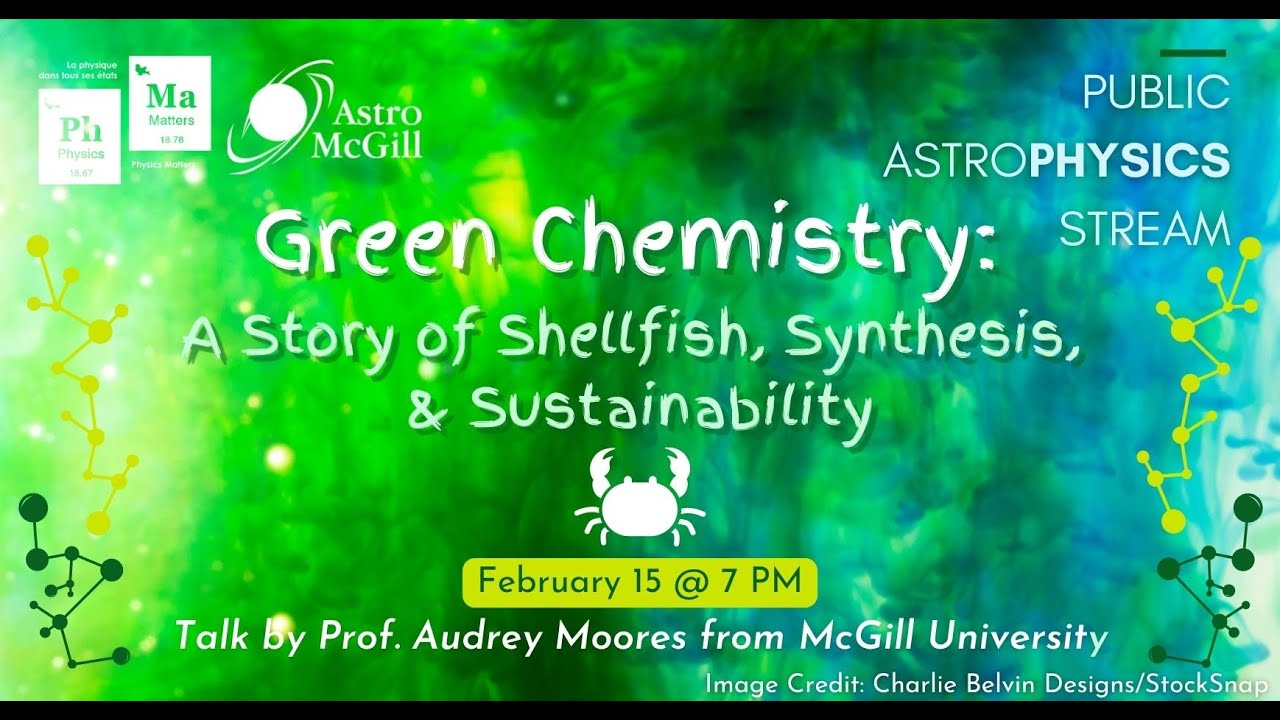
Green Chemistry: A Story of Shellfish, Synthesis & Sustainability
Keywords
Summary
191 words
Critical Evaluation
Value of the Information & Strength of the Argument
The talk provides valuable insights into the emerging field of mechanochemistry, showcasing its potential to make chemical synthesis more sustainable. The speaker presents concrete examples from her own research, including the synthesis of nanoparticles and polymer functionalization, which demonstrates the practical applications. The argumentation is solid, as she explains the principles behind mechanochemistry and supports her claims with experimental results. However, some parts are presented as anecdotal (e.g., the accidental discovery of bismuth sulfide nanoparticles), which adds a human element but may not be as rigorous. The talk also highlights the importance of understanding the mechanisms, as she discusses modeling with the help of theory. Overall, the information is valuable for both a general audience and those interested in green chemistry.
Scientific Rigor, Source Quality, Title Accuracy
The scientific rigor is high, as the speaker is a professor and presents her own peer-reviewed research. She mentions collaborations with other researchers and references specific publications. However, the talk does not provide explicit citations or URLs for the sources, which limits the ability to verify claims. The title is somewhat misleading, as it emphasizes ‘shellfish’ which is only briefly mentioned at the end; the main focus is on mechanochemistry and nanomaterials. The content is well-structured and the speaker is knowledgeable, but the lack of detailed references is a minor weakness.
227 words
Title / Content Match
The title is somewhat misleading as it mentions 'shellfish' which is not a major focus of the talk. The talk primarily covers mechanochemistry and its applications in nanomaterials and polymer chemistry, with a brief mention of chitin (from shellfish) towards the end. The title overemphasizes the shellfish aspect, which is only a minor part of the content.
Quality & Reliability
8/10
The talk is presented by a professor of chemistry at McGill University, with a solid scientific background. The content is based on her own research and collaborations, and she references specific studies and publications. The presentation is clear and well-structured, with a focus on explaining mechanochemistry and its applications. However, as a public lecture, it lacks detailed citations and peer-reviewed references, and some claims are presented without direct evidence in the video.
Key Moments
Markers derived by PSI from the transcript: the creator did not define chapters.
- Introduction to the talk and the concept of energy barriers in chemical reactions.
- Explanation of different energy sources for chemical reactions, including thermal, photochemical, and mechanical.
- Introduction to mechanochemistry and its recognition by IUPAC.
- Discussion on the use of mechanochemistry for synthesizing nanomaterials, including gold nanoparticles.
- Example of making bismuth sulfide nanoparticles for cancer detection, including the accidental discovery.
- Application of mechanochemistry to make nickel phosphide for water splitting.
- Modeling the formation of nanoparticles using facial theory and the addition of a ballistic term.
- Discussion on polymer functionalization using mechanochemistry, including the synthesis of a PEG-amine ligand.
- Application to polyketone modification and the potential for using renewable resources like chitin.
- Conclusion and summary of the potential of mechanochemistry for sustainable chemistry.
Cited Sources
- AstroMcGill website — The talk is part of the AstroMcGill public lecture series, and the website provides information about upcoming events.
Concurring Sources
- IUPAC - Mechanochemistry — The talk mentions that IUPAC named mechanochemistry as one of the top ten technologies that will change the world. This source provides the list.
Contribution & Novelties
The talk provides an accessible overview of mechanochemistry and its applications in green chemistry, particularly in the synthesis of nanomaterials and polymer functionalization. It highlights the potential of solvent-free methods to reduce waste and energy consumption. The speaker also presents her own research, including the use of mechanochemistry to make bismuth sulfide nanoparticles for cancer detection and nickel phosphide for water splitting. The talk emphasizes the importance of understanding the mechanisms and the role of modeling in predicting outcomes.
Pour aller plus loin :
- Mechanochemistry - Wikipedia — Overview of mechanochemistry, its history, and applications.
- Green Chemistry - Wikipedia — Principles of green chemistry and its goals.
- Nanoparticle - Wikipedia — Definition and applications of nanoparticles.
- Chitin - Wikipedia — Information on chitin, a renewable resource mentioned in the talk.
130 words
Radar Profile
The radar profile shows high scores in quantity and quality of information, reflecting the speaker's expertise and the depth of content. The technical level is moderate, suitable for a general audience, while reliability is high due to the speaker's academic background. The overall profile indicates a well-rounded and informative presentation.
💬 Sur les 0 commentaires analysés, aucune tendance n'a pu être dégagée.