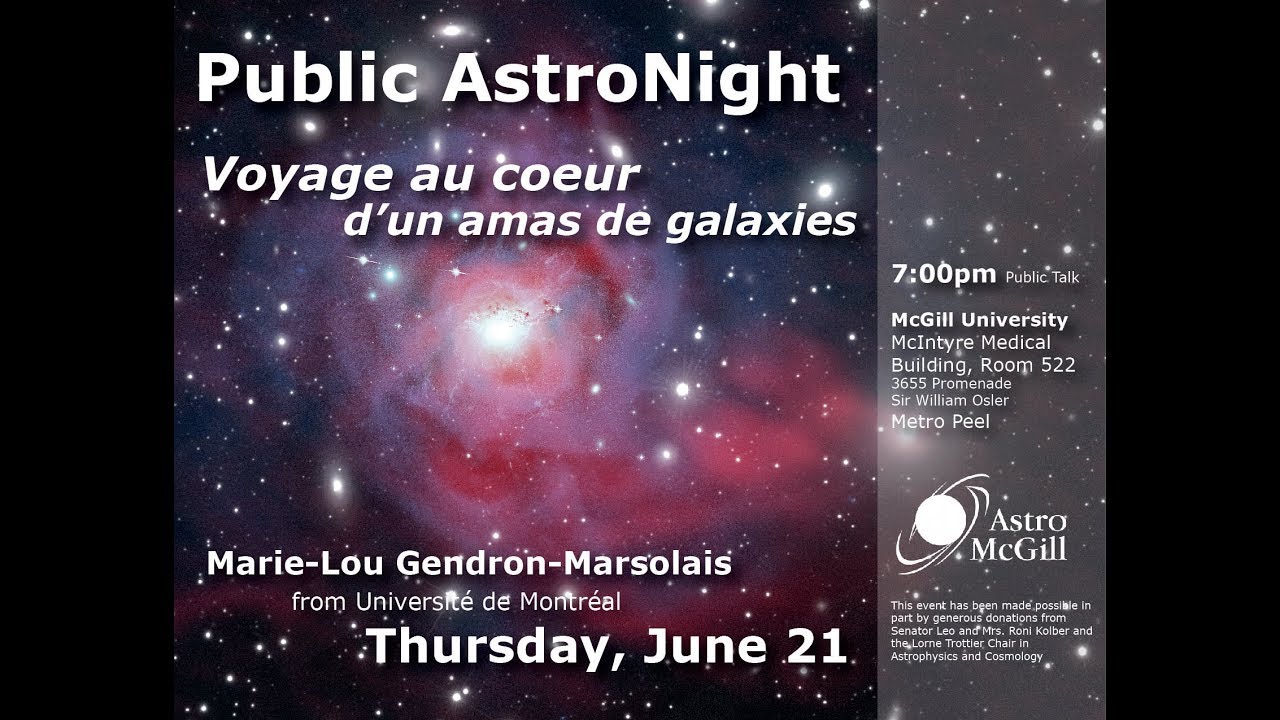
AstroNight: Voyage au coeur d'un amas de galaxies
Keywords
Summary
200 words
Critical Evaluation
Value of the Information & Strength of the Argument
The talk provides valuable insights into the study of galaxy clusters, particularly the Perseus cluster, and showcases the importance of multi-wavelength observations. The speaker effectively argues for the use of integral field spectroscopy (SITELLE) to map the kinematics of the filaments, presenting her own results as a significant advancement. The argumentation is solid, as she builds from basic concepts to more complex ones, and supports her claims with observational data and comparisons to other instruments. However, the talk is aimed at a general audience, so some technical details are simplified, and the argumentation could be more rigorous in terms of citing specific studies or data reductions.
Scientific Rigor, Source Quality, Title Accuracy
The scientific rigor is high, as the speaker is a PhD candidate presenting her own research, which is presumably based on peer-reviewed work. She mentions specific telescopes and instruments (CFHT, SITELLE, Chandra, VLA) and describes the methodology clearly. The sources are not explicitly cited in the talk, but the description provides links to the AstroMcGill website and social media, which may contain further references. The title accurately reflects the content, as the talk is indeed a journey through the Perseus cluster. The talk does not include any advertising or sponsorship segments.
212 words
Title / Content Match
The title accurately reflects the content, as the talk is a journey through the Perseus galaxy cluster, covering its components and the methods used to study it.
Quality & Reliability
8/10
The talk is given by a PhD candidate specializing in galaxy clusters, presenting her own research with data from major observatories. The content is scientifically accurate and well-structured, though it is a public lecture aimed at a general audience, so it lacks detailed citations and peer-reviewed references.
Key Moments
Markers derived by PSI from the transcript: the creator did not define chapters.
- Introduction by the host, presenting Marie-Lou Gendron-Marsolais and her background.
- Marie-Lou begins her talk, thanking the organizers and introducing the topic of galaxy clusters.
- Explanation of what a galaxy is, using the Milky Way as an example, and its size.
- Discussion of other galaxies and their interactions, including the Whirlpool Galaxy and the Mice Galaxies.
- Introduction to supermassive black holes at the centers of galaxies, with the example of Sagittarius A*.
- Video from the Sloan Digital Sky Survey showing the large-scale structure of the universe.
- Introduction to the Perseus cluster and its location in the sky, with an amateur image.
- Explanation of the electromagnetic spectrum and the need for different telescopes.
- Visit to the Canada-France-Hawaii Telescope and the SITELLE instrument, and the study of NGC 1275's filaments.
- Presentation of the velocity map of the filaments, showing their chaotic dynamics.
- Discussion of X-ray and radio observations of the cluster, and the role of the supermassive black hole.
Cited Sources
- AstroMcGill website — The official website of the AstroMcGill group, which organizes the public lecture series and provides information about the speaker and her research.
Concurring Sources
- Perseus Cluster (Wikipedia) — Provides general information about the Perseus cluster, consistent with the talk's description.
- SITELLE (Wikipedia) — Describes the SITELLE instrument, which the speaker used for her research.
Contribution & Novelties
The talk presents original research by the speaker, particularly the first velocity map of the filaments in NGC 1275 using the SITELLE instrument. This is a novel contribution to the study of galaxy clusters, as it provides new insights into the dynamics of the mysterious filaments. The talk also synthesizes existing knowledge about the Perseus cluster, making it accessible to a broader audience.
Pour aller plus loin :
- Perseus Cluster (Wikipedia) — Overview of the Perseus cluster and its properties.
- SITELLE (Wikipedia) — Description of the SITELLE instrument and its capabilities.
- Chandra X-ray Observatory — Official site of the Chandra X-ray Observatory, which has observed the Perseus cluster extensively.
- Very Large Array (Wikipedia) — Information about the VLA radio telescope, used to study the cluster’s radio emission.
127 words
Radar Profile
The radar profile shows high scores in quantity and quality of information, and moderate technical level, indicating a well-balanced talk that is informative but not overly technical. The global reliability is high, reflecting the speaker's expertise and the use of real data.