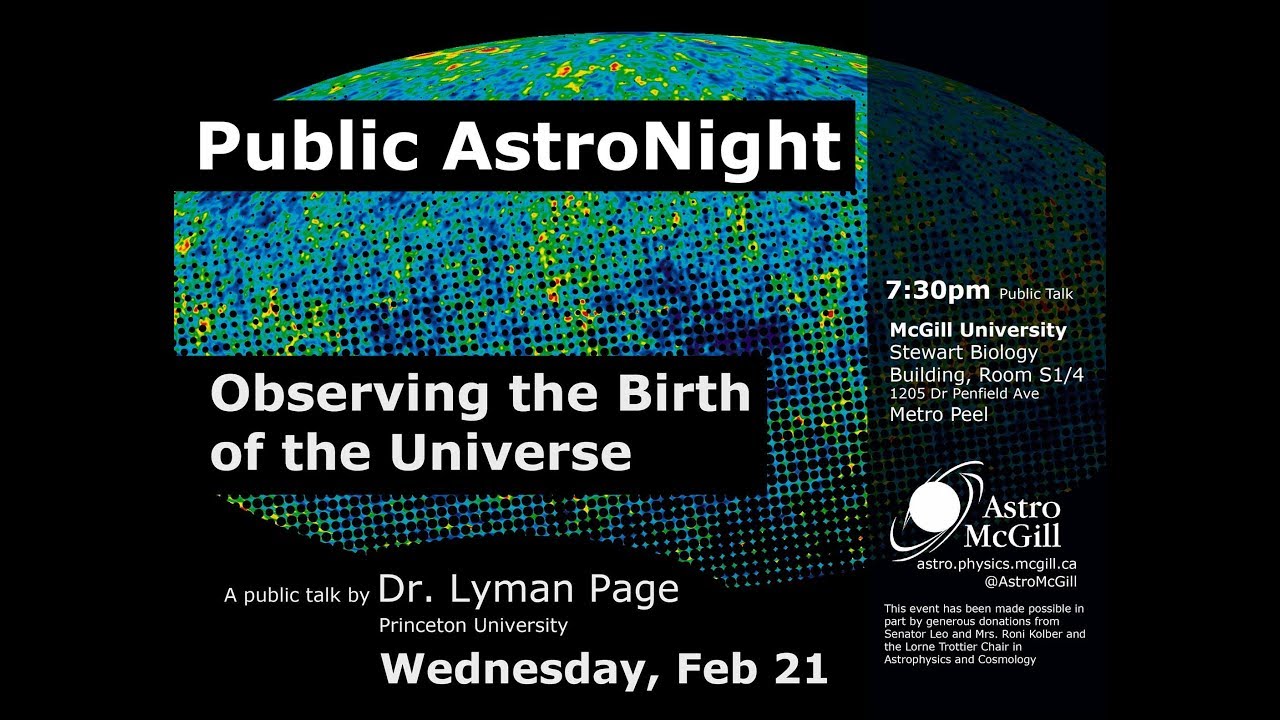
AstroNight: Observing the Birth of the Universe
Keywords
Summary
211 words
Critical Evaluation
Value of the Information & Strength of the Argument
The lecture provides a clear and engaging explanation of complex cosmological concepts, using analogies and visual aids to make them accessible. The argumentation is solid, based on well-established observations and the standard cosmological model. The speaker carefully distinguishes between observations and interpretations, and acknowledges uncertainties, such as the factor of three in the number of stars. The logical flow from observations to the CMB to its implications is well-structured and convincing.
80 words
Title / Content Match
The title accurately reflects the content: a public lecture on observing the cosmic microwave background and understanding the early universe.
Quality & Reliability
9/10
Presentation by a leading cosmologist (Princeton professor, Breakthrough Prize winner) based on established observations (WMAP, Planck) and standard cosmological model. High reliability, with minor simplifications for a public audience.
Key Moments
Markers derived by PSI from the transcript: the creator did not define chapters.
- Introduction to the lecture and the Breakthrough Prize ceremony.
- Setting the scale: from the Moon to the Milky Way.
- Hubble's law and the expansion of space.
- The observable universe and looking back in time.
- Introduction to the Cosmic Microwave Background.
- Inflation and quantum fluctuations seeding structure.
- How the CMB is measured: WMAP and Planck.
- The characteristic spot size and its significance.
- Using the CMB to determine the universe's composition.
- Conclusion and summary of the standard model of cosmology.
Cited Sources
- AstroMcGill website — Official website of the AstroMcGill lecture series, providing information about the event and related resources.
Concurring Sources
- WMAP mission — WMAP's measurements of the CMB are consistent with the lecture's description.
- Planck satellite — Planck's data provide the most detailed CMB maps, as mentioned in the lecture.
Contribution & Novelties
The lecture provides a comprehensive and accessible overview of the cosmic microwave background and its role in understanding the universe’s origin. It effectively explains complex concepts like inflation and the standard ruler using analogies and clear reasoning. The speaker’s expertise and the inclusion of recent measurements (Planck) add value.
Pour aller plus loin :
- Cosmic microwave background — Overview of the CMB and its significance.
- Inflation (cosmology) — Explanation of the inflationary epoch.
- WMAP mission — Details on the WMAP satellite and its results.
- Planck satellite — Information on the Planck mission and its measurements.
95 words
Radar Profile
The radar profile shows high scores in quality and reliability, with slightly lower but still strong scores in quantity and technical level. This reflects a lecture that is scientifically sound and well-presented, but not extremely dense in technical detail, suitable for a general audience.