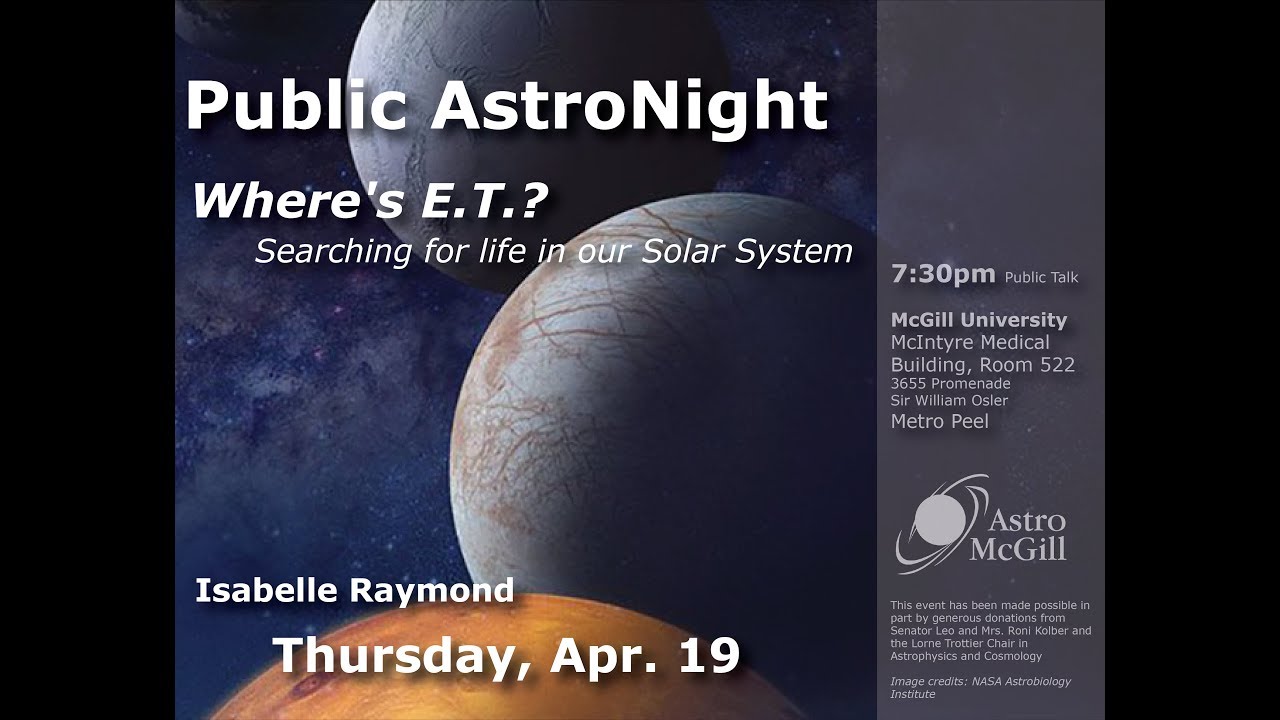
AstroNight: Where's E.T.?
Keywords
Summary
184 words
Critical Evaluation
Value of the Information & Strength of the Argument
The talk provides a valuable overview of astrobiology, particularly the microbiological perspective, which is often underrepresented in popular science. The speaker effectively argues for the importance of studying extremophiles on Earth to understand the potential for life elsewhere. She presents a logical progression from defining life to discussing detection methods, and she is careful to note the limitations of current evidence, such as the non-biological origins of some biosignatures. However, the argumentation is somewhat general and lacks depth in certain areas, such as the specifics of the instruments being developed. The talk is more informative than persuasive, but it successfully conveys the excitement and challenges of the field.
Scientific Rigor, Source Quality, Title Accuracy
The scientific rigor is moderate: the speaker is a qualified microbiologist and presents established concepts accurately, but she does not cite specific studies or sources during the talk. The quality of sources is therefore based on her expertise rather than explicit references. The title ‘Where’s E.T.?’ is somewhat sensational but accurately reflects the topic. The content is well-structured and the speaker is careful to distinguish between established facts and hypotheses. However, some claims, such as the oldest microfossils, are presented with appropriate caveats. Overall, the talk is scientifically sound but not deeply referenced.
216 words
Title / Content Match
The title 'Where's E.T.?' is catchy and accurately reflects the talk's focus on the search for extraterrestrial life, though the content is more about astrobiology and life detection methods than a direct answer to the question.
Quality & Reliability
7/10
The talk is given by a microbiologist with relevant expertise, and covers established scientific concepts and current research. However, it is a public lecture with limited depth and no formal citations, and some claims are simplified or based on ongoing debates.
Key Moments
Markers derived by PSI from the transcript: the creator did not define chapters.
- Introduction to astrobiology and its multidisciplinary nature.
- Definition of life and the cell as the basic unit.
- Overview of the origin and evolution of life on Earth.
- Discussion of the three domains of life and the dominance of microbes.
- Conditions required for life and the oldest evidence of life.
- Introduction to extremophiles and their habitats on Earth.
- Potential for life on Mars, including evidence of water and organic molecules.
- Discussion of Europa and Enceladus as ocean worlds.
- Biosignatures and the challenges of life detection.
- New methods for life detection and the speaker's lab work.
- Future astrobiology missions and the search for life beyond our solar system.
Cited Sources
- AstroMcGill website — Mentioned as a resource for upcoming lectures and events.
Concurring Sources
- NASA Astrobiology — General information on astrobiology and life detection.
Contribution & Novelties
The talk provides a clear and accessible introduction to astrobiology from a microbiologist’s perspective, emphasizing the importance of extremophiles and the challenges of life detection. It highlights the need for new instruments for unambiguous biosignature detection, a topic of current research. The speaker’s personal experience adds authenticity.
Pour aller plus loin :
- Astrobiology (Wikipedia) — Overview of the field.
- Extremophile (Wikipedia) — Organisms thriving in extreme environments.
- Biosignature (Wikipedia) — Substances indicating past or present life.
- Europa (moon) (Wikipedia) — Ocean moon of Jupiter.
- Enceladus (Wikipedia) — Ocean moon of Saturn.
91 words
Radar Profile
The radar profile shows a balanced performance with relatively high scores in information quantity and quality, but a lower score in technical level, reflecting the talk's accessible nature. The overall reliability is solid, indicating a trustworthy but not deeply technical presentation.
💬 No comments were provided for analysis.