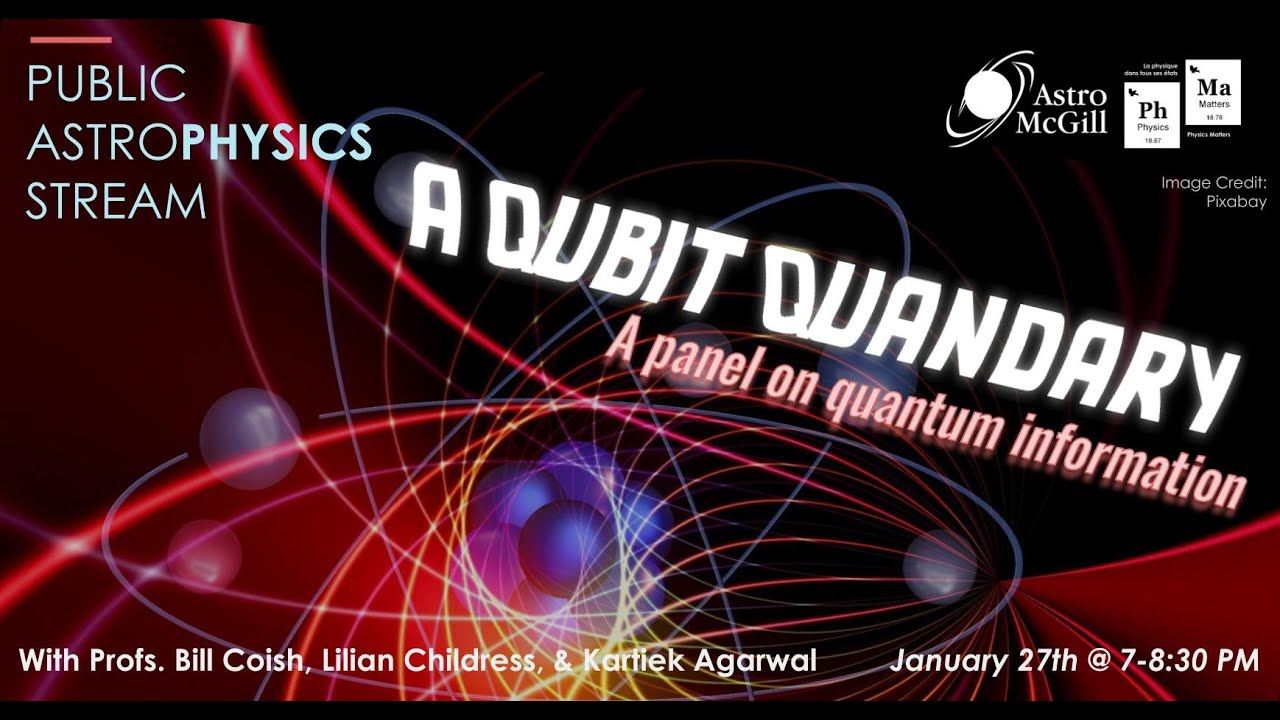
A Qubit Quandary: A Panel on Quantum Information
Keywords
Summary
144 words
Critical Evaluation
Value of the Information & Strength of the Argument
The panel provides a comprehensive and accessible overview of quantum information, with each speaker contributing a distinct perspective. Bill Coish’s explanation of quantum information using the dream analogy and the concept of superposition is particularly effective for a general audience. Kartik Agrawal’s discussion of quantum advantage and Shor’s algorithm is well-argued, clearly explaining why quantum computers could outperform classical ones for specific problems. Lily Childress’s survey of physical platforms is thorough, covering both historical and current approaches. The arguments are logically structured and supported by examples, making the content valuable for viewers seeking a foundational understanding of quantum information.
Scientific Rigor, Source Quality, Title Accuracy
The scientific rigor is high, as the panelists are experts in the field and present accurate information. However, the discussion is a public lecture and does not include formal citations or references to specific papers. The title accurately reflects the content, and the panel effectively addresses the stated questions. The description provides links to the AstroMcGill website and social media, but no additional sources are cited. The content is well-structured and the speakers are credible, contributing to the overall reliability.
194 words
Title / Content Match
The title accurately reflects the content: a panel discussion on quantum information, covering fundamental concepts, applications, and physical implementations.
Quality & Reliability
8/10
The panel features three physics professors from McGill University, providing a high level of expertise. The content is well-structured and accurate, with clear explanations of quantum information concepts. However, as a public lecture, it lacks detailed citations and peer-reviewed references.
Key Moments
Markers derived by PSI from the transcript: the creator did not define chapters.
- Introduction by Garrett, outlining the panel format and introducing the three panelists.
- Bill Coish begins answering the first question: 'What is quantum information?' He introduces the concept of a qubit and the analogy of quantum mechanics as a dream.
- Bill Coish explains superposition and entanglement, and the exponential scaling of quantum states, referencing IBM's 127-qubit processor.
- Kartik Agrawal answers the second question: 'What can quantum information be used for?' He discusses complexity theory and Shor's algorithm for prime factorization.
- Kartik Agrawal highlights quantum simulation as a near-term application, particularly for simulating molecules and materials.
- Lily Childress begins answering the third question: 'What physical systems can be used in quantum computers?' She outlines the requirements for qubit platforms.
- Lily Childress discusses nuclear spins in molecules as an early platform, and then moves to trapped ions and quantum dots.
- Lily Childress explains superconducting qubits, including Cooper pair boxes and flux qubits, and their scalability.
- Lily Childress discusses photonic qubits and their advantages for long-distance communication, concluding the panel's initial answers.
Cited Sources
- AstroMcGill Website — Referenced in the video description as a source for more information about upcoming lectures and events.
Concurring Sources
- Quantum Information Science — General reference for quantum information concepts discussed in the video.
Contribution & Novelties
The panel provides a unique multi-perspective overview of quantum information, combining theoretical foundations, potential applications, and physical implementations in a single discussion. It effectively bridges the gap between popular science and technical detail, making it valuable for both newcomers and those with some background. The inclusion of current research examples, such as IBM’s 127-qubit processor, adds relevance.
Pour aller plus loin :
- Quantum computing — Overview of quantum computing concepts and history.
- Shor’s algorithm — Detailed explanation of the quantum algorithm for integer factorization.
- Superconducting quantum computing — Information on superconducting qubit platforms.
- Trapped ion quantum computer — Overview of trapped ion qubits.
- Quantum entanglement — Fundamental concept underlying quantum information.
111 words
Radar Profile
The radar profile shows high scores across all dimensions, indicating a well-rounded and reliable content. The panel excels in information quality and technical depth, with a slight dip in the quantity of information due to the limited scope of the discussion.
💬 No comments were provided for analysis.