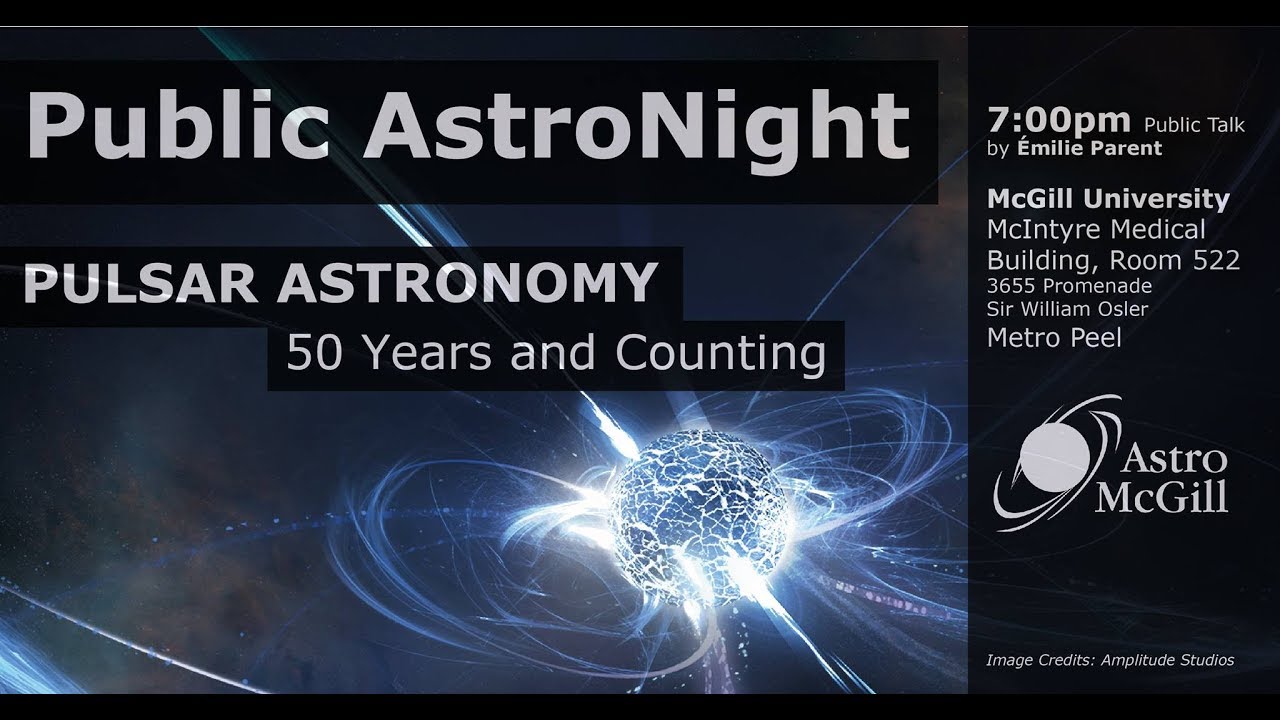
AstroNight: Pulsar Astronomy: 50 Years and Counting
Keywords
Summary
187 words
Critical Evaluation
Value of the Information & Strength of the Argument
The talk provides a solid overview of pulsar astronomy, combining historical context with current research. The argumentation is clear and logical, building from stellar evolution to the discovery of pulsars and their use as tools. The speaker effectively communicates complex concepts like the lighthouse model and nuclear pasta with accessible analogies. The value lies in its synthesis of established knowledge and open questions, making it a good introduction for a general audience. However, it lacks depth on some topics and does not present new research findings.
Scientific Rigor, Source Quality, Title Accuracy
The scientific content is accurate and aligns with current understanding. The speaker references key historical events (Bell’s discovery, Nobel Prize) and known telescopes. However, specific sources are not cited within the talk, and the description only provides a link to the AstroMcGill website. The title accurately reflects the content, which is a retrospective on pulsar astronomy. The talk is well-structured and the speaker’s expertise is evident, though a more rigorous citation of sources would enhance its scientific value.
179 words
Title / Content Match
The title accurately reflects the content, which covers the history and current state of pulsar astronomy, marking the 50th anniversary of the discovery.
Quality & Reliability
8/10
Talk by a researcher at McGill, based on established astrophysics, with clear explanations and references to known discoveries. Minor technical issues (audio start) and lack of detailed citations slightly reduce the score.
Key Moments
Markers derived by PSI from the transcript: the creator did not define chapters.
- Introduction and technical difficulties (audio starts at 9:22)
- Start of the talk: stellar evolution and supernovae
- Formation of neutron stars and their extreme properties
- Discovery of pulsars by Jocelyn Bell Burnell
- Lighthouse model and how pulsars are observed
- Radio telescopes used for pulsar searches (Parkes, Green Bank, Arecibo, FAST)
- Pulsar surveys and discoveries (planets, binaries)
- Using pulsars to study extreme physics: equation of state and nuclear pasta
- Future prospects and conclusion
Cited Sources
- AstroMcGill Website — Mentioned in the video description as a resource for more information about the lecture series.
Concurring Sources
- Pulsar - Wikipedia — Confirms the basic properties and discovery history of pulsars.
- Neutron star - Wikipedia — Provides details on neutron star formation and characteristics.
Contribution & Novelties
The talk provides a comprehensive and accessible overview of pulsar astronomy, highlighting the historical significance of the discovery and current research directions. It effectively communicates the extreme nature of neutron stars and their potential as cosmic laboratories. The speaker’s enthusiasm and clear explanations make it a valuable educational resource.
Pour aller plus loin :
- Pulsar - Wikipedia — General overview of pulsars, their discovery, and properties.
- Neutron star - Wikipedia — Detailed information on neutron star structure and physics.
- Jocelyn Bell Burnell - Wikipedia — Biography of the discoverer of pulsars.
- Nuclear pasta - Wikipedia — Explanation of the exotic phases of nuclear matter in neutron star crusts.
- Equation of state (astrophysics) - Wikipedia — Discussion of the equation of state for neutron stars.
124 words
Radar Profile
The radar profile shows high scores in information quantity, quality, and reliability, with a moderate technical level. This indicates a well-balanced talk that is both informative and accessible, suitable for a general audience interested in astrophysics.
💬 No comments were provided for analysis.