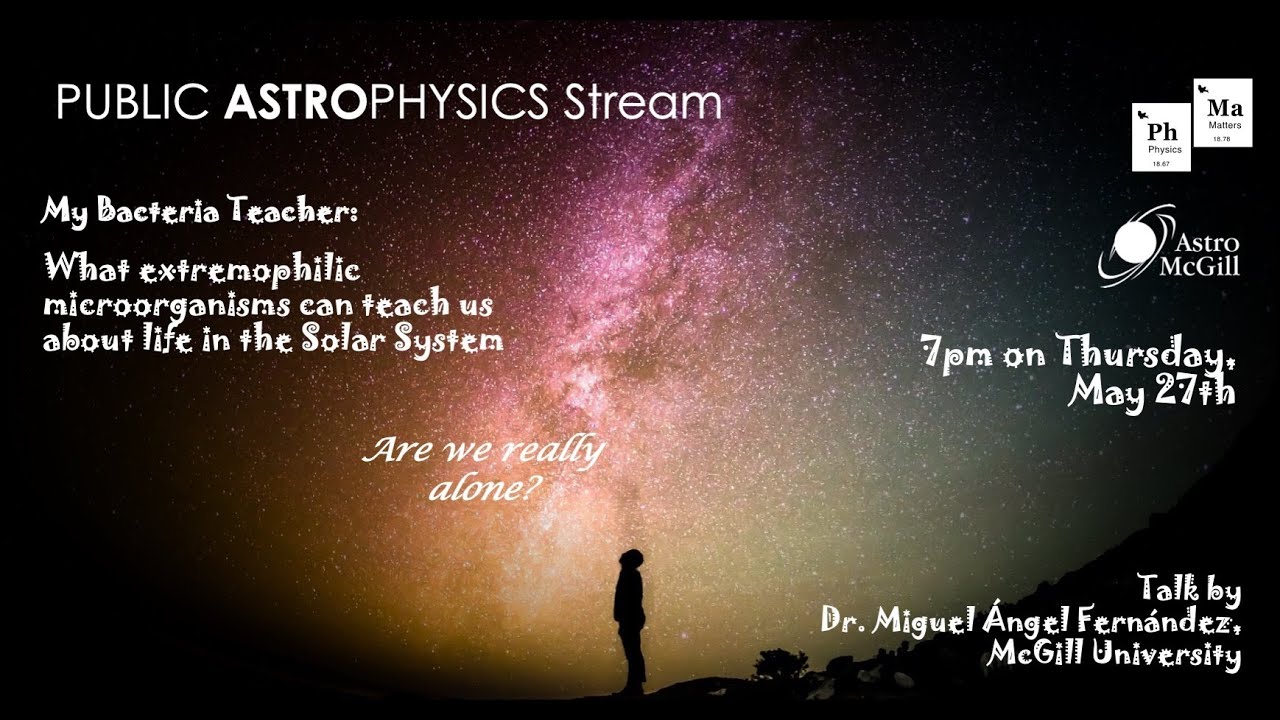
My Bacteria Teacher
Keywords
Summary
241 words
Critical Evaluation
Value of the Information & Strength of the Argument
The lecture provides valuable insights into astrobiology, particularly the use of terrestrial analogs to understand potential habitable environments elsewhere. The argumentation is solid, building from foundational definitions to specific examples and ongoing research. The speaker effectively explains complex concepts in an accessible manner, using analogies and clear explanations. The discussion of the Mars simulation chamber and the Lost Hammer spring illustrates current research approaches. The argument that studying extreme environments on Earth can guide the search for life is well-supported by examples and logical reasoning.
94 words
Title / Content Match
The title 'My Bacteria Teacher' creatively references the documentary 'My Octopus Teacher' and accurately reflects the theme of learning from microorganisms about life beyond Earth.
Quality & Reliability
8/10
The lecture is given by a researcher in astrobiology and polar microbiology, presenting established scientific concepts and recent findings (e.g., ethanolamine discovery in the interstellar medium). The content is consistent with current scientific understanding, though it is a public lecture and not peer-reviewed.
Key Moments
Markers derived by PSI from the transcript: the creator did not define chapters.
- Introduction to the lecture and the title 'My Bacteria Teacher'.
- Definition of astrobiology and the question 'What is life?'.
- Discussion of the discovery of ethanolamine in the interstellar medium and meteorites.
- Explanation of habitability and the requirements for life (CHNOPS, energy, water).
- Introduction to terrestrial analogs and the Antarctic environments.
- Description of endolithic microorganisms in Antarctic dry valleys.
- Presentation of the Mars simulation chamber (MARTE) and experiments.
- Discussion of the Lost Hammer spring in the Canadian Arctic as an analog for Mars and Europa.
- Comparison of Lost Hammer to Europa and the potential for subsurface oceans.
- Conclusion and emphasis on the importance of studying extreme environments on Earth.
Cited Sources
- AstroMcGill — Website of the McGill Space Institute, where the lecture was hosted.
Concurring Sources
- AstroMcGill — The lecture is hosted by AstroMcGill, and the content aligns with the institute's research focus.
Contribution & Novelties
The lecture provides an accessible overview of astrobiology, emphasizing the importance of terrestrial analogs. It highlights recent research, such as the discovery of ethanolamine in space and ongoing studies in extreme environments. The speaker’s personal insights and examples from his own work add originality.
Pour aller plus loin :
- Astrobiology (Wikipedia) — Overview of the field.
- Extremophile (Wikipedia) — Organisms thriving in extreme conditions.
- Mars habitability (NASA) — Information on Mars exploration and habitability.
74 words
Radar Profile
The radar profile shows high scores in information quantity, quality, and reliability, with a moderate technical level. This indicates a well-balanced lecture that is informative and credible, but not overly technical, making it suitable for a general audience.