AstroMcGill Public Astro Night: Into the Heart of the Milky Way
Keywords
Summary
144 words
Critical Evaluation
Value of the Information & Strength of the Argument
The talk provides a solid overview of black hole physics and the specific case of Sagittarius A*. The argumentation is clear and logical, building from basic definitions to current research. The speaker uses analogies (e.g., escape velocity, accretion) to make complex concepts accessible. The inclusion of recent gravitational wave detection adds value, connecting the topic to cutting-edge discoveries. The evidence for the supermassive black hole is well-presented, using stellar orbit animations and X-ray data. The speaker’s expertise is evident, and the explanations are accurate.
Scientific Rigor, Source Quality, Title Accuracy
The scientific rigor is high; the speaker is a professional astrophysicist and presents established knowledge. However, no formal sources are cited in the talk, and the description does not provide references. The title accurately reflects the content, focusing on the Milky Way’s center. The talk is well-structured and reliable, though it is a public lecture rather than a peer-reviewed presentation.
159 words
Title / Content Match
The title accurately reflects the content, which focuses on the supermassive black hole at the center of the Milky Way.
Quality & Reliability
8/10
The talk is given by an expert astrophysicist, presents established scientific knowledge and recent discoveries (gravitational waves) with accurate explanations. The content is well-structured and reliable, though it is a public lecture without formal citations.
Key Moments
Markers derived by PSI from the transcript: the creator did not define chapters.
- Introduction to gravitational waves and LIGO detection
- Definition of black holes using escape velocity
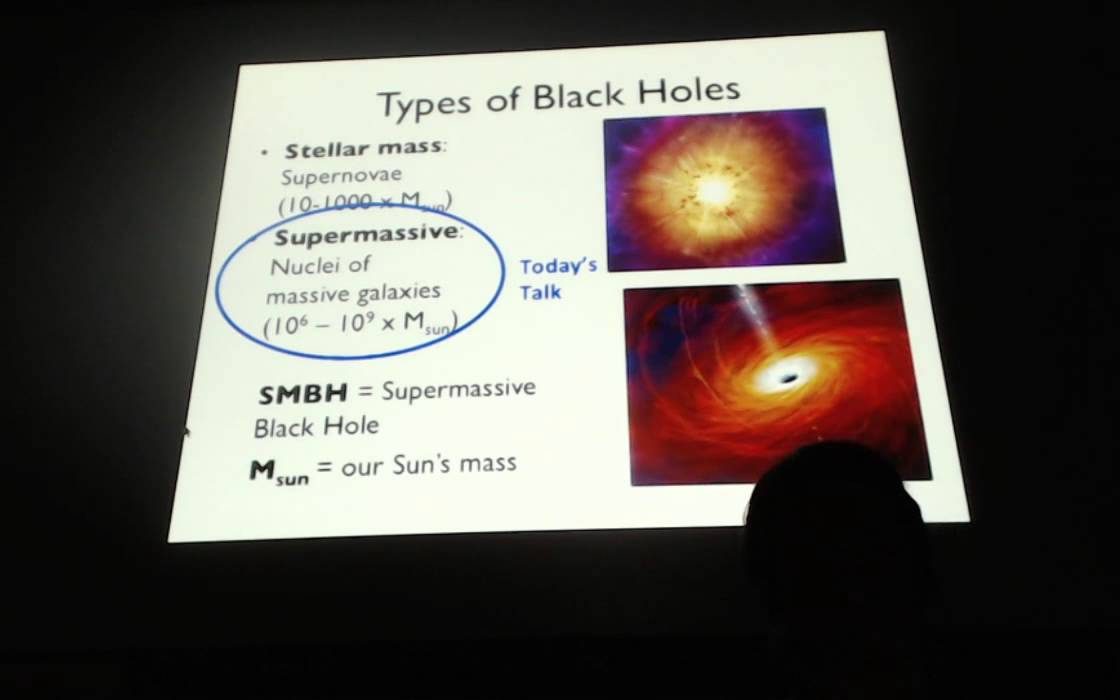
- Types of black holes: stellar-mass and supermassive
- How supermassive black holes grow via accretion
- Observational challenges and use of X-ray/radio wavelengths
- Evidence for Sagittarius A* from stellar orbits
- X-ray observations of the galactic center and open questions
Contribution & Novelties
The talk provides a comprehensive and accessible overview of the supermassive black hole at the center of the Milky Way, synthesizing current knowledge and recent discoveries. It effectively communicates the scientific process and the importance of multi-wavelength observations. The inclusion of the gravitational wave detection as a related breakthrough adds context.
Pour aller plus loin :
- Sagittarius A* — Wikipedia article providing detailed information on the supermassive black hole.
- Accretion disk — Wikipedia article explaining the physics of accretion disks.
- LIGO — Wikipedia article on the Laser Interferometer Gravitational-Wave Observatory.
90 words
Radar Profile
The radar profile shows high scores in information quantity and quality, with a moderate technical level, indicating a well-balanced and informative presentation suitable for a general audience. The reliability is high, reflecting the speaker's expertise.