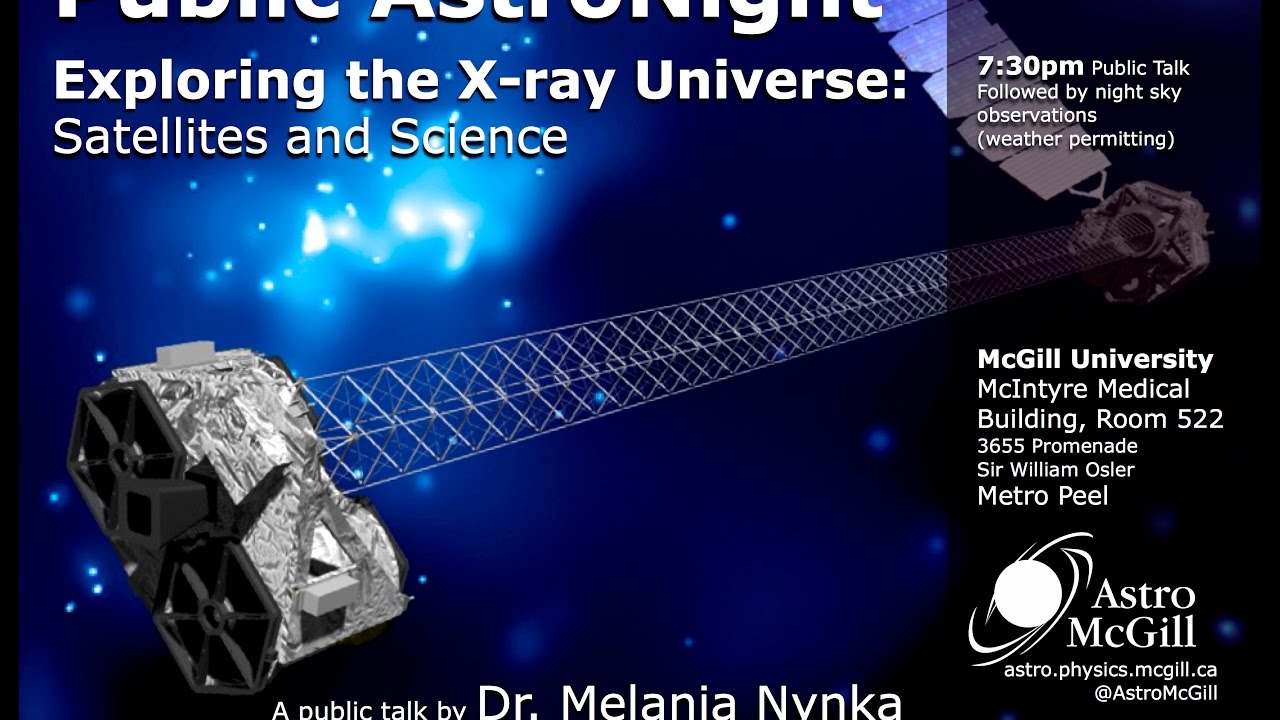
AstroMcGill Public Astro Night: Exploring the X-ray Universe - Satellites and Science
Keywords
Summary
123 words
Critical Evaluation
Value of the Information & Strength of the Argument
The talk provides valuable insights into the engineering and scientific process behind X-ray astronomy, particularly through the personal account of building NuSTAR’s optics. The argumentation is solid, grounded in the speaker’s direct involvement and the successful outcomes of the mission. She effectively explains complex concepts in an accessible manner, using analogies and real examples. The scientific value is high, offering a unique behind-the-scenes perspective that is rarely shared in public lectures.
Scientific Rigor, Source Quality, Title Accuracy
The scientific rigor is evident in the accurate description of X-ray physics and the technical details of telescope construction. The speaker is a credible expert, and the information aligns with established knowledge. However, no explicit sources are cited in the talk, and the transcription is heavily garbled, which may obscure some details. The title accurately reflects the content, and the talk is well-structured. The public engagement is positive, with an interactive Q&A session.
159 words
Title / Content Match
The title accurately reflects the content: a public talk on X-ray astronomy, focusing on satellites and the science they enable.
Quality & Reliability
8/10
The talk is given by a scientist directly involved in the construction of NuSTAR, providing first-hand expertise. The content is well-structured, covering both fundamental X-ray astronomy and engineering challenges. However, the transcription is heavily garbled, limiting the precision of details, and no formal citations are provided.
Key Moments
Markers derived by PSI from the transcript: the creator did not define chapters.
- Introduction to the electromagnetic spectrum and why X-rays are important.
- Explanation of why X-ray telescopes must be in space.
- Overview of past X-ray missions like Chandra and XMM-Newton.
- Introduction to NuSTAR and its unique capabilities.
- Detailed description of the construction of NuSTAR's optics.
- Testing and integration of the optics into the satellite.
- Launch of NuSTAR and initial operations.
- Scientific discoveries from NuSTAR, including imaging the galactic center.
- Q&A session with the audience.
Contribution & Novelties
The talk offers a unique first-hand account of building a space telescope, providing insights into the engineering challenges and the scientific payoff. It bridges the gap between public understanding and the practical realities of space instrumentation.
Pour aller plus loin :
- NuSTAR mission page — Official NASA page with mission details and discoveries.
- X-ray astronomy — Overview of the field.
- Chandra X-ray Observatory — Another major X-ray telescope.
- Grazing incidence optics — Explanation of the technique used in X-ray telescopes.
80 words
Radar Profile
The radar profile shows high scores in information quantity, quality, and reliability, with a slightly lower technical level, indicating a talk that is informative and credible but not overly technical, suitable for a general audience.