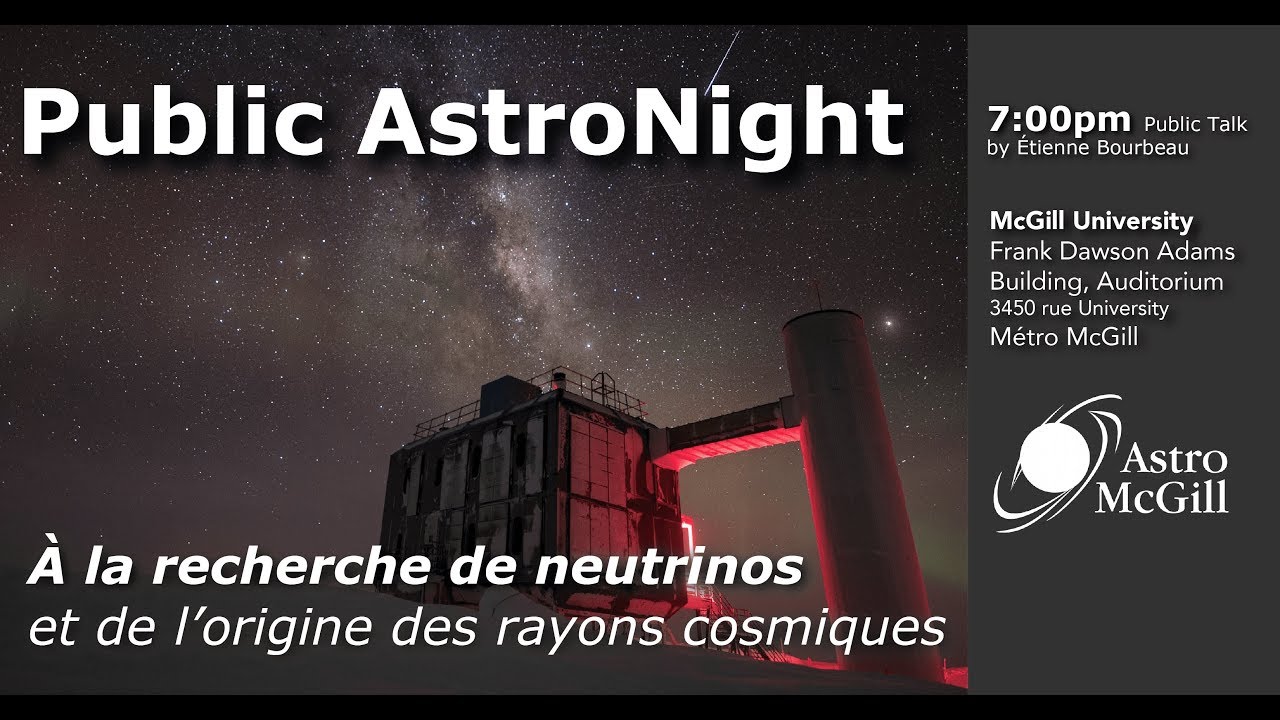
AstroNight: À la recherche de neutrinos et de l’origine des rayons cosmiques
Keywords
Summary
183 words
Critical Evaluation
Value of the Information & Strength of the Argument
The talk provides a clear and compelling narrative, from the historical discovery of cosmic rays to the modern search for their sources using neutrinos. The argumentation is logically structured: it establishes the problem (unknown origin of cosmic rays), explains why charged particles are unsuitable for tracing origins, and introduces neutrinos as the solution. The speaker effectively uses analogies (e.g., measuring distances from a meter to the Moon) to convey the vast energy range of cosmic rays. The presentation is accessible to a general audience while maintaining scientific accuracy. The highlight is the detailed account of the IceCube detector and the landmark detection of a neutrino from TXS 0506+056, which is presented with appropriate context and significance.
Scientific Rigor, Source Quality, Title Accuracy
The scientific content is rigorous, reflecting the speaker’s expertise in the field. The historical account of Victor Hess’s discovery is accurate. The description of IceCube and the detection of TXS 0506+056 aligns with published results. The talk does not cite specific sources in the video, but the description provides a link to the AstroMcGill website, which may contain further references. The title accurately reflects the content, focusing on the search for neutrinos and cosmic ray origins. The talk is a public lecture, so it avoids deep technical details, but it does not oversimplify the science.
226 words
Title / Content Match
The title accurately reflects the content: the talk covers the search for neutrinos and the origin of cosmic rays, with a focus on the IceCube detector.
Quality & Reliability
8/10
The presentation is given by a physicist actively involved in neutrino research with IceCube, providing accurate and up-to-date information. The scientific content is well-structured and aligns with established knowledge in astroparticle physics. Minor simplifications are typical of a public lecture.
Key Moments
Markers derived by PSI from the transcript: the creator did not define chapters.
- Introduction to the talk and the mystery of cosmic rays.
- Historical background: radioactivity and early measurements.
- Victor Hess's balloon flights and discovery of cosmic rays.
- Explanation of cosmic rays: composition and energy spectrum.
- The problem of tracing cosmic ray origins due to magnetic deflection.
- Introduction to neutrinos as ideal cosmic messengers.
- The IceCube detector: design and operation.
- The detection of the first cosmic neutrino source: TXS 0506+056.
- Implications for multimessenger astronomy.
- Conclusion and future prospects.
Cited Sources
- AstroMcGill website — Official website of the AstroMcGill group, providing information about public lectures and events.
Concurring Sources
- IceCube Collaboration (2018) - Neutrino emission from the direction of the blazar TXS 0506+056 — Peer-reviewed paper reporting the detection of a neutrino from TXS 0506+056, confirming the talk's main claim.
Contribution & Novelties
The talk provides an accessible yet scientifically accurate overview of the search for cosmic ray origins using neutrinos, culminating in the landmark detection of a neutrino from the blazar TXS 0506+056. It effectively explains the role of neutrinos as cosmic messengers and the significance of the IceCube detector. The presentation is valuable for a general audience interested in astrophysics.
Pour aller plus loin :
- IceCube Neutrino Observatory — Official website of the IceCube collaboration, with detailed information about the detector and its discoveries.
- TXS 0506+056 — Wikipedia article on the blazar identified as the first source of high-energy neutrinos.
- Multimessenger astronomy — Wikipedia article explaining the concept of combining different cosmic messengers.
112 words
Radar Profile
The radar profile shows high scores in information quantity, quality, and reliability, with a moderate technical level. This indicates a well-balanced presentation that is both informative and accessible, suitable for a general audience interested in astrophysics.