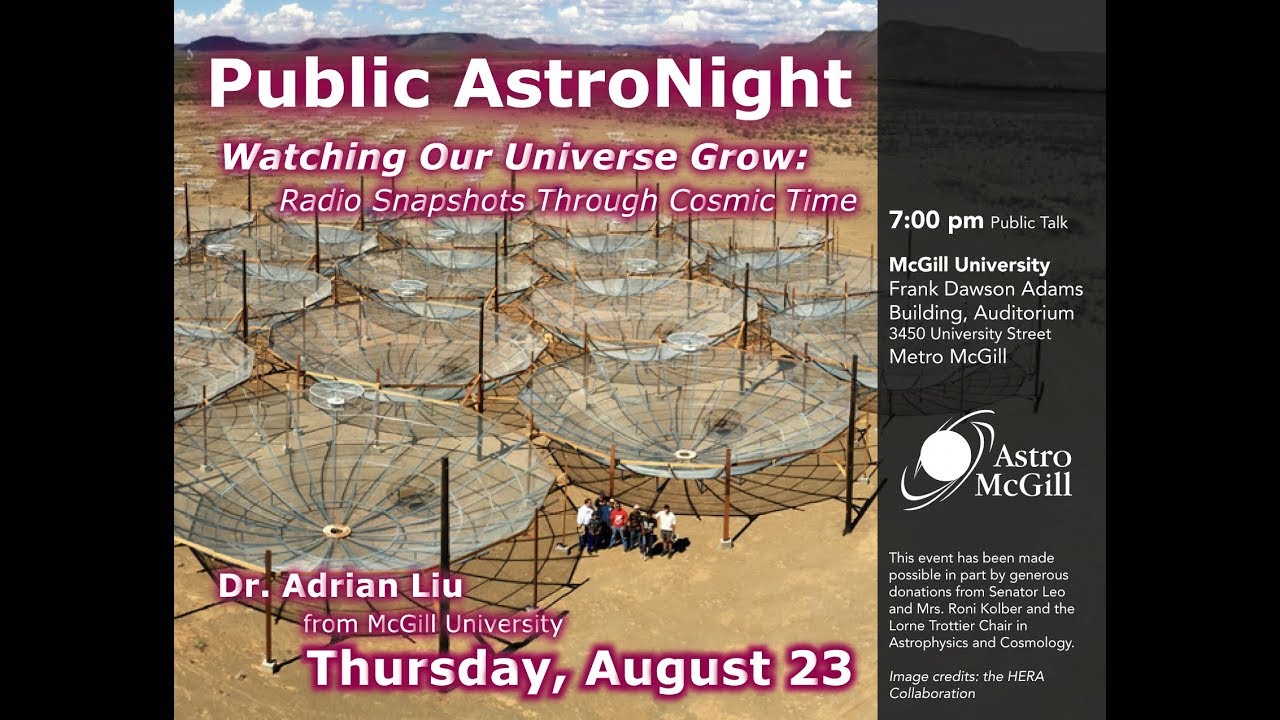
AstroNight: Watching Our Universe Grow Up
Keywords
Summary
191 words
Critical Evaluation
Value of the Information & Strength of the Argument
The talk provides valuable insights into a cutting-edge area of cosmology, explaining complex concepts in an accessible manner. The argumentation is solid, built on established cosmological principles (expansion, CMB, structure formation) and logical reasoning. The speaker effectively uses analogies (e.g., time machine, cloud watching) to illustrate abstract ideas. The presentation is well-structured, progressing from basic scales to the specific topic of 21cm cosmology, and convincingly argues for the importance of this new observational window.
Scientific Rigor, Source Quality, Title Accuracy
The scientific rigor is high; the speaker is a professional astrophysicist and the content aligns with current cosmological knowledge. The talk references real missions (Planck, Voyager) and simulations (e.g., by Mark Vogelsberger and Marcelo Alvarez). The description provides links to AstroMcGill’s website and social media, but no direct references to specific papers. The title accurately reflects the content, focusing on the universe’s evolution. The talk is a public lecture, so it does not delve into technical details, but it maintains accuracy.
170 words
Title / Content Match
The title accurately reflects the content: the talk focuses on how the universe evolved from the early universe to the present, using 21cm cosmology to observe the 'growing up' process.
Quality & Reliability
8/10
The talk is given by a professional astrophysicist (Dr. Adrian Liu) with a strong background in cosmology and radio observations. The content is scientifically accurate, well-structured, and based on established cosmological knowledge. The speaker clearly explains complex concepts and uses real data (e.g., Planck satellite CMB map). The presentation is aimed at a general audience but maintains scientific rigor.
Key Moments
Markers derived by PSI from the transcript: the creator did not define chapters.
- Introduction: Dr. Adrian Liu's background and the talk's purpose.
- Scales of the universe: from Earth to galaxy clusters, emphasizing the speed of light.
- The night sky as a time machine: looking farther means looking back in time.
- The observable universe and the cosmic microwave background (CMB) as a plasma screen.
- The CMB: a snapshot of the universe at 400,000 years old, with tiny density fluctuations.
- Structure formation: how gravity amplifies density fluctuations to form stars and galaxies.
- The missing era: no direct observations of the epoch of first star formation.
- Introduction to 21cm cosmology: detecting neutral hydrogen to observe the early universe.
- Challenges in 21cm cosmology: foreground contamination and instrumental effects.
- Upcoming experiments (HERA, SKA) and the future of 21cm cosmology.
Cited Sources
- AstroMcGill Website — The talk is part of AstroMcGill public lectures; the website provides information about the department and events.
Concurring Sources
- Planck Satellite — The talk references the Planck satellite's CMB map, which is a key observational result in cosmology.
Contribution & Novelties
The talk provides a clear and accessible introduction to 21cm cosmology, a relatively new and specialized field. It explains the scientific motivation, the observational challenges, and the potential for future discoveries. The speaker’s expertise and communication skills make complex concepts understandable to a general audience. The talk is particularly valuable for those interested in cosmology but not familiar with this specific area.
Pour aller plus loin :
- Epoch of Reionization — Provides background on the period when the first stars and galaxies ionized the intergalactic medium.
- Hydrogen line — Explains the 21cm spectral line of neutral hydrogen, the basis of 21cm cosmology.
- HERA (Hydrogen Epoch of Reionization Array) — A radio telescope array designed to detect 21cm radiation from the epoch of reionization.
- Square Kilometre Array — A future radio telescope that will be capable of detecting 21cm signals from the early universe.
143 words
Radar Profile
The radar profile shows high scores in information quantity and quality, reflecting the talk's comprehensive and accurate content. The technical level is moderate, suitable for a general audience, while reliability is high due to the speaker's expertise. The overall profile indicates a well-balanced and informative presentation.
💬 No comments were provided for analysis.