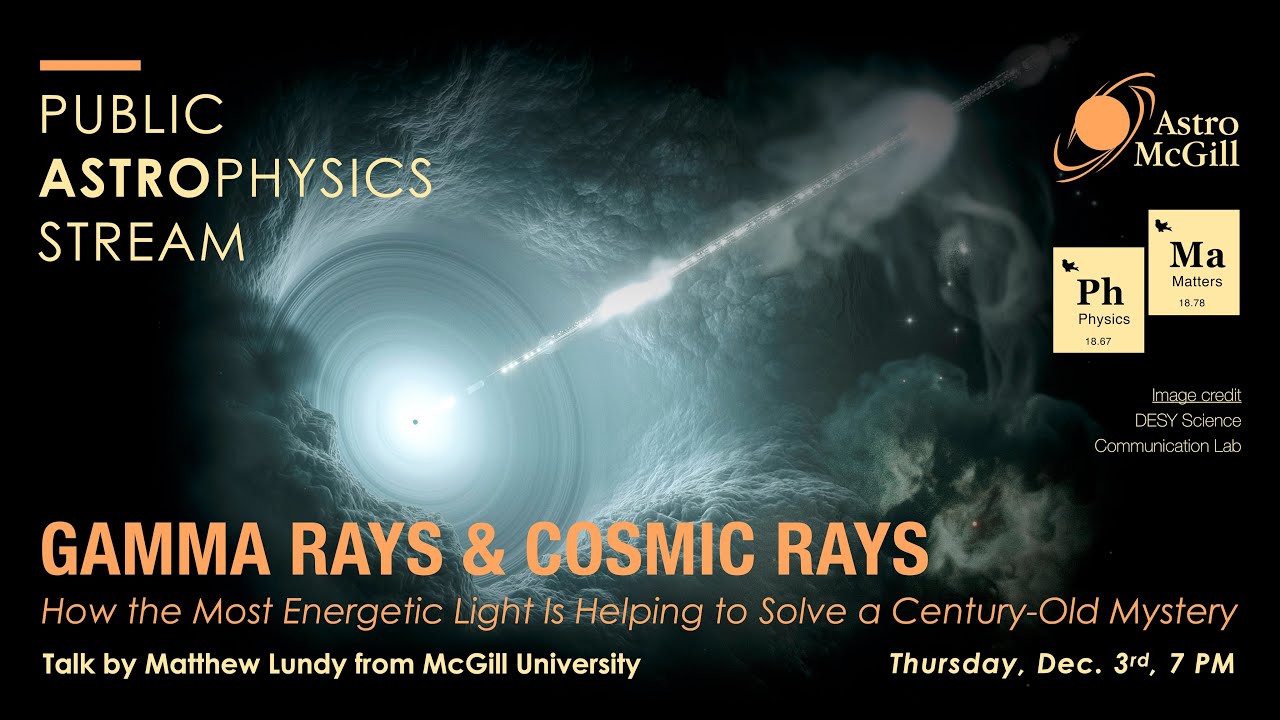
Gamma Rays and Cosmic Rays : How the most energetic light is helping to solve a century-old mystery
Keywords
Summary
184 words
Critical Evaluation
Value of the Information & Strength of the Argument
The talk provides a clear and engaging introduction to cosmic rays and gamma-ray astronomy. It effectively explains the historical development of the field, from early electroscope experiments to modern gamma-ray telescopes. The argumentation is logical and well-structured, building from the mystery of cosmic rays to the use of gamma rays as tracers. The speaker uses analogies, such as the piano octaves for the electromagnetic spectrum and sonic booms for Cherenkov radiation, to make complex concepts accessible. The value of the information is high for a general audience, providing a solid foundation for understanding current research in high-energy astrophysics.
Scientific Rigor, Source Quality, Title Accuracy
The talk is scientifically accurate and well-presented, but it lacks explicit citations to specific research papers or sources. The speaker mentions historical figures like Hess and Pacini and the VERITAS collaboration, but does not provide detailed references. The title accurately reflects the content, and the talk stays on topic. The lack of formal citations is typical for a public lecture, but it limits the ability to verify specific claims. The speaker’s affiliation with McGill and VERITAS lends credibility, but the absence of detailed sourcing reduces the overall rigor.
201 words
Title / Content Match
The title accurately reflects the content, which focuses on gamma rays and cosmic rays and how they help solve the mystery of cosmic ray origins.
Quality & Reliability
7/10
The talk is delivered by a graduate student working on the VERITAS collaboration, providing a solid background. The content is accurate and well-structured, with clear explanations of complex concepts. However, it is a public lecture aimed at a general audience, so it lacks detailed citations and rigorous source referencing. The information is reliable but not exhaustive.
Key Moments
Markers derived by PSI from the transcript: the creator did not define chapters.
- Introduction to the talk and the mystery of cosmic rays.
- Explanation of the electroscope and early experiments by Pacini and Wulf.
- Victor Hess's balloon flight and the discovery that cosmic rays come from space.
- Use of cloud chambers to identify cosmic ray particles.
- Composition of cosmic rays: protons, alpha particles, and heavier nuclei.
- The challenge of cosmic ray directionality due to magnetic fields.
- Introduction to gamma rays as tracers for cosmic ray sources.
- The electromagnetic spectrum and the energy of gamma rays.
- Air showers and Cherenkov radiation as detection method.
- Ground-based gamma-ray telescopes like VERITAS and their role.
Cited Sources
- AstroMcGill Website — Mentioned as a resource for more information about the AstroMcGill public lectures and events.
Concurring Sources
- Cosmic ray - Wikipedia — Provides general information on cosmic rays, their composition, and detection, consistent with the talk.
- Gamma-ray astronomy - Wikipedia — Supports the talk's explanation of gamma-ray detection and its role in astrophysics.
Contribution & Novelties
The talk provides a comprehensive overview of cosmic ray and gamma-ray astronomy, synthesizing historical discoveries with modern detection techniques. It emphasizes the importance of gamma rays as tracers for cosmic ray sources, a key concept in current astrophysics research. The speaker’s connection to the VERITAS collaboration adds a practical perspective.
Pour aller plus loin :
- Cosmic ray - Wikipedia — Provides a detailed overview of cosmic rays, their composition, and origins.
- Gamma-ray astronomy - Wikipedia — Explains the field of gamma-ray astronomy and its detection methods.
- Cherenkov radiation - Wikipedia — Describes the phenomenon of Cherenkov radiation, which is central to the detection technique discussed.
- VERITAS (very energetic radiation imaging telescope array system) - Wikipedia — Information about the VERITAS observatory, which the speaker works with.
126 words
Radar Profile
The radar profile shows a balanced performance across all dimensions, with slightly higher scores in quality of information and fiabilite, reflecting the speaker's expertise and the accuracy of the content. The lower score in quantity of information is due to the talk's focus on a general audience, limiting the depth of technical details.
💬 No comments were provided for analysis.