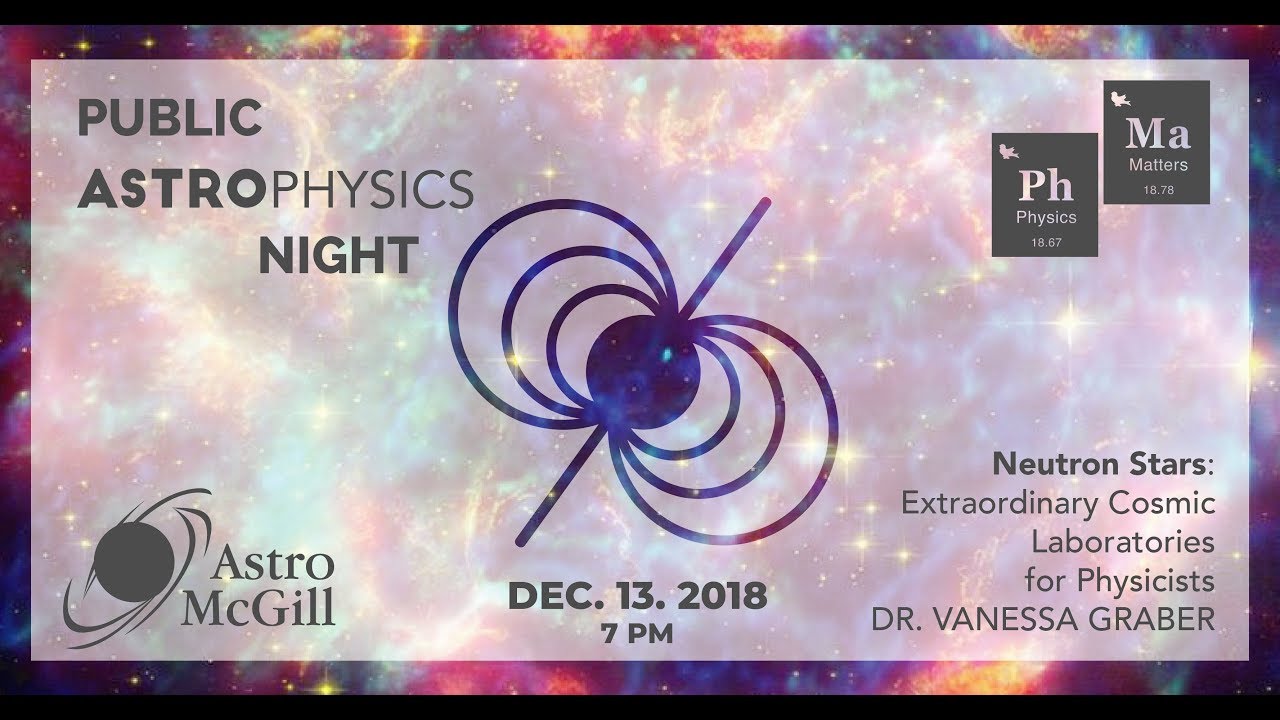
AstroNight: Neutron Stars: Extraordinary Cosmic Laboratories for Physicists
Keywords
Summary
176 words
Critical Evaluation
Value of the Information & Strength of the Argument
The talk provides a valuable overview of neutron star physics, effectively conveying the extreme conditions and their significance for fundamental physics. The argumentation is solid, building from observational evidence (pulsar timing, X-ray spectra) to theoretical implications. The speaker clearly explains the reasoning behind current knowledge and uncertainties, such as the unknown equation of state. The use of analogies (e.g., compressing all humans into a sugar cube) aids comprehension without oversimplifying the science. The presentation is well-structured, moving from observations to interior physics, and highlights the importance of neutron stars as laboratories for testing matter under extreme conditions.
Scientific Rigor, Source Quality, Title Accuracy
The scientific rigor is high: the speaker is a researcher in the field, and the content aligns with established astrophysical knowledge. The talk is a public lecture, so it does not cite specific sources in detail, but it references known objects (Crab Nebula, Cassiopeia A) and historical discoveries (Jocelyn Bell Burnell). The description provides links to the AstroMcGill website and social media, but no direct references to papers. The title accurately reflects the content, focusing on neutron stars as cosmic laboratories. The talk appropriately distinguishes between well-established facts and open questions, such as the equation of state. Overall, the information is reliable and presented with appropriate caveats.
219 words
Title / Content Match
The title accurately reflects the content: a public lecture on neutron stars as extreme laboratories for physics.
Quality & Reliability
8/10
Talk by a researcher (Dr. Vanessa Graber) presenting established astrophysical knowledge and current research challenges. Content is scientifically accurate, well-structured, and appropriately caveated regarding uncertainties. No obvious errors or misleading claims.
Key Moments
Markers derived by PSI from the transcript: the creator did not define chapters.
- Introduction to the concept of cosmic laboratories and the speaker's research approach.
- Explanation of neutron star formation and their extreme density (all humans compressed into a sugar cube).
- Discussion of rapid rotation and strong magnetic fields, with comparison to Earth's magnetic field.
- Discovery of pulsars by Jocelyn Bell Burnell and the lighthouse effect.
- Pulsar timing and the period-period derivative diagram, showing different classes of neutron stars.
- Observation of X-rays from neutron stars and determination of temperature and radius.
- Interior structure of neutron stars: crust, core, and the unknown equation of state.
- Comparison of theoretical equations of state with observed masses, and the challenge of measuring radii.
- Introduction to superfluidity and superconductivity in neutron stars, and their potential observational signatures.
- Ongoing efforts to constrain the equation of state using telescopes like NICER and future missions.
Cited Sources
- AstroMcGill website — Provided in the video description as a resource for more information about the lecture series and department.
Concurring Sources
- Neutron star - Wikipedia — Provides general information on neutron stars, consistent with the talk's content.
- Pulsar - Wikipedia — Details on pulsar discovery and properties, matching the talk's description.
Contribution & Novelties
The talk provides a clear and accessible synthesis of neutron star physics, emphasizing their role as extreme laboratories. It effectively communicates the current state of knowledge and the key open question of the equation of state. The presentation is valuable for a general audience interested in astrophysics, offering a comprehensive overview without oversimplifying.
Pour aller plus loin :
- Neutron star - Wikipedia — General overview of neutron stars, their properties, and types.
- Pulsar - Wikipedia — Detailed information on pulsars, including discovery and timing.
- Equation of state (astrophysics) - Wikipedia — Explanation of the equation of state and its role in neutron star modeling.
- NICER mission — NASA mission dedicated to measuring neutron star radii, directly relevant to the talk’s discussion of constraining the equation of state.
127 words
Radar Profile
The radar profile shows high scores in information quantity, quality, and reliability, with a slightly lower technical level, reflecting the accessible nature of the talk. The overall assessment is strong, with the talk excelling in providing accurate and well-structured information for a general audience.