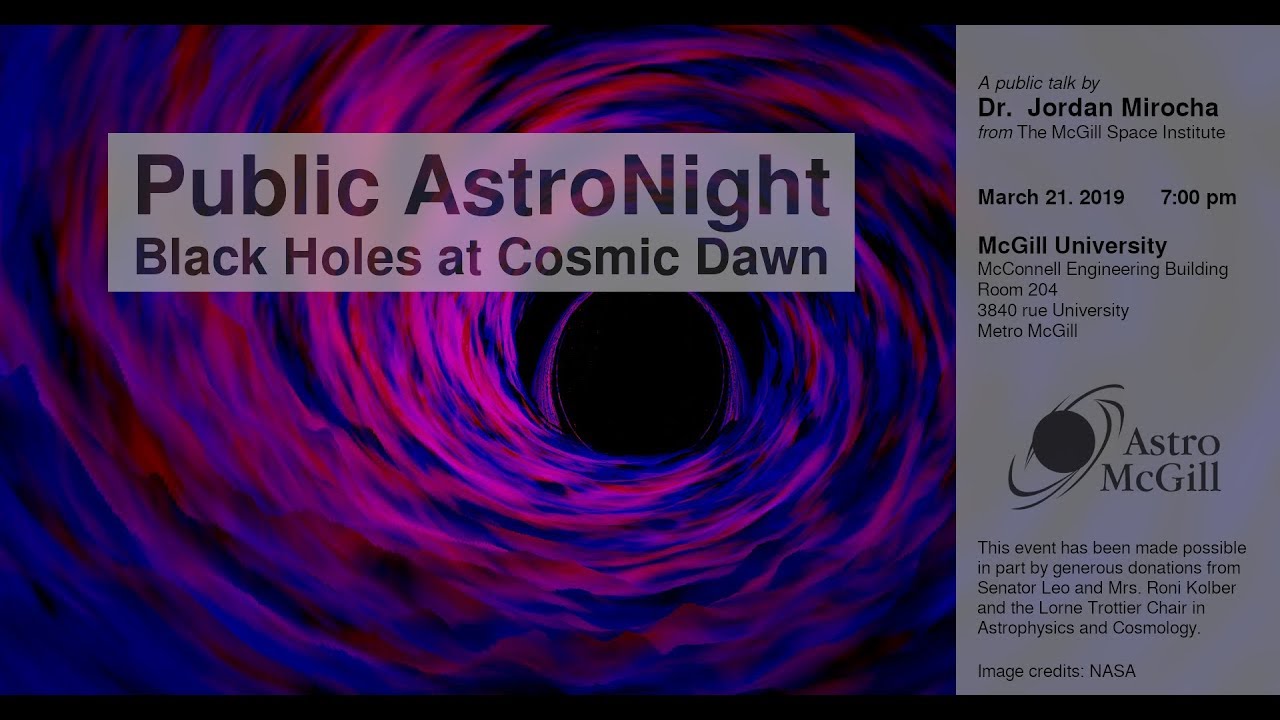
AstroNight: Black Holes at Cosmic Dawn
Keywords
Summary
168 words
Critical Evaluation
Value of the Information & Strength of the Argument
The talk provides a clear and engaging overview of black hole physics and the specific puzzle of early supermassive black holes. The argumentation is logically structured, starting with fundamental concepts and building up to the central problem. The speaker effectively uses analogies and visual aids to explain complex ideas. The value lies in its synthesis of current knowledge and the articulation of open questions, making it a good introduction for non-specialists. However, it does not delve into the latest research details or alternative hypotheses in depth.
Scientific Rigor, Source Quality, Title Accuracy
The scientific content is accurate and reflects the current understanding of black holes. The speaker is a researcher in the field, lending credibility. However, the talk does not cite specific sources or references, which limits its utility for verification. The title accurately reflects the content. The description provides links to the AstroMcGill website and social media, but no direct references to scientific papers. Overall, the rigor is high for a public lecture, but the lack of explicit citations is a minor weakness.
183 words
Title / Content Match
The title accurately reflects the content, focusing on black holes in the early universe.
Quality & Reliability
8/10
The talk is given by a postdoctoral researcher in theoretical astrophysics, presenting established physics and current research. The content is accurate and well-structured, though it is a public lecture without formal citations.
Key Moments
Markers derived by PSI from the transcript: the creator did not define chapters.
- Introduction: The puzzle of supermassive black holes in the early universe.
- What is a black hole? Escape velocity and event horizon.
- Observational evidence: stellar orbits in the Milky Way.
- Tidal disruption events and accretion disks.
- Gravitational waves from LIGO as a new window.
- How black holes form: stellar collapse and hydrostatic equilibrium.
- The puzzle: supermassive black holes at cosmic dawn.
- Possible formation scenarios and future observations.
Cited Sources
- AstroMcGill website — Official website of the AstroMcGill public lecture series, providing information about the talk and the speaker.
Concurring Sources
- Event Horizon Telescope — The telescope network mentioned in the talk, aiming to image black holes.
Contribution & Novelties
The talk provides a clear synthesis of the current understanding of black holes and the specific puzzle of their early existence. It is valuable for a general audience seeking to understand the basics and the open questions. The speaker’s expertise adds credibility.
Pour aller plus loin :
- Event Horizon Telescope — The project aiming to image black holes, directly relevant to the talk’s discussion of observing black holes.
- LIGO — The gravitational wave observatory mentioned in the talk, which has detected merging black holes.
- Direct collapse black holes — A proposed formation mechanism for supermassive black holes, relevant to the puzzle discussed.
- Supermassive black hole — General overview of the objects central to the talk.
115 words
Radar Profile
The radar profile shows high scores in quantity and quality of information, with a moderate technical level. This indicates a well-balanced talk that is informative and accurate, but not overly technical, suitable for a general audience.