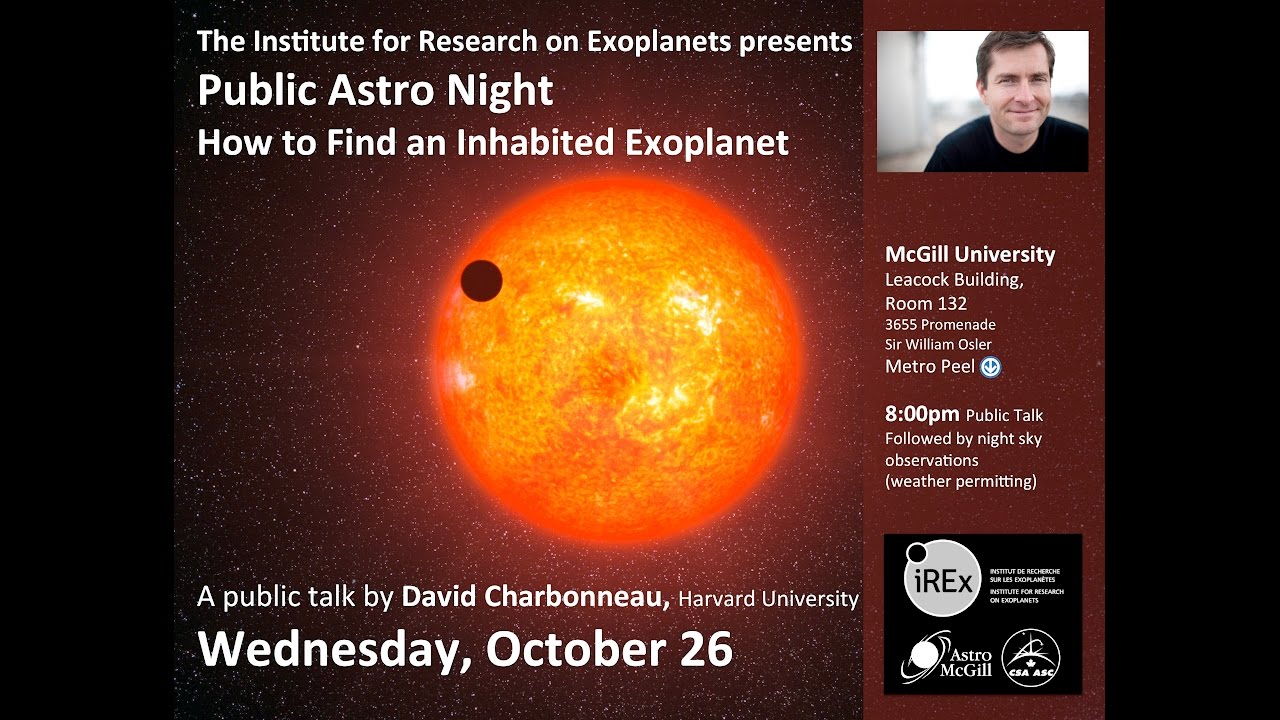
AstroMcGill Public Astro Night: How to find an inhabited planet
Keywords
Summary
202 words
Critical Evaluation
Value of the Information & Strength of the Argument
The lecture provides a comprehensive and accessible overview of the current state of exoplanet research, emphasizing the transit method and its potential for atmospheric characterization. Charbonneau’s argumentation is logical and well-structured, moving from historical context to methodological explanations, then to recent discoveries and future prospects. He effectively communicates the significance of the field and the excitement of recent findings, such as the prevalence of Earth-like planets. The discussion of biosignatures and the role of upcoming telescopes is particularly valuable, as it outlines a concrete path forward. The argument that telescopes are our best ‘spaceships’ is compelling and well-supported.
Scientific Rigor, Source Quality, Title Accuracy
The presentation is scientifically rigorous, with Charbonneau referencing specific missions (Kepler, JWST, GMT) and historical figures (Lomonosov, Bruno). The methods described are well-established and accurately explained. The title accurately reflects the content, which focuses on the search for habitable planets. The lecture is aimed at a general audience but does not oversimplify the science. The sources cited are primarily the missions and telescopes mentioned, which are credible and verifiable. The description mentions the collaboration with iREx and the Canadian Space Agency, adding to the credibility. Overall, the scientific quality is high, and the title-content alignment is excellent.
210 words
Title / Content Match
The title accurately reflects the content, focusing on the search for habitable exoplanets and the methods to characterize them.
Quality & Reliability
8/10
Presentation by a leading Harvard professor, based on established scientific methods and recent discoveries, with clear explanations and references to ongoing missions.
Key Moments
Markers derived by PSI from the transcript: the creator did not define chapters.
- Introduction by René Doyon, context of JWST conference
- Historical perspectives on other worlds (Epicurus, Giordano Bruno)
- Discussion of interstellar travel and SETI as unlikely paths
- Scale of the challenge: planets are small and dim compared to stars
- Transit method explained, historical transit of Venus, Lomonosov's discovery of Venus's atmosphere
- Doppler method and transit method details, density calculations
- Transits allow atmospheric studies, biosignatures like oxygen
- James Webb Space Telescope and Giant Magellan Telescope as key tools
- Kepler mission's discoveries, example of a transit light curve
- Frequency of Earth-like planets: one in four stars, based on Courtney Dressing's work
Cited Sources
- Kepler Mission — Mentioned as the mission that discovered thousands of exoplanets and enabled statistical studies.
- James Webb Space Telescope — Discussed as the upcoming space telescope that will characterize atmospheres of terrestrial planets.
- Giant Magellan Telescope — Presented as a ground-based telescope under construction that will complement JWST.
- Transit of Venus — Historical event used to illustrate the transit method and Lomonosov's discovery.
Concurring Sources
- Kepler Mission — Supports the claim that Kepler discovered thousands of exoplanets.
- James Webb Space Telescope — Confirms the launch date and capabilities of JWST.
Contribution & Novelties
The lecture provides a clear and engaging synthesis of the current methods and goals in exoplanet research, emphasizing the transit method’s potential for atmospheric characterization and the search for biosignatures. It highlights the recent statistical result that one in four stars hosts an Earth-like planet, which is a key motivation for future missions. The presentation of JWST and GMT as complementary tools is particularly insightful.
Pour aller plus loin :
- Exoplanet Exploration Program — NASA’s official page on exoplanets, offering up-to-date information.
- Habitable Zone — Wikipedia article explaining the concept of the habitable zone.
- Biosignature — Wikipedia article on biosignatures, relevant to the search for life.
- Transit Photometry — Wikipedia article on the transit method.
115 words
Radar Profile
The radar profile shows high scores in information quantity, quality, and reliability, with a moderate technical level. This indicates a well-balanced presentation that is both informative and accessible, suitable for a general audience interested in astronomy.
💬 Sur les 0 commentaires analysés, aucune tendance n'est disponible.