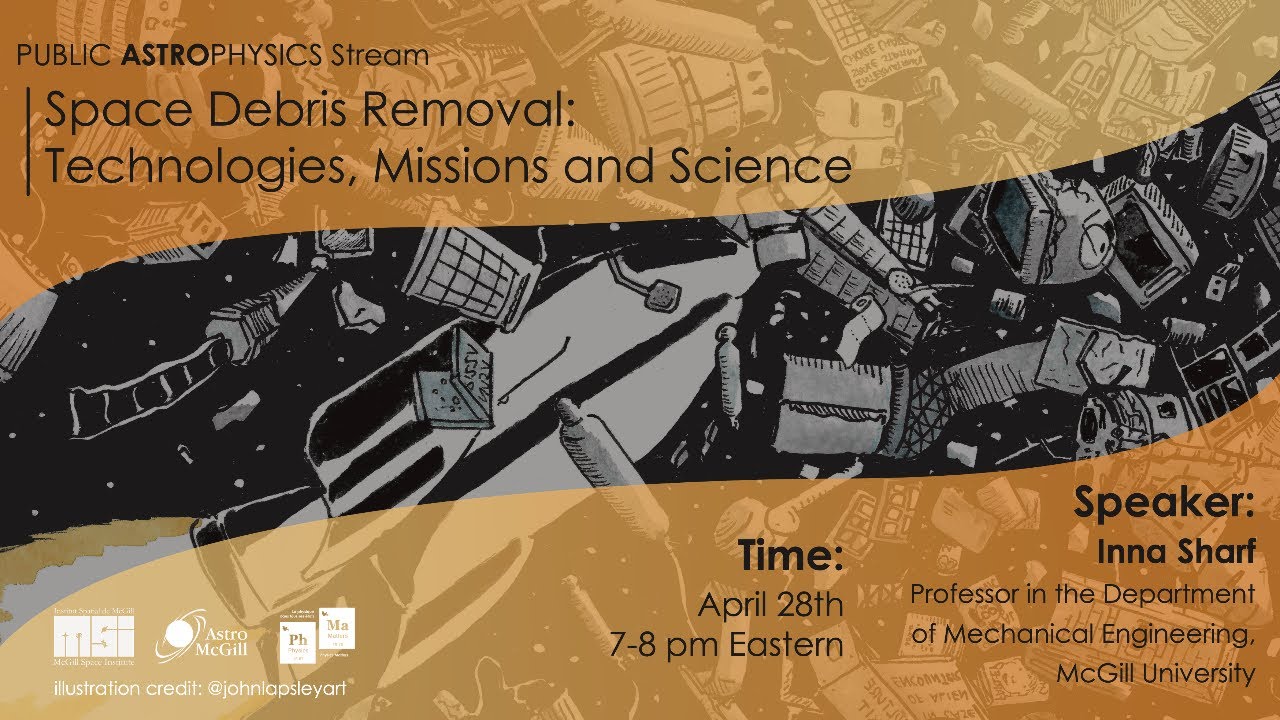
Space Debris Removal: Technologies, Missions and Science
Keywords
Summary
163 words
Critical Evaluation
Value of the Information & Strength of the Argument
The lecture provides valuable insights into the engineering challenges and solutions for space debris removal. The speaker effectively argues for the necessity of ADR and presents her group’s contributions, including simulation tools and mission optimization. The argumentation is solid, grounded in her research and supported by visual demonstrations. The discussion of trade-offs between robotic and net capture is well-reasoned, and the presentation of mission planning results adds practical value.
Scientific Rigor, Source Quality, Title Accuracy
The scientific rigor is high, with the speaker referencing specific missions (e.g., RemoveDebris, Astroscale’s ELSA-d) and her own published research. The sources are credible, though not exhaustively cited in the talk. The title accurately reflects the content, covering technologies, missions, and scientific aspects. The talk is well-structured and technically accurate, suitable for an informed audience.
139 words
Title / Content Match
The title accurately reflects the content, covering technologies, missions, and scientific aspects of space debris removal.
Quality & Reliability
8/10
The talk is given by a professor in mechanical engineering with extensive research in the field, and presents both established concepts and original research results. The content is well-structured and technically sound, though it is a public lecture and not peer-reviewed.
Key Moments
Markers derived by PSI from the transcript: the creator did not define chapters.
- Introduction and overview of the presentation topics.
- Background on space debris: statistics and types of debris.
- Explanation of the Kessler syndrome and collision threats.
- Introduction to active debris removal and the need to remove large debris.
- Challenges of large debris: mass, tumbling, lack of grapple fixtures.
- Overview of a typical ADR mission and demonstration missions (RemoveDebris, ELSA-d).
- Robotic capture research: blimp experiments and post-capture for Envisat.
- Tethered-net capture: benefits and simulation development.
- Multiple debris removal mission: time-optimal control and results.
- Passive debris removal and scientific study of debris rotation.
Cited Sources
- AstroMcGill Facebook page — Mentioned for more information about upcoming lectures.
- AstroMcGill Twitter — Mentioned for updates.
Concurring Sources
- RemoveDEBRIS mission — Mentioned as a demonstration mission for ADR technologies.
- Astroscale ELSA-d — Mentioned as an ongoing mission for debris removal.
Contribution & Novelties
The lecture presents original research on robotic and tethered-net capture for space debris removal, including simulation tools and mission optimization. The speaker highlights novel insights into net dynamics and the use of time-optimal control for multi-debris missions. The scientific study of Envisat’s rotational motion adds to the understanding of debris behavior.
Pour aller plus loin :
- Kessler syndrome — Background on the cascade effect.
- Active debris removal — Overview of ADR concepts.
- Envisat — Details on the defunct satellite studied.
80 words
Radar Profile
The radar profile shows high scores in information quantity, quality, and reliability, with a slightly lower technical level, indicating a well-balanced and accessible presentation for a general audience.