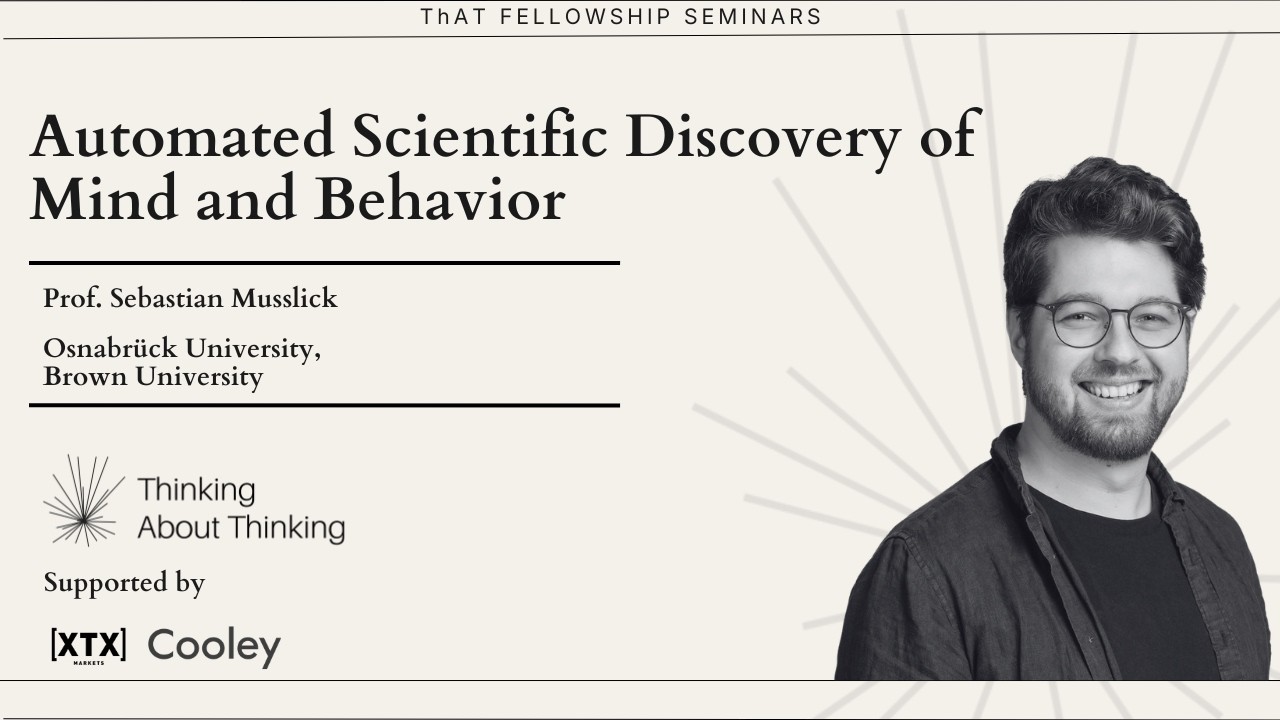
Fellowship Seminars: Automated Scientific Discovery of Mind and Behavior with Prof. Sebastian Mußlick
Keywords
Summary
155 words
Critical Evaluation
Value of the Information & Strength of the Argument
The talk provides valuable insights into the current state and potential of automated scientific discovery in cognitive science. The argumentation is solid, grounded in the speaker’s research and examples like the robot scientists Adam and Eve. The presentation of AutoRA as a modular, language-based framework is compelling, and the case study on reinforcement learning illustrates its practical utility. The speaker acknowledges limitations and open challenges, which adds credibility. However, the talk is more of an overview and demo than a deep dive into specific results, and some claims about acceleration and scalability could be further substantiated.
Scientific Rigor, Source Quality, Title Accuracy
The talk demonstrates scientific rigor by referencing historical work (Herb Simon) and modern systems (Adam, Eve, AlphaFold). The speaker is a recognized expert, and the framework AutoRA is open-source, allowing verification. The title accurately reflects the content. The talk does not cite specific papers in detail, but the description mentions a book chapter and the AutoRA project. The audience questions are not provided, so no comment trends can be analyzed.
181 words
Title / Content Match
The title accurately reflects the content: a seminar on automated scientific discovery applied to mind and behavior.
Quality & Reliability
8/10
The talk is given by a leading researcher in computational neuroscience and AI for science, presenting a framework (AutoRA) with case studies. The content is well-structured and grounded in the speaker's expertise, but it is primarily an overview and demonstration rather than a peer-reviewed presentation of new results.
Key Moments
Markers derived by PSI from the transcript: the creator did not define chapters.
- Introduction by Rory McLenna and Anastasia Ilina, overview of Thinking About Thinking fellowship.
- Sebastian Mußlick introduces the problem of empirical fragmentation in cognitive science.
- Discussion on how AI can expand the space of experiments and models.
- Historical context: Herb Simon and early automated discovery systems like Adam and Eve.
- Introduction to AutoRA framework: automated theorist and experimentalist agents.
- Explanation of knowledge graphs and tool-based validation for robustness.
- Case study: applying AutoRA to reinforcement learning, demonstrating closed-loop discovery.
- Challenges and future directions for automated scientific discovery.
Cited Sources
- AutoRA (Automated Research Assistant) — Open-source framework for automated scientific discovery, mentioned as the core system.
- Adam: Robot Scientist — Historical example of autonomous discovery system studying yeast metabolism.
- Eve: Robot Scientist — Successor to Adam, discovered triclosan's effectiveness against malaria.
- AlphaFold — AI system used in automated discovery for protein structure prediction, mentioned in context of nanobody design.
Concurring Sources
- AutoRA GitHub — Open-source codebase supporting the claims about the framework.
- Thinking About Thinking — Organization hosting the seminar, providing context on the fellowship program.
Contribution & Novelties
The talk presents AutoRA as a novel framework that integrates automated experiment design, data collection, and model inference in a closed loop, specifically for cognitive science. It emphasizes the use of knowledge graphs and tool-based validation to ensure robustness and transparency. The demonstration on reinforcement learning shows practical applicability.
Pour aller plus loin :
- Automated Scientific Discovery — Overview of the field and historical context.
- Robot Scientist — Details on Adam and Eve systems.
- Reinforcement Learning — Background on the case study domain.
83 words
Radar Profile
The radar profile shows high scores in quality of information and reliability, reflecting the speaker's expertise and the well-structured presentation. The quantity of information is moderate, as the talk is a high-level overview with a demo. The technical level is high, suitable for an academic audience. Overall, the profile indicates a solid, expert-led seminar.