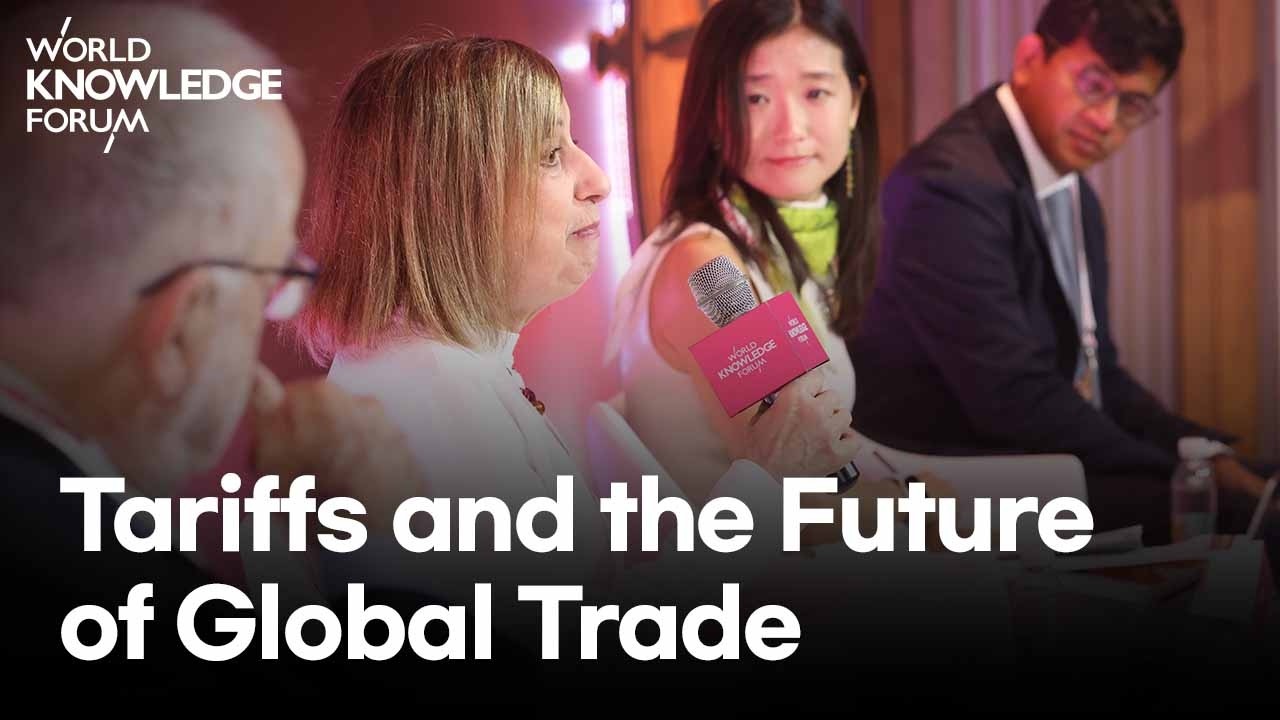
From Free Trade to ‘America First’: What Comes Next?│Wendy Cutler, Zongyuan Zoe Liu, Pushan Dutt
Keywords
Summary
138 words
Critical Evaluation
The panel provides a comprehensive and nuanced analysis of the current trade landscape, drawing on the expertise of three distinguished speakers. Pushan Dutt’s use of the trade policy uncertainty index effectively illustrates the unprecedented spike in uncertainty under the Trump administration, grounding the discussion in empirical data. His quadrant framework, based on an Italian economist’s model, offers a useful heuristic for understanding the distributional effects of tariffs, though it simplifies complex realities. Zongyuan Zoe Liu’s argument that tariffs are here to stay is compelling, as she points to structural factors such as the securitization of trade and the difficulty of reversing policies once implemented. Her analysis of China’s likely responses—retaliation, diversification, and technological self-sufficiency—is well-reasoned and aligns with observable trends. Wendy Cutler brings a practitioner’s perspective, emphasizing the domestic political drivers of tariff policy and the challenges of negotiating in an environment where economic security trumps traditional trade liberalization. She rightly highlights the erosion of the WTO’s authority and the rise of minilateral agreements as a pragmatic response. The discussion on globalization and job loss is particularly insightful, acknowledging the real distributional consequences that have fueled populist backlash, while also cautioning against scapegoating trade for broader economic shifts. The Q&A segment on Korea’s CPTPP accession adds a practical dimension, illustrating the strategic choices facing middle powers. Overall, the panel is intellectually rigorous and balanced, though it could have benefited from more explicit references to specific studies or data sources to enhance verifiability. The lack of a formal citation list is a minor weakness, but the speakers’ credibility and the coherence of their arguments mitigate this. The title accurately reflects the content, and the session provides valuable insights for policymakers, business leaders, and academics alike.
284 words
Title / Content Match
The title accurately reflects the discussion on the shift from free trade to protectionist policies under 'America First'.
Quality & Reliability
8/10
Panel of recognized experts (INSEAD professor, Asia Society VP, CFR fellow) providing data-driven analysis and policy insights. No formal citations but references to established economic concepts and indices. Balanced perspectives, though limited by time constraints.
Chapters
Contribution & Novelties
The panel offers a timely and expert analysis of the shift from free trade to protectionism, providing a framework for understanding country responses and the strategic considerations for businesses and governments. It synthesizes current data and policy developments, offering actionable insights for navigating the volatile trade environment.
Pour aller plus loin :
- Trade Policy Uncertainty Index — The index referenced by Pushan Dutt, useful for tracking policy uncertainty.
- WTO — The World Trade Organization’s official site, relevant for understanding the rules-based trading system.
- CPTPP — Information on the Comprehensive and Progressive Agreement for Trans-Pacific Partnership, discussed in the Q&A.
99 words
Radar Profile
The radar profile shows high scores in quantity and quality of information, reflecting the depth and expertise of the panel. The technical level is moderate, making it accessible to a broad audience. The overall reliability is strong, though the lack of formal citations slightly reduces the score.