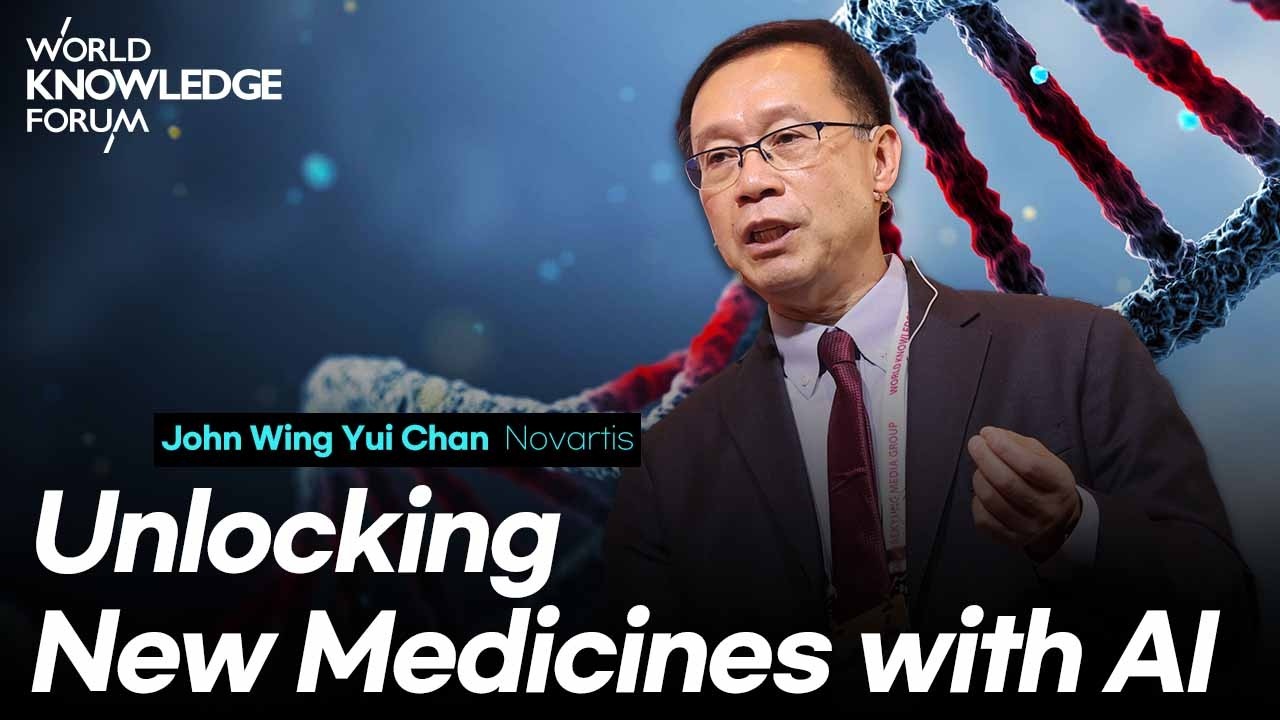
Unlocking New Medicines with AI│John Wing Yui Chan (Novartis, Head of digital, informatics and AI)
Keywords
Summary
192 words
Critical Evaluation
The talk provides a compelling overview of AI’s potential in drug discovery, delivered by a senior industry leader. The speaker effectively communicates the scale of the challenges facing pharmaceutical R&D, using striking statistics such as the 95% gap between known diseases and available treatments, and the astronomical number of potential drug molecules. The argument that AI can address information overload and pattern recognition is well-supported by examples like AlphaFold, which has predicted structures for over 200 million proteins. However, the presentation lacks depth in several areas. The speaker does not provide specific case studies or quantitative results from Novartis’s own AI initiatives, relying instead on general assertions. The discussion of digital twins is promising but remains vague, with no concrete examples of their application. The treatment of AI’s limitations is superficial; while he mentions the inability to handle ambiguous data, he does not delve into issues like data bias, interpretability, or regulatory challenges. The talk is more inspirational than rigorously analytical, and the lack of citations or references to specific studies weakens its scientific credibility. Nevertheless, the speaker’s position at Novartis lends authority, and the content aligns with broader industry trends. The title accurately reflects the content, and the talk is well-structured, progressing from problem to solution. Overall, it serves as a useful high-level introduction for a general audience, but it would benefit from more concrete evidence and a more critical examination of AI’s limitations.
235 words
Title / Content Match
The title accurately reflects the content, which focuses on how AI is transforming drug discovery and development at Novartis.
Quality & Reliability
7/10
The speaker is a senior executive at Novartis, providing credible industry insights. The talk is largely anecdotal and high-level, with no detailed data or citations, but it is consistent with known trends in AI-driven drug discovery.
Key Moments
Markers derived by PSI from the transcript: the creator did not define chapters.
- Introduction: AI as a transformative force in medicine, analogous to the telescope and microscope.
- Statistics on disease burden: 1 billion disabled, $5 trillion US healthcare costs, 75% from chronic diseases.
- The 95% gap: only 500 of 10,000 diseases have approved treatments; 400 million rare disease patients.
- Historical evolution: from surgery to targeted therapy (Gleevec) and the current productivity crisis.
- Challenges: complexity of protein interactions, vast chemical space, and patient heterogeneity.
- AI addressing information overload: 3,000 papers daily, AI systems for rapid data retrieval.
- AI for pattern recognition in high dimensions and as an intelligent lab assistant.
- Digital twins: simulating biological systems to test drugs virtually.
- Human vs AI: AI's inductive and deductive strengths (AlphaFold) vs human creativity (Fleming's discovery).
- Conclusion: AI is already transforming medicine; we must shape it, not react, while addressing risks like bias.
Cited Sources
- AlphaFold — Mentioned as an example of AI's inductive ability to predict protein structures.
Concurring Sources
- AI in drug discovery — Nature Reviews Drug Discovery article discussing AI applications in drug development.
Dissenting Sources
- Concerns about AI in drug discovery
Contribution & Novelties
The talk provides an industry insider’s perspective on how a major pharmaceutical company is integrating AI across the drug discovery pipeline, from literature mining to digital twins. It emphasizes the complementary roles of AI and human scientists, framing AI as an augmenting tool rather than a replacement. The speaker’s position at Novartis lends authority, and the discussion of digital twins is forward-looking.
Pour aller plus loin :
- AlphaFold — The AI system mentioned for protein structure prediction.
- Digital twin in healthcare — Concept of digital twins applied to biological systems.
- Drug discovery — Overview of the drug development process and challenges.
101 words
Radar Profile
The radar profile shows a balanced performance across all dimensions, with slightly higher scores in information quantity and reliability, reflecting the speaker's expertise and the breadth of topics covered. The lower technical depth score indicates the talk is more accessible than deeply technical.
💬 No comments were provided for analysis.