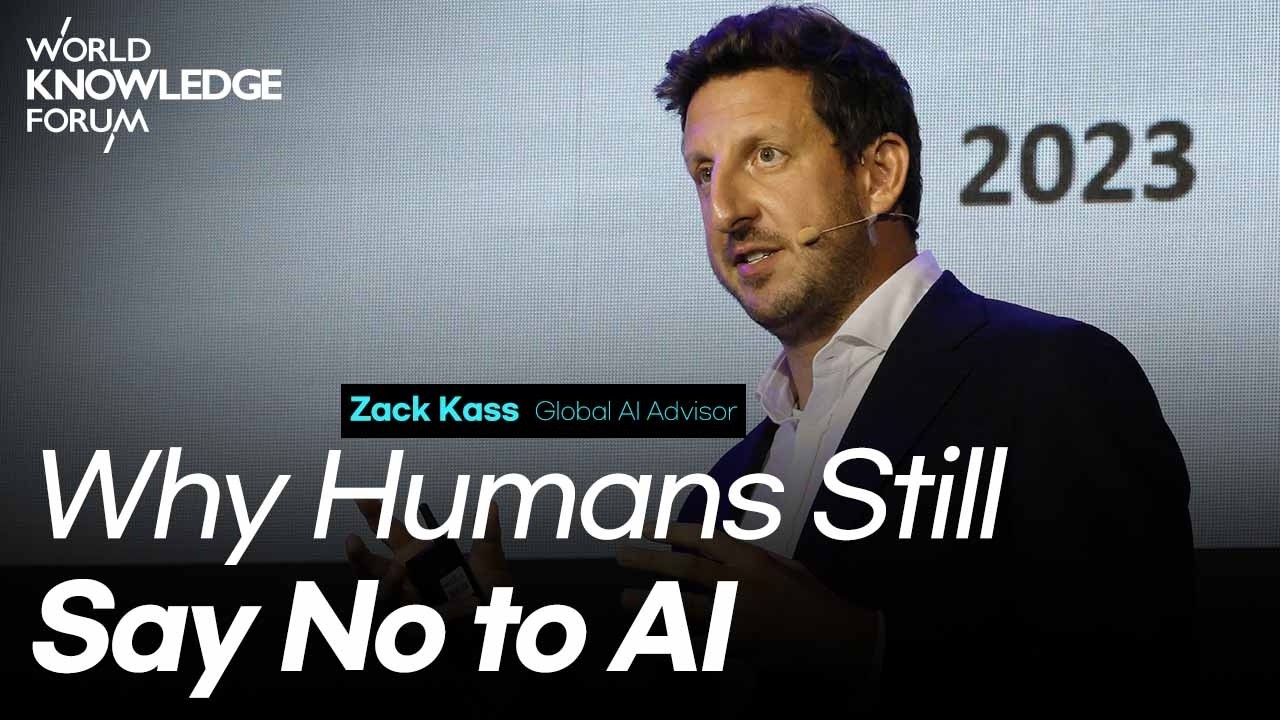
The Hidden Barrier to AI Revolution: Human Psychology
Keywords
Summary
144 words
Critical Evaluation
The talk provides a compelling and accessible argument about the psychological barriers to AI adoption. Kase’s background at OpenAI lends authority, and he effectively uses the historical analogy of the elevator to illustrate the concept of societal thresholds. The three reasons he presents—control, pace of change, and asymmetric tolerance for failure—are well-articulated and supported by anecdotes and examples, such as the Disneyland ride and the radiologist anecdote. However, the talk is largely opinion-based and lacks rigorous empirical evidence. While he mentions studies, he does not provide specific citations, making it difficult to verify claims. The argument about the radiologist’s outdated knowledge is powerful but relies on a single anecdote. The discussion of autonomous vehicle approval is based on polls, but the source is not cited. The talk is more persuasive than analytical, and it could benefit from more data and references. The title is appropriate, and the content is well-structured. Overall, it is a thought-provoking talk that raises important questions, but its scientific rigor is limited by the lack of detailed sources and empirical support.
175 words
Title / Content Match
The title accurately reflects the core theme: the psychological barriers to AI adoption, though it could be more specific.
Quality & Reliability
7/10
The speaker is a former Head of Go-To-Market at OpenAI, lending credibility. He presents a coherent argument with historical analogies and references to studies, but lacks detailed citations and empirical data. The talk is opinion-based, with some anecdotal evidence.
Key Moments
Markers derived by PSI from the transcript: the creator did not define chapters.
- Introduction: The pursuit of AI and the concept of unmetered intelligence.
- Introduction of societal thresholds and the elevator example.
- Discussion of autonomous vehicles as a current societal threshold.
- First reason: Humans love control, with examples from wealthy individuals and Disneyland.
- Second reason: Technological thresholds moving too quickly, with the radiologist anecdote.
- Third reason: Asymmetric tolerance for human vs. machine failure.
- Conclusion: The need to address psychological barriers for AI adoption.
Contribution & Novelties
The talk offers a fresh perspective on AI adoption by focusing on psychological and societal barriers rather than purely technical ones. It introduces the concept of ‘societal thresholds’ and uses the elevator analogy to explain why adoption lags. The three reasons identified (control, pace, and failure tolerance) provide a framework for understanding resistance to AI.
Pour aller plus loin :
- Diffusion of Innovations — Relevant for understanding how new technologies are adopted over time.
- Technology Acceptance Model — A theoretical model explaining user acceptance of technology.
- Autonomous vehicle safety statistics — Provides context on the safety and public perception of autonomous vehicles.
102 words
Radar Profile
The radar profile shows moderate scores across all dimensions, indicating a balanced but not deeply technical talk. The highest score is in information quantity, while technical level is lower, reflecting the focus on psychology rather than AI mechanics.