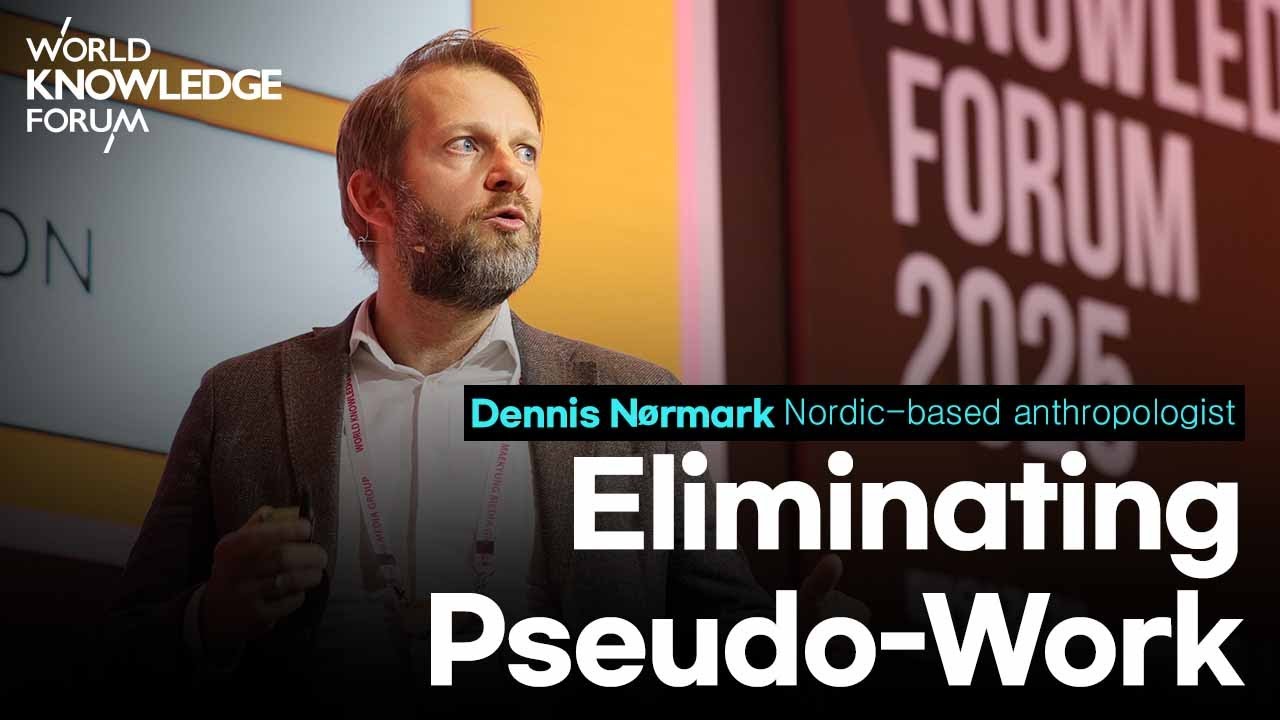
Eliminating Pseudo-Work
Keywords
Summary
166 words
Critical Evaluation
The presentation offers a compelling and accessible critique of modern workplace inefficiencies. Nørmark’s background as an anthropologist and consultant lends credibility to his observations, and he effectively uses anecdotes to illustrate his points. The argument is logically structured: he defines pseudo-work, provides evidence of its prevalence, explores its causes, and suggests remedies. However, the evidence he cites is often anecdotal or drawn from non-peer-reviewed sources, such as a BCG analysis and surveys from the UK and Netherlands. While these are suggestive, they are not rigorously analyzed, and he does not provide specific citations or methodological details. The concept of pseudo-work is not new—similar ideas appear in David Graeber’s ‘Bullshit Jobs’—but Nørmark offers a distinct perspective with practical examples. The presentation is more of an expert opinion than a systematic study, and it lacks a thorough examination of counterarguments or potential limitations of his proposals. The title accurately reflects the content, and the talk is engaging and thought-provoking. Overall, it provides valuable insights into organizational dysfunction, but its scientific rigor is moderate, relying heavily on personal experience and selected data.
179 words
Title / Content Match
The title accurately reflects the core topic of the presentation, which focuses on defining pseudo-work and discussing its elimination.
Quality & Reliability
7/10
The speaker is an anthropologist and bestselling author with relevant consulting experience. He cites several studies and statistics (e.g., BCG analysis, UK and Netherlands surveys, Parkinson's law) but does not provide detailed references or peer-reviewed sources. The argument is coherent and well-illustrated with anecdotes, but lacks systematic evidence.
Key Moments
Markers derived by PSI from the transcript: the creator did not define chapters.
- Introduction: Dennis Nørmark introduces the topic of pseudo-work and its relevance.
- Anecdote about PowerPoint template incident illustrating pseudo-work in consulting.
- Discussion of declining productivity growth and increased bureaucracy.
- Reference to Boston Consulting Group analysis on layers and coordination bodies.
- Examples of pseudo-work: meetings, reports, and email overload.
- Pandemic as a quick fix: examples of accelerated processes like curbside delivery.
- Discussion of working hours and productivity paradox, referencing South Korea.
- Surveys on meaningfulness of work in UK and Netherlands.
- Parkinson's law and its application to modern work expansion.
- Examples of pseudo-work: changing button color and other pointless tasks.
Cited Sources
- Pseudo-work: How we got sidetracked by what we do — Book by Dennis Nørmark and Anders Fogh Jensen, published in Danish in 2018, translated to multiple languages.
- Boston Consulting Group analysis on organizational complexity — Referenced in the talk to show increases in layers, interfaces, and coordination bodies over 15 years.
- UK survey on meaningful work — Survey cited showing 37% of British respondents felt their job did not make a meaningful contribution.
- Netherlands survey on meaningful work — Similar survey in the Netherlands with even more depressing results, as mentioned by the speaker.
Concurring Sources
- Bullshit Jobs: A Theory — David Graeber's book argues that a significant portion of modern work is meaningless, aligning with Nørmark's concept of pseudo-work.
- Parkinson's law — The principle that work expands to fill the time available, directly referenced in the talk.
Dissenting Sources
- The Productivity Paradox — Some economists argue that productivity growth is hard to measure and may be underestimated, which could challenge the claim of declining productivity.
Contribution & Novelties
The talk provides a clear and engaging definition of pseudo-work and offers practical examples from organizational life. It synthesizes existing concepts like Parkinson’s law and bureaucratic dysfunction into a coherent framework. The speaker’s anthropological perspective adds a unique lens, emphasizing cultural and social factors. The presentation also offers actionable advice for reducing pseudo-work, such as questioning the necessity of tasks and focusing on value creation.
Pour aller plus loin :
- Bullshit Jobs: A Theory — David Graeber’s book explores similar themes of meaningless work.
- Parkinson’s law — The principle that work expands to fill the time available.
- The Peter Principle — Related concept about incompetence in hierarchies.
107 words
Radar Profile
The radar profile shows high scores in quantity of information and global reliability, reflecting the speaker's extensive use of examples and data. The lower score in technical level indicates that the content is accessible to a general audience, while the moderate quality of information suggests reliance on anecdotal evidence.
💬 No comments were provided for analysis.