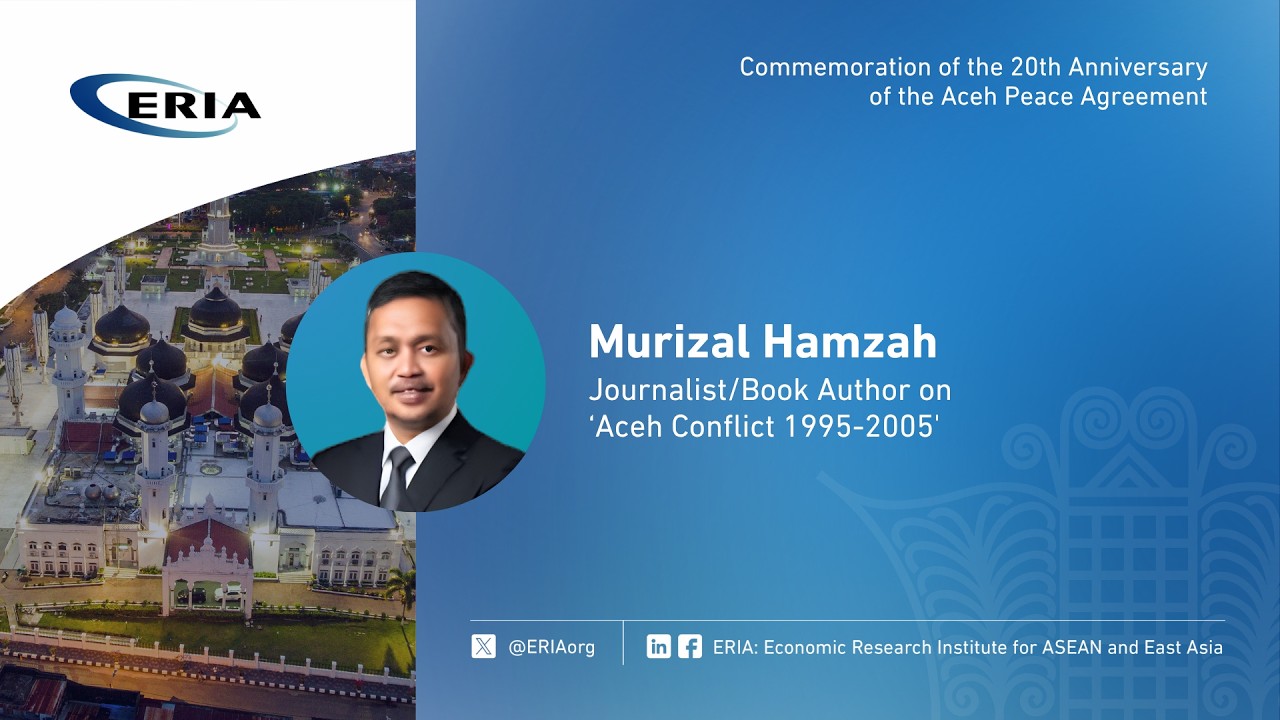
ERIA | Murizal Hamzah's Speech on Commemoration of the 20th Anniversary of Aceh Peace Agreement
Keywords
Summary
157 words
Critical Evaluation
Value of the Information & Strength of the Argument
The value of the information lies in the unique first-hand perspective of a journalist who lived through the conflict and participated in the peace process. His anecdotes provide concrete examples of the dangers faced by journalists and the importance of their role. The argumentation is based on personal experience and observations, which gives it authenticity but also limits its generalizability. He makes a compelling case for the role of local journalists in conflict resolution, and his critique of the ’tsunami myth’ is well-founded, as he points out that negotiations had started before the disaster. However, his arguments are not systematically supported by data or references, and some statements are subjective or politically charged.
Scientific Rigor, Source Quality, Title Accuracy
The speech is not rigorously sourced; it relies on personal testimony and anecdotal evidence. No external sources are cited, and the description of the video provides some context but no specific references. The title accurately reflects the content, as it is indeed a speech by Murizal Hamzah at the commemoration event. The scientific rigor is limited, but the speaker’s credibility as a journalist with direct experience adds some weight to his account.
200 words
Title / Content Match
The title accurately reflects the content: a speech by Murizal Hamzah at the 20th anniversary commemoration of the Aceh Peace Agreement.
Quality & Reliability
6/10
The speaker is a journalist with direct experience of the Aceh conflict, providing valuable first-hand testimony. However, the speech is largely anecdotal and lacks systematic referencing or verifiable data. The reliability is moderate, with a strong personal perspective.
Key Moments
Markers derived by PSI from the transcript: the creator did not define chapters.
- Introduction and opening remarks in Indonesian.
- Discussion of his book and early experiences as a journalist.
- Recounting violence and the role of local journalists.
- Reflections on the peace process and the 'tsunami myth'.
- Critique of the current situation in Aceh, including poverty and the Rohingya issue.
- Call for continued research and education for peace.
- Concluding remarks and thanks.
Contribution & Novelties
The speech provides a unique insider perspective on the Aceh peace process, particularly the role of journalists and the importance of local knowledge. It challenges common misconceptions and offers insights into the ongoing challenges of peacebuilding. The speaker’s personal anecdotes add depth to the understanding of the conflict and its aftermath.
Pour aller plus loin :
- Aceh peace process — Overview of the Helsinki Agreement and the peace process.
- Aceh Monitoring Mission — Details on the EU-led monitoring mission.
- Role of media in conflict resolution — Academic perspective on media’s role in peacebuilding.
93 words
Radar Profile
The radar profile shows moderate scores across information quantity, quality, and reliability, with a low technical level. This reflects a personal, experience-based speech rather than a technical or data-driven analysis.