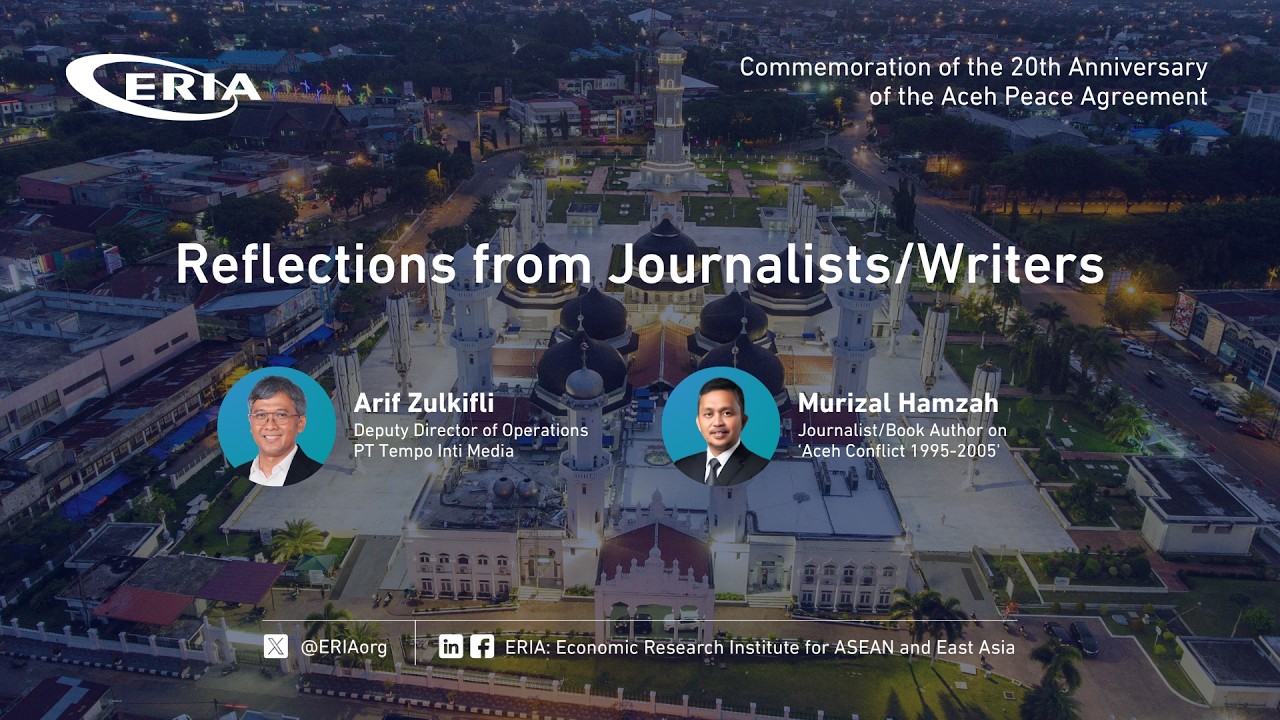
ERIA | Q&A Session of Reflections From Journalists/Writers
Keywords
Summary
122 words
Critical Evaluation
Value of the Information & Strength of the Argument
The value of the information lies in the firsthand accounts and insider perspectives from journalists who covered the Aceh conflict and peace process. The speakers provide nuanced insights into the political dynamics, media’s role, and grassroots realities. The argumentation is largely anecdotal and relies on personal experiences rather than systematic analysis, but it offers a rich qualitative understanding of the complexities involved. The discussion is coherent and engaging, though it lacks empirical data or references to academic literature.
Scientific Rigor, Source Quality, Title Accuracy
The session is a panel discussion with no formal citations or references to external sources. The speakers draw on their professional experiences, which adds authenticity but limits verifiability. The title accurately describes the content as a Q&A session with journalists and writers. The discussion is not structured as a scientific presentation but as an informal exchange, which is appropriate for the format. The lack of formal sources is a limitation for scientific rigor, but the primary nature of the accounts provides unique value.
176 words
Title / Content Match
The title accurately reflects the content: a Q&A session with journalists and writers reflecting on the Aceh peace process.
Quality & Reliability
7/10
The session features firsthand accounts from journalists and academics directly involved in or covering the Aceh peace process, providing valuable primary perspectives. However, the discussion is largely anecdotal and lacks formal citations or verifiable data, limiting its scientific rigor.
Key Moments
Markers derived by PSI from the transcript: the creator did not define chapters.
- Introduction and invitation for questions from the audience.
- Discussion on political contestation between SBY and JK over credit for the peace agreement.
- Speaker shares experience of interviewing SBY and the tension between SBY and JK.
- Discussion on the hidden conflict potential and the role of actors who benefit from conflict.
- Anecdotes about being detained by GAM and TNI, and advice on handling such situations.
- Discussion on economic disparities and governance issues in Aceh, including the role of the governor.
- Question about the perception of the peace process outside Aceh and the role of young people.
- Discussion on the media's role in shaping narratives and the need for historical honesty.
- Closing remarks on the importance of continued action and the role of youth in sustaining peace.
Cited Sources
- ERIA School of Government — Organizer of the forum and source of the video.
Concurring Sources
- ERIA School of Government — Organizer of the forum and source of the video.
Contribution & Novelties
This video provides a unique, firsthand account of the Aceh peace process from the perspective of journalists and writers who were directly involved. It offers insights into the political dynamics, media’s role, and grassroots challenges that are rarely captured in formal academic literature. The discussion highlights the importance of continued engagement and the need for historical honesty in sustaining peace.
Pour aller plus loin :
- Aceh Peace Agreement — Overview of the 2005 Helsinki MoU.
- Aceh Monitoring Mission — Details on the neutral monitoring mission.
- Benedict Anderson on nationalism — Reference to the theorist mentioned in the discussion.
98 words
Radar Profile
The radar profile shows high scores in quantity and quality of information, reflecting the rich firsthand accounts and detailed discussion. The technical level is lower, indicating the content is accessible to a general audience. The overall reliability is moderate, as the discussion is anecdotal and lacks formal citations.
💬 No comments were provided for analysis.