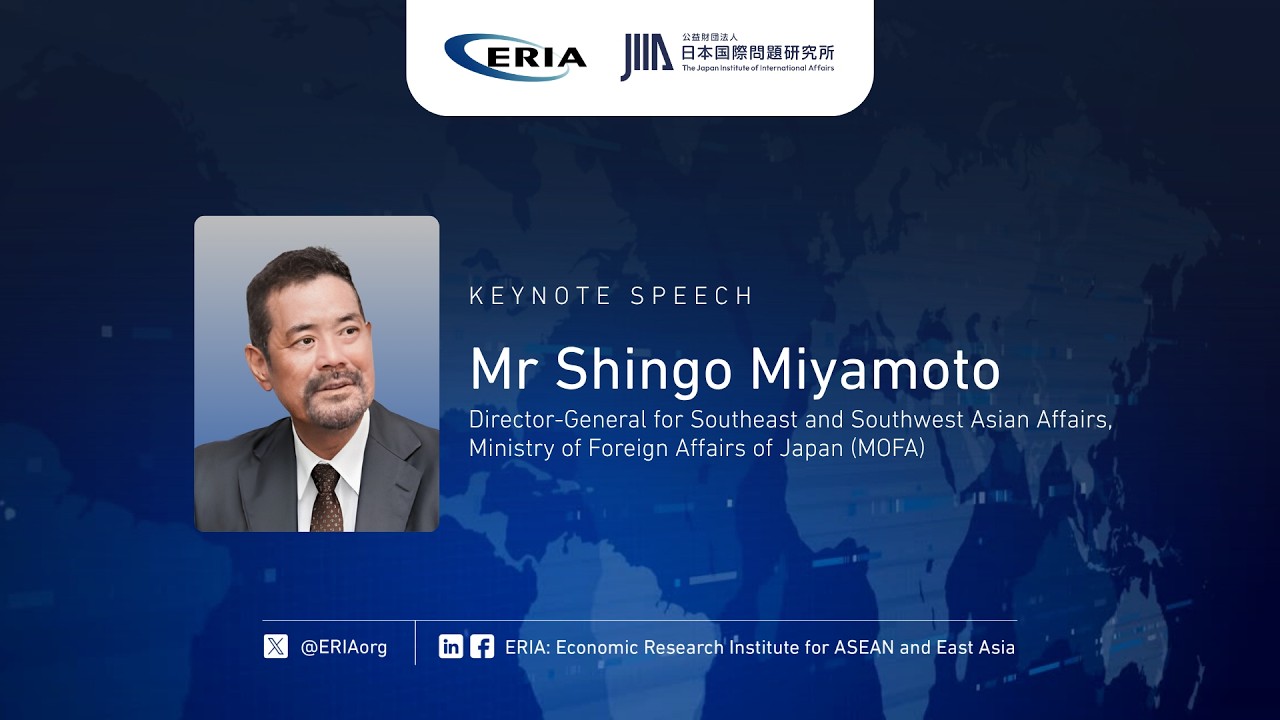
ERIA | Shingo Miyamoto's Remarks on ERIA-JIIA FOIP-AOIP Special Symposium
Keywords
Summary
157 words
Critical Evaluation
Value of the Information & Strength of the Argument
The value of the information lies in its authoritative source: a senior Japanese diplomat directly involved in policy formulation. The speech provides a clear articulation of Japan’s updated FOIP strategy, including its rationale and priority areas. The argumentation is coherent and structured, building from the current geopolitical context to the specific pillars of the new FOIP. However, it is a policy statement rather than an analytical or critical assessment, so it lacks independent evaluation of the strategy’s effectiveness or potential challenges.
Scientific Rigor, Source Quality, Title Accuracy
The speech is a primary source from an official representative, lending it high credibility for policy positions. However, it does not cite external sources or provide evidence beyond the speaker’s assertions. The title accurately reflects the content, which is a formal remark at a symposium. The description provides context about the ERIA School of Government and the AOIP lecture series, but no additional sources are cited. Overall, the scientific rigor is moderate, typical of diplomatic statements.
172 words
Title / Content Match
The title accurately reflects the content, which is a recorded speech by Shingo Miyamoto at an ERIA-JIIA symposium on FOIP and AOIP.
Quality & Reliability
7/10
The speaker is a senior Japanese diplomat, providing authoritative insights into Japan's updated FOIP vision. The content is an official policy statement, not peer-reviewed, but reflects current government positions. The speech is coherent and detailed, but lacks independent verification and critical analysis.
Key Moments
Markers derived by PSI from the transcript: the creator did not define chapters.
- Introduction and thanks
- Key message: Japan and ASEAN partners for resilience and prosperity
- Anecdote about summit logistics with US and ASEAN
- Structural changes in international order
- Introduction of updated FOIP vision by PM Takichi
- Core principles of FOIP and complementarity with AOIP
- Priority area 1: Economic infrastructure for AI and data
- Priority area 2: Co-creation of economic growth and rule-sharing
- Priority area 3: Enhancing security cooperation
- Examples of regional cooperation: AZEC and Power Asia initiative
- Closing remarks on FOIP's flexible approach
Contribution & Novelties
This speech provides an official, up-to-date articulation of Japan’s updated FOIP vision, including specific policy priorities and initiatives. It offers insights into Japan’s strategic thinking and its alignment with ASEAN’s AOIP, which is valuable for understanding regional geopolitics. The speech also highlights concrete examples of cooperation, such as the AZEC and Power Asia initiatives.
Pour aller plus loin :
- Free and Open Indo-Pacific Strategy — Official MOFA document outlining Japan’s FOIP strategy.
- ASEAN Outlook on the Indo-Pacific — Official ASEAN document on AOIP.
- Asia Zero Emission Community (AZEC) — METI page on AZEC initiative.
94 words
Radar Profile
The radar profile shows high scores in information quantity, quality, and reliability, with a moderate technical level. This reflects a well-structured and authoritative policy speech, but with limited technical depth and no critical analysis.