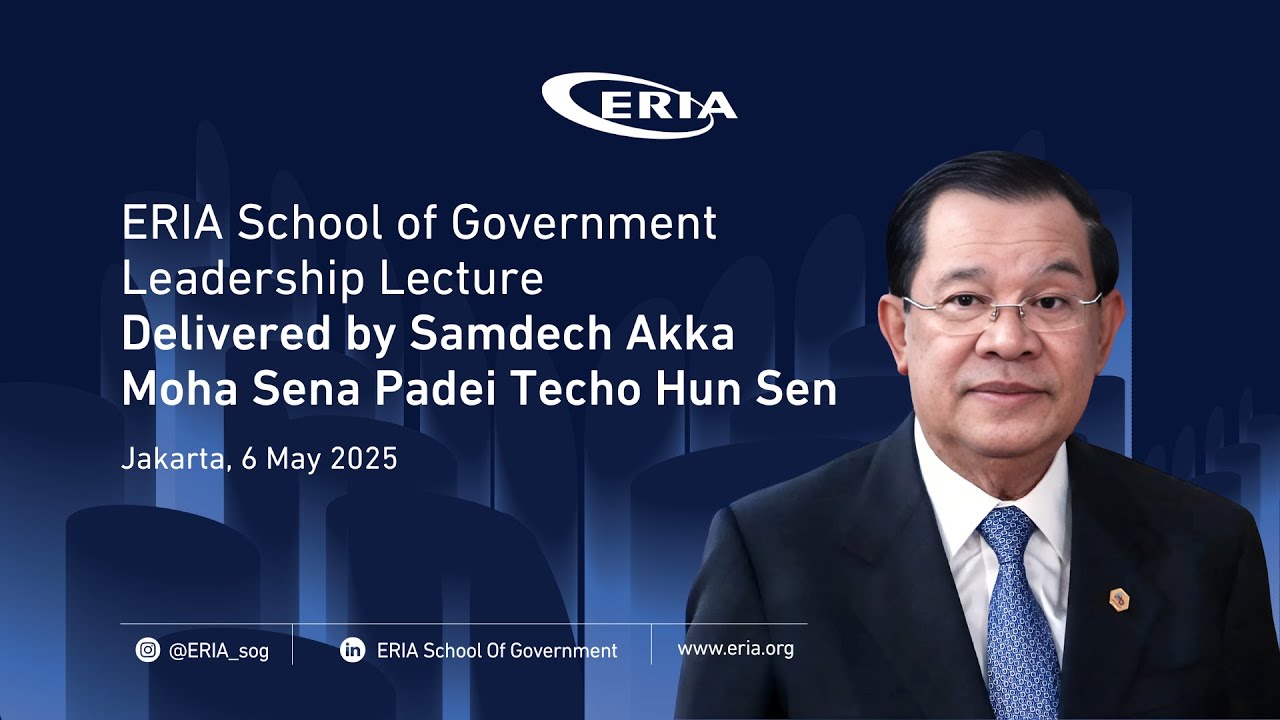
ERIA | 2nd SOG Leadership Lecture by Samdech Akka Moha Sena Padei Techo Hun Sen
Keywords
Summary
161 words
Critical Evaluation
Value of the Information & Strength of the Argument
The lecture provides valuable first-hand insights into Cambodia’s peace process, offering unique perspectives on key events and decisions. Hun Sen’s argumentation is coherent and structured, emphasizing the effectiveness of the Win-Win Policy and the necessity of political dialogue. He supports his claims with personal anecdotes and specific historical details, which adds credibility to his narrative. However, the argumentation is inherently one-sided, reflecting his own role and perspective, and lacks critical examination of alternative viewpoints or potential criticisms.
Scientific Rigor, Source Quality, Title Accuracy
The lecture is based on the speaker’s personal experiences and historical involvement, making it a primary source. While it references specific events and agreements, it does not cite external sources or academic references. The title accurately reflects the content, and the lecture is presented in a formal setting, enhancing its perceived authority. However, the lack of independent verification and the speaker’s vested interest in the narrative limit its scientific rigor.
162 words
Title / Content Match
The title accurately reflects the content: a leadership lecture by Hun Sen at ERIA, focusing on Cambodia's peace process.
Quality & Reliability
7/10
The lecture is a first-person account by a key political figure, providing unique insights into Cambodia's peace process. However, it is inherently subjective and lacks independent verification. The speaker's role as a protagonist introduces potential bias, and the content is not peer-reviewed.
Key Moments
Markers derived by PSI from the transcript: the creator did not define chapters.
- Introduction and thanks to ERIA for organizing the lecture.
- Hun Sen begins discussing Cambodia's peace process and the Win-Win Policy.
- Personal account of his flight to Vietnam in 1977 and the decision to seek assistance.
- Discussion of the post-liberation challenges and rebuilding the country.
- Details on the political and economic reforms initiated in the 1980s.
- Negotiations leading to the Paris Peace Accords and the role of international actors.
- Creation of the Supreme National Council and the Jakarta Informal Meetings.
- Reflections on the importance of historical truth and preventing future atrocities.
- Concluding remarks on the value of peace and leadership lessons for Southeast Asia.
Cited Sources
- ERIA School of Government — The lecture was hosted by ERIA, and the description mentions the ERIA School of Government.
Concurring Sources
- United Nations Peacekeeping — The UN's role in Cambodia's peace process is consistent with the lecture's account.
Dissenting Sources
- Human Rights Watch — Human Rights Watch has criticized Hun Sen's government for human rights abuses, which contrasts with the positive portrayal in the lecture.
Contribution & Novelties
The lecture offers a unique insider perspective on Cambodia’s peace process, providing personal anecdotes and details not commonly found in academic literature. It contributes to the understanding of the Win-Win Policy and the role of leadership in conflict resolution.
Pour aller plus loin :
- Paris Peace Accords — Overview of the 1991 agreement that ended the Cambodian conflict.
- Khmer Rouge — Background on the regime that Hun Sen fought against.
- Win-Win Policy — Explanation of the policy that brought peace to Cambodia.
82 words
Radar Profile
The radar profile shows high scores in information quantity and quality, reflecting the rich historical content. The technical level is moderate, as the lecture is accessible to a general audience. Reliability is moderate due to the subjective nature of the account.
💬 No comments were provided for analysis.