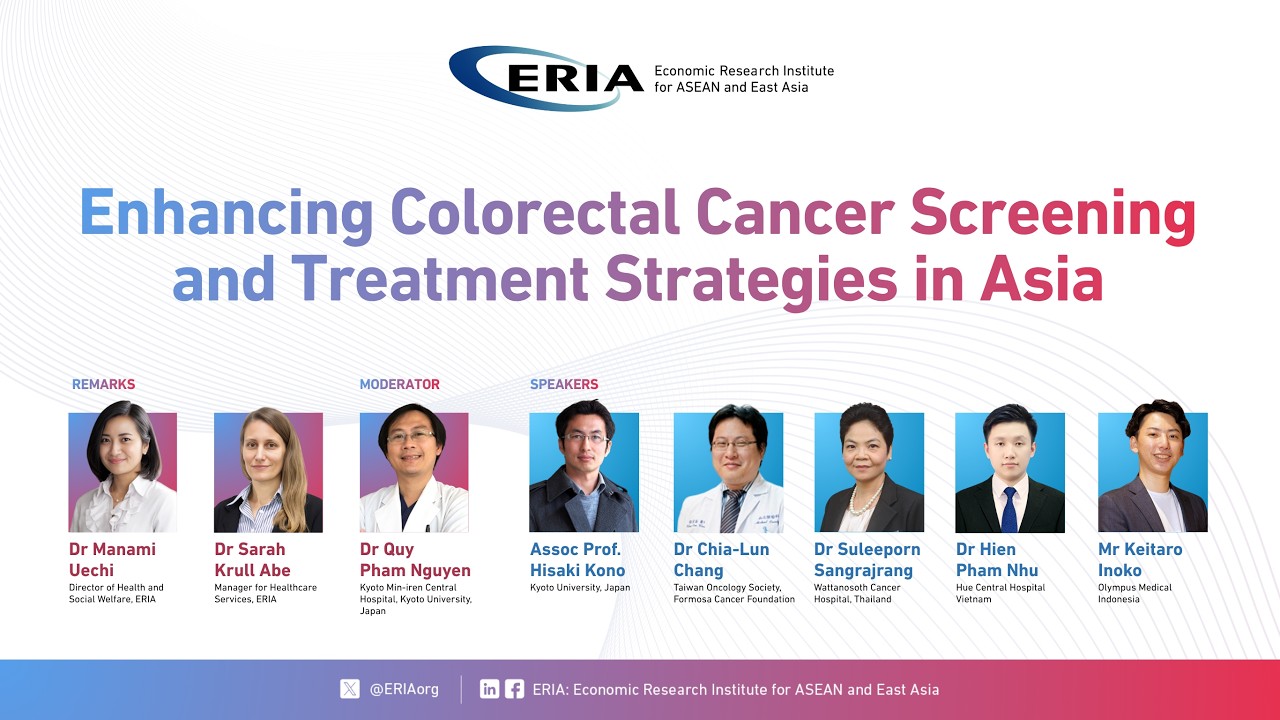
ERIA | Webinar Enhancing Colorectal Cancer Screening and Treatment Strategies in Asia
Keywords
Summary
159 words
Critical Evaluation
Value of the Information & Strength of the Argument
The webinar provides valuable insights into colorectal cancer screening strategies across different Asian countries. The economic perspective from Dr. Kono offers a theoretical framework for understanding screening uptake, supported by references to behavioral economics concepts. The country-specific presentations from Taiwan and Thailand provide practical examples of successful screening programs, including policy changes and community engagement. The argumentation is generally solid, relying on expert opinion and national data, though some claims lack detailed statistical backing. The discussion highlights the importance of addressing behavioral barriers and health system challenges, contributing to a comprehensive understanding of the issue.
Scientific Rigor, Source Quality, Title Accuracy
The webinar maintains a scientific tone, with speakers citing their own experiences and national programs. However, specific sources are not explicitly cited within the presentation, and the reliance on anecdotal evidence limits the rigor. The title accurately reflects the content, focusing on enhancing screening and treatment strategies. The webinar is well-structured, with clear presentations and a moderated discussion. The lack of detailed data and references reduces the overall scientific rigor, but the expertise of the speakers lends credibility.
188 words
Title / Content Match
The title accurately reflects the content, which focuses on enhancing colorectal cancer screening and treatment strategies in Asia.
Quality & Reliability
7/10
The webinar features expert opinions and country-specific experiences from healthcare professionals and researchers. While not a peer-reviewed study, it provides credible insights into regional screening programs and policy implications. The content is largely anecdotal and lacks rigorous data presentation, but the speakers are qualified and the discussion is relevant.
Key Moments
Markers derived by PSI from the transcript: the creator did not define chapters.
- Introduction by Dr. Manami Wii, setting the context of colorectal cancer burden in Asia.
- Dr. Kono presents on behavioral economics and cancer screening, discussing present bias and salience.
- Dr. Kono discusses the cost-effectiveness of FIT and barriers to colonoscopy compliance.
- Dr. Chan shares Taiwan's screening program, including FIT reimbursement and recall rate improvements.
- Dr. Chan mentions lowering screening age to 45 and 40 for family history, and the role of patient advocacy.
- Dr. Sulipon presents Thailand's cancer epidemiology and national screening infrastructure.
- Dr. Sulipon describes the pilot project using FIT and colonoscopy, with village health volunteers.
- Discussion on linking scientific evidence with advocacy and addressing barriers.
- Q&A session begins, with questions from participants.
Cited Sources
- ERIA Webinar Description — Official description of the webinar, providing context and objectives.
Concurring Sources
- WHO Colorectal Cancer Fact Sheet — Provides global statistics and screening recommendations, aligning with the webinar's emphasis on early detection.
Contribution & Novelties
The webinar offers a comparative analysis of colorectal cancer screening strategies in Asia, highlighting the importance of behavioral economics and health system approaches. It provides practical examples from Taiwan and Thailand, showcasing successful implementation and policy changes. The discussion emphasizes the need for multi-stakeholder collaboration and public awareness.
Pour aller plus loin :
- Behavioral economics in health — Provides background on concepts like present bias and salience.
- Fecal immunochemical test — Overview of FIT and its use in screening.
- Colorectal cancer screening — WHO fact sheet on colorectal cancer and screening recommendations.
92 words
Radar Profile
The radar profile shows moderate to high scores across all dimensions, indicating a well-rounded presentation with good information quantity and quality, though the technical level is moderate. The fiabilite is solid due to expert speakers, but the lack of cited sources slightly reduces the overall score.