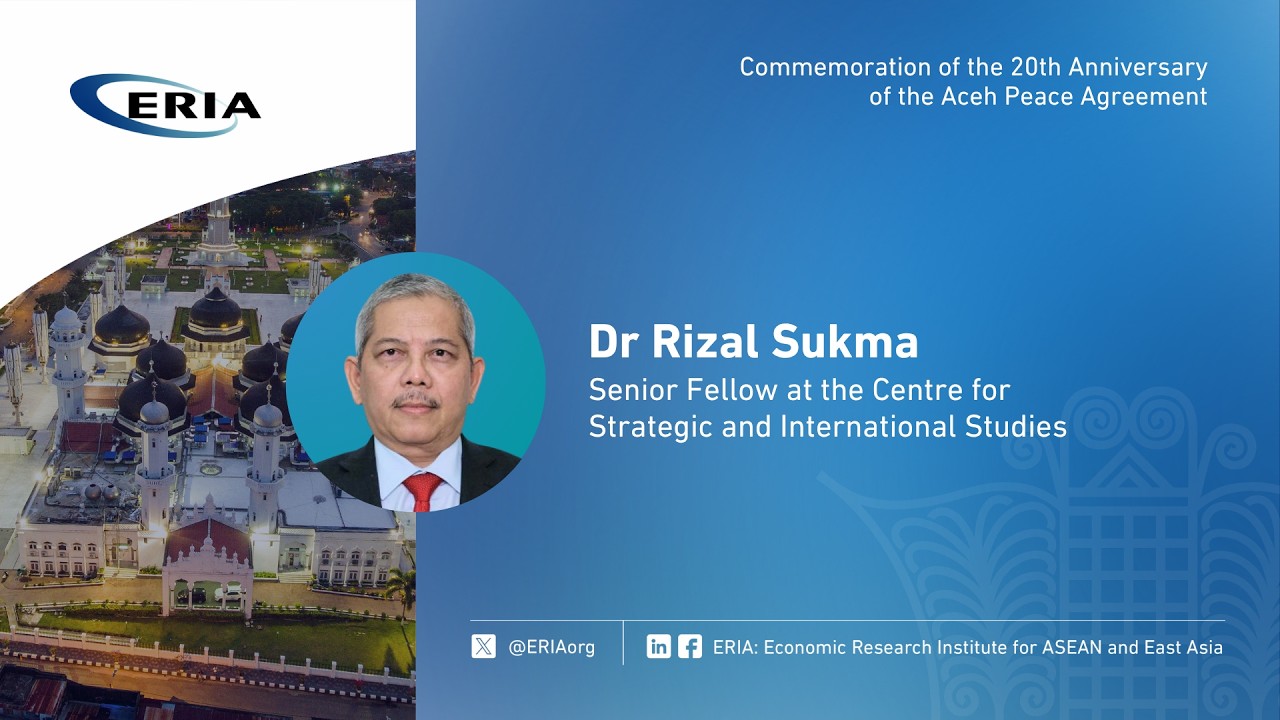
ERIA | Dr Rizal Sukma's Speech on Commemoration of the 20th Anniversary of Aceh Peace Agreement
Keywords
Summary
148 words
Critical Evaluation
Value of the Information & Strength of the Argument
The speech provides valuable insights from a key insider, offering a nuanced analysis of why the Aceh peace process succeeded. Dr Sukma challenges simplistic narratives, such as attributing peace solely to the tsunami, and instead presents a multi-causal explanation. His argumentation is coherent and well-structured, supported by personal anecdotes and specific references to events and individuals. He effectively balances academic analysis with practical experience, making a compelling case for the lessons learned.
Scientific Rigor, Source Quality, Title Accuracy
The speech is based on the speaker’s direct involvement and extensive knowledge of the subject, lending it high credibility. While not a formal academic presentation, it references specific agreements, programs, and individuals, demonstrating a solid factual foundation. The title accurately reflects the content, and the speech is delivered in a professional manner. No external sources are cited, but the speaker’s authority and the detailed account contribute to the overall reliability.
157 words
Title / Content Match
The title accurately describes the content: a speech by Dr Rizal Sukma commemorating the 20th anniversary of the Aceh peace agreement.
Quality & Reliability
8/10
The speaker is a recognized scholar and former diplomat with direct involvement in the peace process, providing first-hand testimony and analysis. The speech is grounded in specific historical events and policy details, though it is an opinion piece rather than a peer-reviewed study.
Key Moments
Markers derived by PSI from the transcript: the creator did not define chapters.
- Introduction and thanks to organizers
- Discussion on the role of tsunami as a humanitarian context
- Explanation of the comprehensive nature of the Helsinki MoU
- Importance of DDR in building trust
- Role of authoritative leaders and third-party mediation
- Civil society's contribution and the Aceh Recovery Forum
- Institutional setup and presence on the ground as critical lessons
- Future directions and warning against complacency
Concurring Sources
- Aceh Peace Process — Official website documenting the Helsinki MoU and peace process.
Contribution & Novelties
The speech offers a unique insider perspective on the Aceh peace process, providing nuanced lessons that are often missing in academic literature. It emphasizes the importance of comprehensive agreements, trust-building mechanisms, and the role of civil society. The speaker’s call for continued international engagement and his warning against complacency, drawing parallels with Myanmar, adds a forward-looking dimension.
Pour aller plus loin :
- Helsinki MoU text — Primary document of the peace agreement.
- Aceh Monitoring Mission — Overview of the AMM’s role.
- Disarmament, Demobilization and Reintegration — General concept and its application in Aceh.
93 words
Radar Profile
The radar profile shows high scores in quality and reliability, reflecting the speaker's expertise and the substantive content. The lower score in technical level indicates that the speech is accessible to a general audience, while the quantity of information is moderate, as it is a concise speech rather than a comprehensive analysis.
💬 Sur les 0 commentaires analysés, aucune tendance n'est disponible.