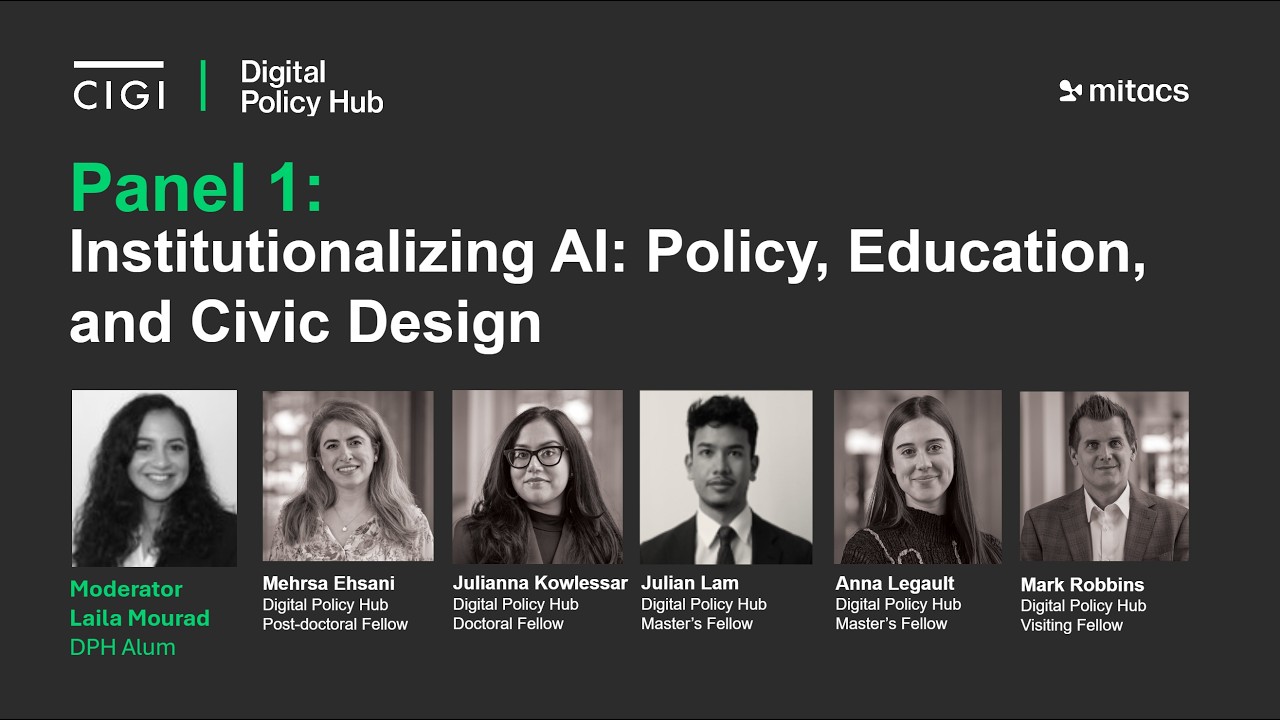
Digital Policy Hub - April 2026 Conference - Panel 1: Institutionalizing AI
Keywords
Summary
106 words
Critical Evaluation
The panel provides a valuable overview of current research on AI governance, focusing on practical challenges in institutionalizing AI across sectors. The presentations are grounded in original research: Esaani conducted over 25 interviews with SME stakeholders, and Juliana performed a systematic content analysis of Ontario school board policies. The methodological approaches are appropriate and clearly described, lending credibility to the findings. The argumentation is solid, with each presenter offering specific policy recommendations based on their evidence. However, the scope is limited to Canadian contexts, and the presentations are brief, leaving depth to the subsequent discussions. The sources cited are primarily the presenters’ own research and the CIGI Digital Policy Hub, which is a reputable institution but not a peer-reviewed source. The panel does not address potential counterarguments or limitations in depth, such as the generalizability of the findings or the feasibility of the proposed policies. The adéquation between titles and content is strong, with each presentation directly addressing its stated topic. Overall, the panel offers insightful, evidence-based perspectives on AI policy, but its impact is constrained by the brevity of presentations and the lack of external validation.
187 words
Title / Content Match
The title accurately reflects the content: a panel discussion on institutionalizing AI, covering policy, education, and SME adoption.
Quality & Reliability
7/10
The panel presents original research from five fellows, based on interviews and content analysis, with clear methodology and policy recommendations. However, the video is a conference recording with limited peer review and no external verification of claims.
Key Moments
Markers derived by PSI from the transcript: the creator did not define chapters.
- Introduction by moderator Layla, outlining the session structure.
- Merissa Esaani presents on SMEs and generative AI adoption.
- Juliana presents on AI policies in Ontario schools and critical media literacy.
- Discussion on civic design and AI.
- Panel on AI in the public sector.
- Q&A session with audience using Slido.
Cited Sources
- CIGI Digital Policy Hub — Mentioned in the video description as the hub for the fellows' research.
Concurring Sources
- OECD AI Policy Observatory — Provides international perspectives on AI governance, aligning with the panel's policy focus.
Dissenting Sources
- Critiques of AI Adoption in SMEs — Some studies argue that AI adoption in SMEs is overestimated and that policy should focus on basic digital infrastructure rather than advanced AI integration.
Contribution & Novelties
The panel contributes original research on AI institutionalization, particularly focusing on understudied areas like SME capability-building and critical media literacy in education policy. It offers practical policy recommendations based on empirical data.
Pour aller plus loin :
- AI and SMEs: A Review of the Literature — Relevant to SME AI adoption challenges.
- Critical Media Literacy Framework — Foundation for critical media literacy concepts.
- Ontario’s AI Guidelines for Education — Context for school board policies.
74 words
Radar Profile
The radar profile shows balanced scores across information quantity, quality, technical level, and reliability, indicating a well-rounded presentation. The highest score is in information quantity, reflecting the breadth of topics covered, while technical level is slightly lower due to the policy-oriented nature.
💬 No comments were provided for analysis.