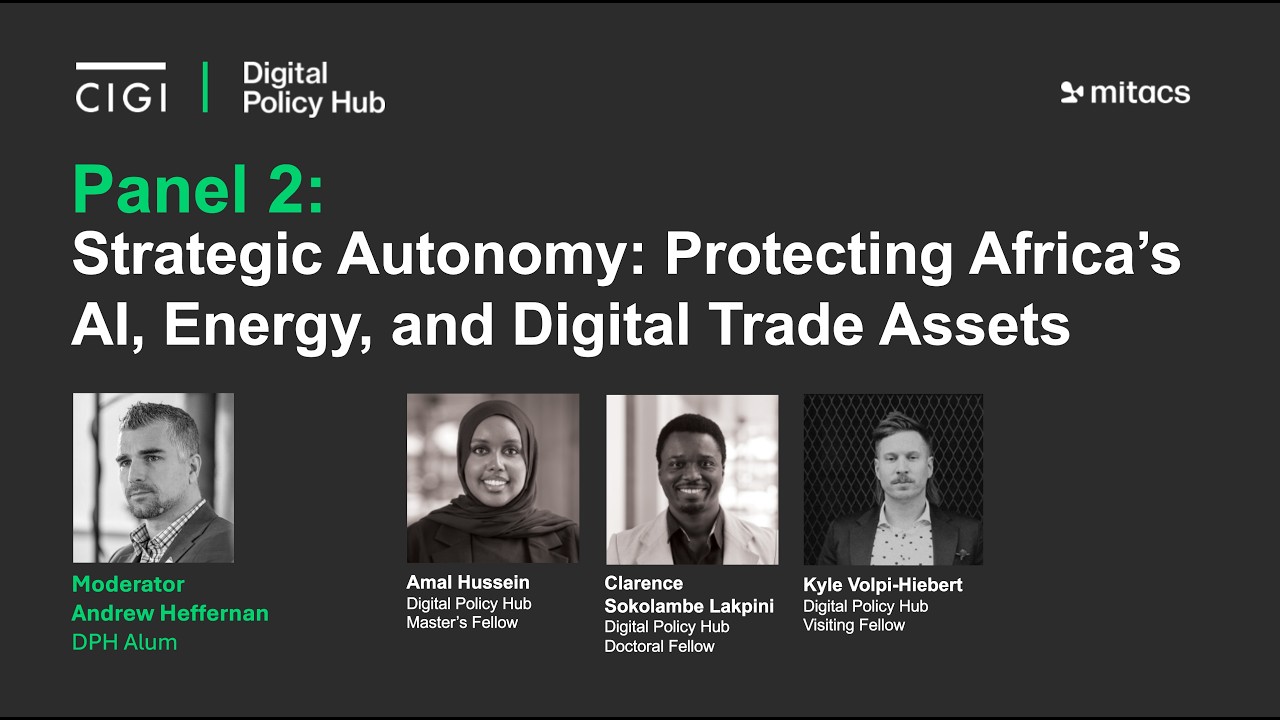
Digital Policy Hub - April 2026 Conference - Panel 2: Strategic Autonomy
Keywords
Summary
182 words
Critical Evaluation
The panel provides a valuable contribution to the discourse on strategic autonomy in digital policy, particularly from the perspective of the Global South. The first presentation on open-weight AI governance in Africa is well-structured and pragmatic, offering a clear framework that addresses real-world challenges. The distinction between open-source and open-weight is crucial and well-explained, and the proposed ‘minimum viable governance’ tiers are actionable and grounded in existing data protection laws. The speaker acknowledges the limitations of open-weight models in terms of dependency on foreign base models, but argues that they offer a stepping stone towards greater sovereignty. This nuanced perspective is refreshing and avoids oversimplification. The second presentation on trade secrets and Nigeria’s energy transition is less developed, likely due to time constraints, but raises important questions about intellectual property and technology transfer. The speaker touches on the tension between protecting trade secrets and fostering local innovation, but the analysis could be deeper. The Q&A session adds value, particularly the discussion on avoiding lock-in to foreign tech stacks. The panelists demonstrate a strong understanding of the policy landscape and offer practical insights. However, the video is a conference recording with limited production quality, and the presentations are not accompanied by slides, which may hinder comprehension. The sources cited are not explicitly mentioned in the video, but the description links to the Digital Policy Hub, which likely contains the papers. Overall, the content is rigorous and relevant, but it would benefit from more detailed exploration of the topics.
247 words
Title / Content Match
The title accurately reflects the content, which is a panel discussion on strategic autonomy in digital policy.
Quality & Reliability
7/10
The panel presents academic research from the Digital Policy Hub, with a focus on AI governance in Africa and trade secrets in Nigeria's energy transition. The speakers are researchers and practitioners, and the content is grounded in policy analysis. However, the video is a conference recording with limited production quality, and the claims are not peer-reviewed in this format.
Key Moments
Markers derived by PSI from the transcript: the creator did not define chapters.
- Introduction by moderator and start of panel
- Amal begins presentation on open-weight AI in Africa
- Amal explains the three-tier governance framework
- Kyle provides response and asks about dependency on foreign tech
- Clarence presents on trade secrets and Nigeria's energy transition
- Q&A session begins
- Panelists discuss regional coordination and future research
Cited Sources
- Digital Policy Hub — The conference is organized by the Digital Policy Hub, and the papers presented are to be published on this site.
Concurring Sources
- Digital Policy Hub — The hub's research focuses on digital policy issues, aligning with the panel's themes.
Contribution & Novelties
The panel offers a fresh perspective on strategic autonomy in digital policy, focusing on the Global South. The first presentation introduces a practical governance framework for open-weight AI, which is a relatively new area of policy research. The second presentation highlights the often-overlooked role of trade secrets in energy transitions. The discussion provides actionable insights for policymakers and researchers.
Pour aller plus loin :
- Open-weight AI governance — Provides background on open-source AI and its governance challenges.
- Technological sovereignty — Explores the concept of technological sovereignty and its implications.
- Trade secrets — Offers an overview of trade secrets and their legal protection.
102 words
Radar Profile
The radar profile shows balanced scores across all dimensions, with slightly higher scores in information quality and reliability, indicating a well-rounded and credible presentation. The lower score in technical depth suggests that the content is accessible to a general audience while still providing substantive analysis.
💬 No comments were provided for analysis.