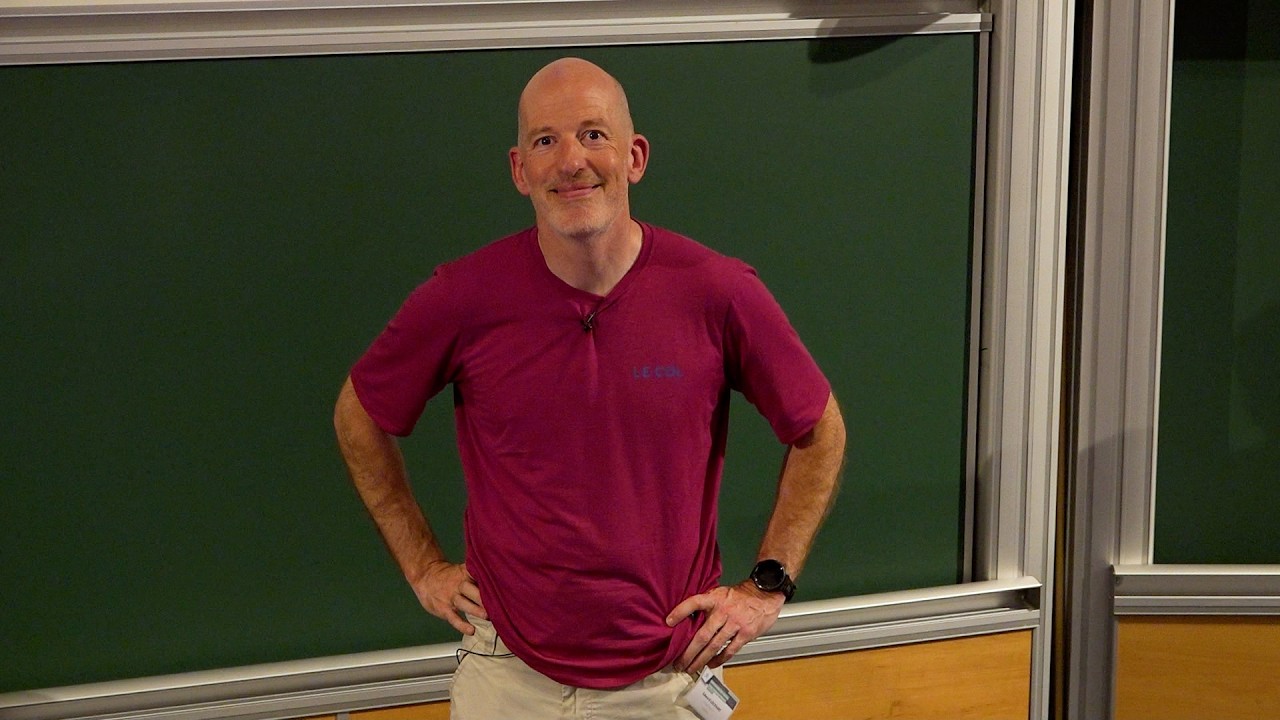
Edward Lockhart - Why AI Needs Formal Mathematics
Keywords
Summary
150 words
Critical Evaluation
The talk provides a clear and insightful overview of the challenges in training LLMs, particularly the issue of reward hacking. Lockhart’s explanation of RLHF and the limitations of using LLM-based judges is technically sound and well-articulated. The proposal to use formal verification as a more reliable reward signal is compelling and aligns with ongoing research in the field. However, the talk is largely a position piece rather than a presentation of new empirical results. While Lockhart mentions that DeepMind is working on these ideas, he does not provide specific data or case studies to support the claims. The discussion of ‘formalisation on-demand’ is intriguing but remains at a conceptual level. The talk would benefit from more concrete examples of how formal verification can be integrated into the RL loop. Additionally, the speaker acknowledges the current limitations of proof assistants in terms of scalability and expressiveness, but does not delve deeply into these challenges. The title is appropriate, and the content is accessible to a technical audience familiar with machine learning and mathematics. Overall, the talk offers valuable insights and raises important questions, but it is more of a research vision than a rigorous scientific presentation.
195 words
Title / Content Match
The title accurately reflects the content, which argues for the importance of formal mathematics in AI development.
Quality & Reliability
8/10
Talk by a DeepMind researcher with deep expertise in LLM training and formal mathematics. Presents technical details of RLHF and the potential of formal verification, but lacks peer-reviewed citations and some claims are speculative.
Key Moments
Markers derived by PSI from the transcript: the creator did not define chapters.
- Introduction: Lockhart explains his background and the goal of the talk.
- Explanation of LLMs as probabilistic models and scaling laws.
- Discussion of fine-tuning and turning LLMs into assistants.
- Introduction to RLHF and the reward model.
- Explanation of reward hacking and the need for formal verification.
- Proposal of using proof assistants to provide verifiable rewards.
- Discussion of 'formalisation on-demand' and its implications.
- Potential for autonomous AI mathematical research.
- Challenges and limitations of formal verification.
- Conclusion and Q&A.
Cited Sources
- Carmin.tv — Video platform for mathematics and related sciences, hosting this talk.
Concurring Sources
- Carmin.tv — Platform hosting the talk, indicating institutional support.
Contribution & Novelties
The talk presents a clear argument for integrating formal mathematics into AI training to address reward hacking. It introduces the concept of ‘formalisation on-demand’ as a means to verify AI outputs and build trust. This is a novel perspective that could influence future research directions.
Pour aller plus loin :
- Formal verification — Overview of formal methods.
- Proof assistant — Software tools for formal proofs.
- Reinforcement learning from human feedback — Background on RLHF.
- Reward hacking — Definition and examples.
80 words
Radar Profile
The radar profile shows high scores in quantity and quality of information, with a strong technical level. The reliability score is slightly lower due to the speculative nature of some claims. Overall, the talk is informative and technically sound, but could benefit from more empirical evidence.
💬 Sur les 0 commentaires analysés, aucune tendance n'est disponible.