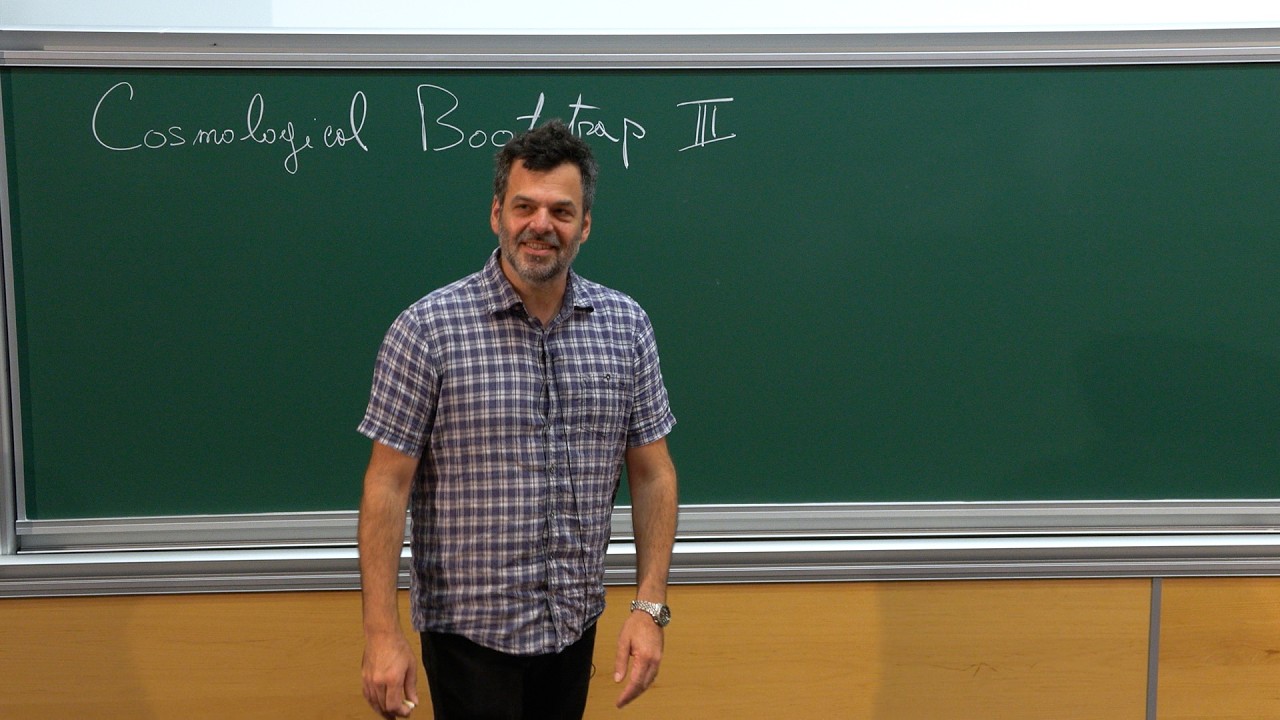
Massimo Taronna - 3/4 Cosmological Bootstrap
Keywords
Summary
149 words
Critical Evaluation
This lecture is a rigorous and detailed exposition of the analyticity properties of cosmological correlators, a foundational aspect of the cosmological bootstrap program. The speaker, Massimo Taronna, demonstrates deep expertise and provides a clear logical progression from the geometry of de Sitter space to the complexification of the path integral. The content is highly technical, targeting an audience of researchers and advanced graduate students in theoretical physics. The argumentation is solid, with careful attention to signs and analytic continuations, which are often sources of confusion. The lecture successfully bridges the gap between the symmetry-based constraints discussed in previous lectures and the non-perturbative bootstrap axioms to be formulated later. The use of diagrams to illustrate the complexified manifolds is helpful, though the drawing quality is limited. The sources cited are minimal, but the lecture is part of a series at IHES, which lends credibility. The title accurately reflects the content, and the lecture delivers on its promise to discuss analyticity. The main limitation is the lack of explicit references to the literature, which would be useful for further study. Overall, this is a high-quality lecture that provides valuable insights into the mathematical foundations of the cosmological bootstrap.
196 words
Title / Content Match
The title accurately reflects the content: the third of four lectures on the cosmological bootstrap, focusing on analyticity properties and the path integral formulation.
Quality & Reliability
8/10
Lecture by a recognized expert in theoretical physics, part of a series at IHES. The content is technically rigorous, with clear derivations and references to established concepts. The presentation is dense and assumes advanced knowledge, but the reasoning is solid and consistent with current research in cosmological bootstrap.
Key Moments
Markers derived by PSI from the transcript: the creator did not define chapters.
- Introduction and recap of previous lectures on symmetries.
- Discussion of de Sitter space embedding in Minkowski space.
- Introduction of the expanding and contracting patches.
- Complexification of de Sitter space and introduction of Euclidean AdS.
- Analytic continuation between de Sitter patches and Euclidean AdS.
- Discussion of the conformal boundary and light cone.
- Metrics for de Sitter and Euclidean AdS.
- Quantum mechanics and the need for complexification.
- Definition of the vacuum state via complex time evolution.
- Path integral contour deformation and phase factor.
Cited Sources
- Carmin.tv — Platform hosting the video and related scientific content.
Concurring Sources
- Carmin.tv — Platform hosting the video and related scientific content.
Contribution & Novelties
This lecture provides a clear and detailed exposition of the analyticity properties of cosmological correlators, emphasizing the role of complexification and the epsilon prescription. It connects the geometry of de Sitter space to the path integral formulation, setting the stage for a non-perturbative bootstrap. The lecture is particularly valuable for its pedagogical clarity on subtle points such as the analytic continuation between de Sitter patches and Euclidean AdS.
Pour aller plus loin :
- de Sitter space — Background on the geometry of de Sitter space.
- Anti-de Sitter space — Background on Euclidean AdS and its relation to de Sitter.
- Path integral formulation — Quantum mechanics path integrals and complexification.
- Conformal field theory — Relevant for the bootstrap approach.
118 words
Radar Profile
The radar profile shows high scores in quantity of information, technical level, and reliability, with a slightly lower score in quality of information due to the lack of explicit references. This indicates a dense, technical lecture with strong content but limited external sourcing.