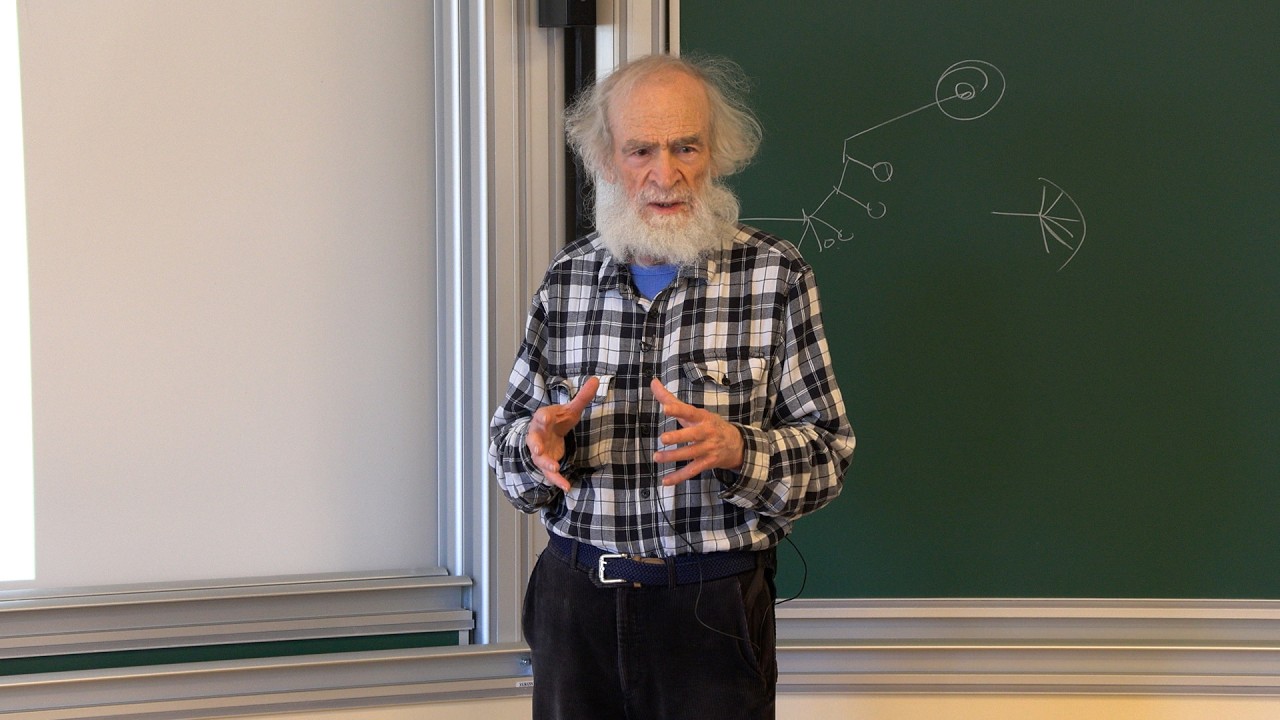
Mikhail Gromov - 2/4 Generation, Transformation, Transmission, Memorization, Storage and (...)
Keywords
Summary
148 words
Critical Evaluation
Mikhail Gromov’s lecture offers a thought-provoking exploration of information theory as applied to biology and artificial intelligence. As a Fields medalist, Gromov brings a unique mathematical perspective, but the lecture is highly speculative and lacks formal rigor. He raises fundamental questions about the nature of information in DNA, the difficulty of protein folding prediction, and the limitations of current AI models. His arguments are based on analogies and intuitive reasoning rather than rigorous proofs, which is appropriate for a lecture aimed at stimulating thought. The content is dense and assumes a high level of mathematical and biological literacy. Gromov’s critique of large language models, particularly their homogeneity and lack of scale separation, is insightful and relevant. However, he does not provide concrete evidence or references to support his claims, relying instead on his authority. The lecture’s strength lies in its interdisciplinary connections and the formulation of open problems. The absence of a clear structure and the informal style may hinder comprehension for some viewers. Overall, the lecture is valuable for researchers interested in the mathematical foundations of information in biological and artificial systems, but it should be viewed as a starting point for discussion rather than a definitive analysis.
199 words
Title / Content Match
The title is incomplete but reflects the lecture's focus on information processing in biological and artificial systems.
Quality & Reliability
8/10
Lecture by a renowned mathematician, presenting speculative but mathematically grounded ideas. No formal proofs, but rigorous thinking and references to known scientific concepts.
Key Moments
Markers derived by PSI from the transcript: the creator did not define chapters.
- Introduction and overview of topics.
- Discussion on DNA as digital information and protein folding.
- Comparison between DNA and human language.
- Challenges in extracting information from DNA.
- Separation of energy and time scales in cells and brain.
- Critique of large language models.
- Metastability and complexity in biological systems.
Cited Sources
- Carmin.tv — Video platform for mathematical sciences, mentioned in description.
Concurring Sources
- Central dogma of molecular biology — Supports the discussion on information flow in cells.
- Protein folding — Relevant to the challenge of predicting structure from sequence.
Dissenting Sources
- Kolmogorov complexity — Gromov argues it is inadequate for biological information, which is a minority view.
Contribution & Novelties
Gromov’s lecture provides a unique mathematical perspective on information processing in biological and artificial systems, drawing parallels between DNA and language, and critiquing current AI models. He introduces the concept of ‘information systems’ and emphasizes the importance of scale separation, which is often overlooked in AI.
Pour aller plus loin :
- Central dogma of molecular biology — Relevant to the discussion of information flow in cells.
- Protein folding problem — Key challenge mentioned in the lecture.
- Kolmogorov complexity — Discussed as inadequate for biological complexity.
- Large language models — Context for Gromov’s critique.
93 words
Radar Profile
The radar profile shows high scores in quantity and technical level, reflecting the dense and advanced content. Quality and reliability are moderate due to the speculative nature and lack of formal proofs.