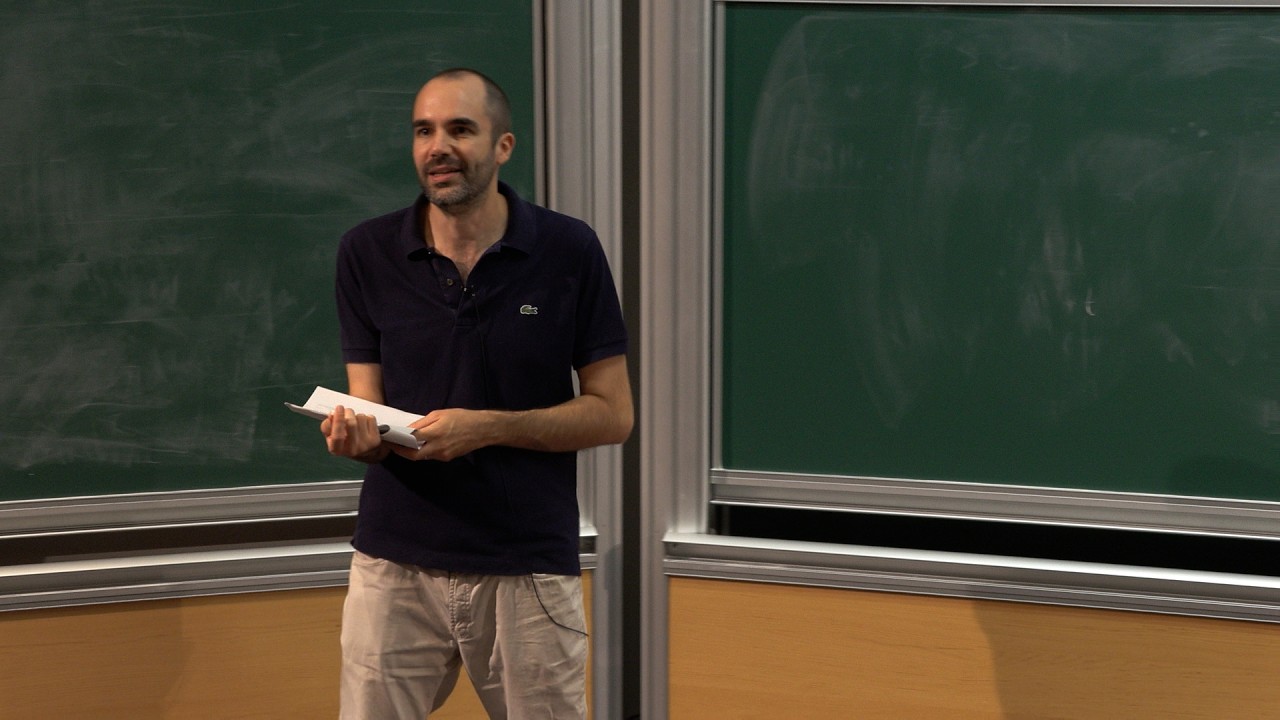
Raffaele D’Agnolo - 2/3 Beyond-the-Standard-Model meets Cosmological Correlators
Keywords
Summary
168 words
Critical Evaluation
The lecture provides a rigorous and detailed exposition of the path integral approach to cosmological correlators, specifically tailored to beyond-the-Standard-Model physics. The speaker, Raffaele D’Agnolo, is a recognized physicist at IPhT, CEA & ENS Paris, and his expertise is evident in the clarity and depth of the presentation. The content is technically advanced, assuming a solid background in quantum field theory and cosmology, but the speaker takes care to review essential concepts, making the lecture accessible to graduate students and researchers in the field.
The scientific value of the lecture is high: it bridges the gap between particle physics and cosmology, demonstrating how cosmological observations can constrain new physics beyond the Standard Model. The derivation of the three-point function and the estimation of f_NL are presented with sufficient detail, and the speaker emphasizes the importance of the slow-roll parameters in determining the observability of non-Gaussianity. The lecture also introduces the concept of the cosmological collider, which is a promising avenue for probing heavy particles during inflation.
The argumentation is solid, and the speaker is careful to highlight approximations and assumptions, such as the neglect of certain terms and the use of order-one estimates. However, the lecture does not provide new original results; it is a pedagogical review of existing techniques and known results. The sources cited are not explicitly mentioned in the video, but the description links to carmin.tv, a platform for scientific videos, which may host related content. The lack of direct references to specific papers is a minor weakness, as viewers might want to consult the original literature for further details.
The title accurately reflects the content, and the lecture is well-structured, with a clear progression from formalism to applications. The technical level is high, but the speaker’s explanations are clear and well-paced. The video is part of a series, and this second lecture builds on the first, which is not available in the provided data. Overall, the lecture is an excellent resource for those interested in the intersection of particle physics and cosmology, and it is likely to be valuable for researchers in the field.
348 words
Title / Content Match
The title accurately reflects the content: the lecture focuses on beyond-the-Standard-Model physics in the context of cosmological correlators, as part of a series.
Quality & Reliability
8/10
Lecture by a recognized physicist (IPhT, CEA & ENS Paris) at IHES, presenting standard techniques in QFT and cosmology. The content is rigorous and technically sound, but as a lecture it does not provide new peer-reviewed results. The description includes a link to a video platform (carmin.tv) but no direct references to specific papers.
Key Moments
Markers derived by PSI from the transcript: the creator did not define chapters.
- Introduction and recap of the path integral formalism
- Perturbation theory and Feynman diagrams
- In-in formalism and propagators
- Application to single-field inflation
- Estimation of the three-point function and f_NL
- Discussion of slow-roll parameters and observability
- Introduction to the cosmological collider
- Beyond-the-Standard-Model signatures
- Summary and outlook
Cited Sources
- Carmin.tv — Video platform for scientific content, mentioned in the description as a source for related videos.
Concurring Sources
- Carmin.tv — Platform hosting the video and related scientific content.
Contribution & Novelties
The lecture provides a clear and detailed pedagogical introduction to the use of cosmological correlators for probing beyond-the-Standard-Model physics. It bridges the gap between quantum field theory and cosmology, offering a step-by-step derivation of the in-in formalism and its application to single-field inflation. The estimation of the three-point function and the discussion of the observability of non-Gaussianity are particularly valuable for researchers entering the field. The lecture also highlights the potential of the cosmological collider as a new probe of heavy particles during inflation.
Pour aller plus loin :
- Cosmological collider physics — A review article on the cosmological collider, directly relevant to the lecture’s topic.
- In-in formalism — Wikipedia page explaining the in-in formalism used in the lecture.
- Primordial non-Gaussianity — Overview of non-Gaussianity and its observational implications.
129 words
Radar Profile
The radar profile shows high scores in technical level and information quality, reflecting the advanced and rigorous nature of the lecture. The quantity of information is also substantial, but the global reliability is slightly lower due to the lack of explicit citations and the pedagogical nature of the content.