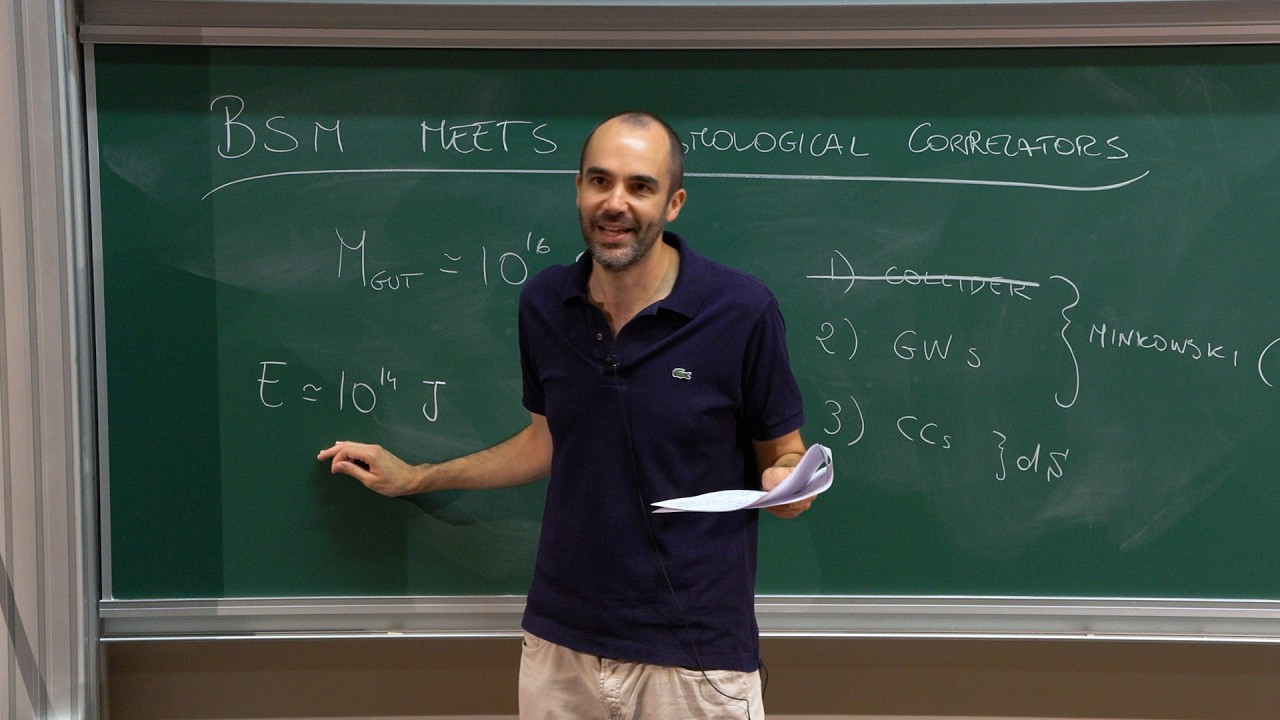
Raffaele D’Agnolo - 1/3 Beyond-the-Standard-Model meets Cosmological Correlators
Keywords
Summary
172 words
Critical Evaluation
The lecture provides a compelling and well-structured argument for the cosmological collider as a unique probe of high-energy physics. D’Agnolo begins with a clear motivation, contrasting the impracticality of a GUT-scale collider with the potential of cosmological observations. The derivation of the gravitational wave detection limit is particularly instructive, as it combines dimensional analysis with quantum noise considerations to establish a fundamental barrier. This argument is presented with appropriate caveats, such as the assumption of a standard model-like thermal history and the uncertainty in the inflationary energy scale. The speaker demonstrates deep expertise and communicates complex ideas effectively, using order-of-magnitude estimates to make the physics transparent. However, the lecture is not a comprehensive review; it focuses on the conceptual framework and leaves many technical details for later parts. The sources cited are minimal, primarily pointing to the Carmin.tv platform, which hosts the video, rather than to specific scientific papers. This limits the ability to verify claims independently, but the content aligns with established knowledge in cosmology and particle physics. The title accurately reflects the content, and the lecture is well-suited for an audience with a background in theoretical physics. Overall, the lecture is a valuable introduction to an emerging research area, offering both motivation and quantitative insight.
207 words
Title / Content Match
The title accurately reflects the content: the lecture introduces the cosmological collider and its connection to beyond-the-Standard-Model physics.
Quality & Reliability
8/10
Lecture by a recognized physicist, part of an IHES series, presenting theoretical arguments with quantitative estimates. The content is rigorous but not peer-reviewed in this format; some estimates are simplified for pedagogical purposes.
Key Moments
Markers derived by PSI from the transcript: the creator did not define chapters.
- Introduction and motivation: probing the GUT scale with cosmological observations.
- Comparison of collider, gravitational wave, and cosmological correlator approaches.
- Estimate of required collider size and magnetic field for GUT-scale physics.
- Introduction to gravitational wave detection limits and frequency scaling.
- Derivation of the quantum noise limit for gravitational wave detectors.
- Conclusion that gravitational wave detection beyond ~1 GHz is impossible.
- Introduction to the cosmological collider concept and its advantages.
- Discussion of how inflation can produce heavy particles and their imprints on correlators.
- Overview of the lecture series structure and topics to be covered.
Cited Sources
- Carmin.tv - Scientific video platform — Mentioned in the video description as the platform hosting the lecture and related scientific videos.
Concurring Sources
- Carmin.tv - Scientific video platform — The platform hosting the lecture, which may contain related talks and resources.
Contribution & Novelties
This lecture provides a clear and accessible introduction to the cosmological collider, a relatively new and rapidly developing field. It offers a pedagogical derivation of the fundamental limits of gravitational wave detection, which is not commonly presented in such a concise manner. The speaker’s emphasis on the quantum noise limit and its implications for probing high-energy scales is a valuable contribution to the popularization of this research area.
Pour aller plus loin :
- Cosmological collider physics — A review article by Chen et al. that provides a comprehensive overview of the cosmological collider mechanism.
- Inflationary cosmology — A general reference on inflation, the framework in which the cosmological collider operates.
- Primordial gravitational waves — An overview of primordial gravitational waves and their detection challenges.
124 words
Radar Profile
The radar profile shows high scores across all dimensions, indicating a well-balanced lecture with substantial information, strong technical depth, and high reliability. The lecture excels in providing quantitative estimates and clear explanations, making it a valuable resource for advanced students and researchers.