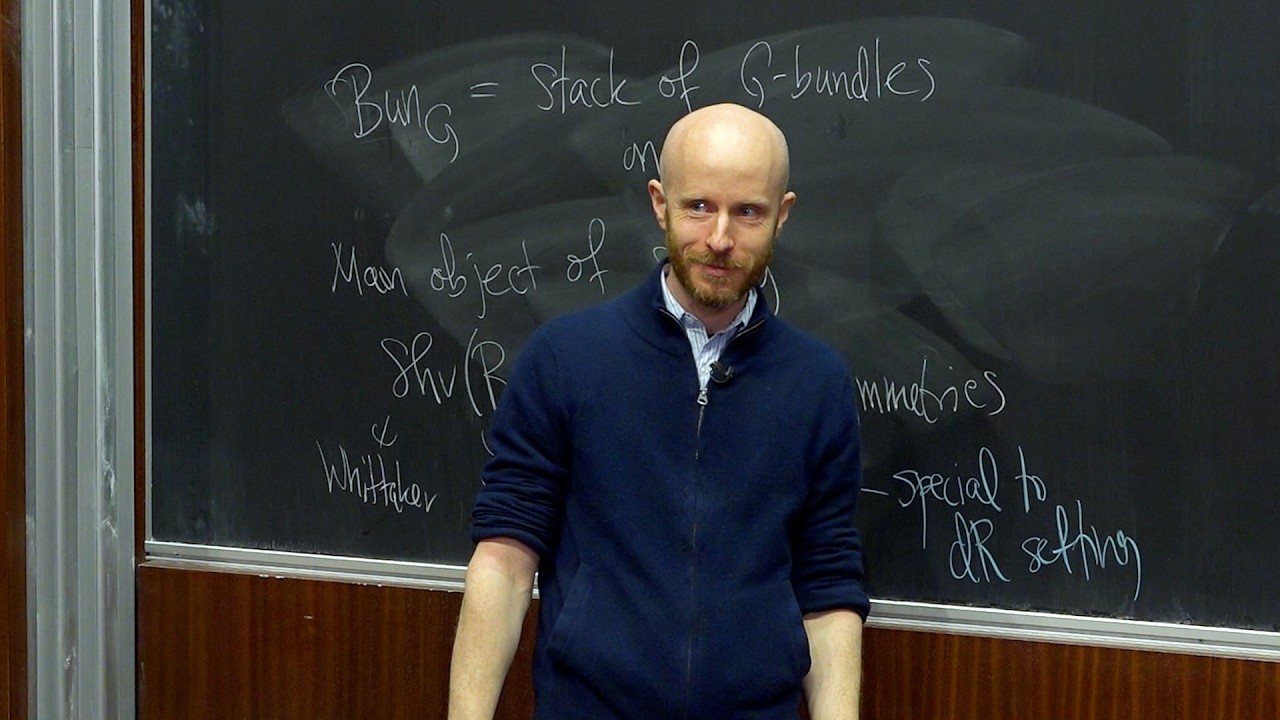
Sam Raskin - 1/6 Some Aspects of the Geometric Langlands Program
Keywords
Summary
191 words
Critical Evaluation
This lecture provides a high-level, rigorous introduction to the geometric Langlands program, delivered by a leading expert. The content is dense and assumes familiarity with algebraic geometry, representation theory, and category theory. The speaker carefully defines the relevant objects, such as the stack Bun_G, local systems, and the categories of sheaves (D-modules, Betti sheaves, étale sheaves), and explains the different formulations of the conjecture. The argumentation is solid, with clear logical flow from motivation to precise statements. The speaker acknowledges open questions and technical subtleties, such as the need for derived structures and the role of the Arthur multiplicity formula. The sources cited are primarily the foundational works of Beilinson-Drinfeld, Arinkin-Gaitsgory, and Ben-Zvi-Nadler, which are appropriate and authoritative. The lecture does not include any experimental data or empirical claims; it is purely mathematical exposition. The title accurately reflects the content. The technical level is very high, suitable for researchers and graduate students in the field. The lecture is part of a series, so it sets the stage for more detailed discussions. Overall, this is an excellent, authoritative introduction to a complex topic.
182 words
Title / Content Match
The title accurately reflects the content: the speaker discusses various aspects of the geometric Langlands program, including recent developments and open problems.
Quality & Reliability
9/10
Lecture by a leading expert (Sam Raskin, Yale) at IHES, part of a series. Content is highly technical and rigorous, aimed at researchers. No obvious errors or unsupported claims; the speaker carefully defines concepts and acknowledges open questions.
Key Moments
Markers derived by PSI from the transcript: the creator did not define chapters.
- Introduction and overview of the lecture series.
- Setup: X smooth projective curve, G reductive group, G∨ Langlands dual.
- Definition of sheaves: D-modules, Betti sheaves, étale sheaves.
- Introduction of Bun_G and Hecke symmetries.
- Three classes of objects: Whittaker, Eisenstein, Katz-Moody.
- Motivation from classical Langlands and Arthur multiplicity formula.
- De Rham version of geometric Langlands (Beilinson-Drinfeld, Arinkin-Gaitsgory).
- Betti version (Ben-Zvi-Nadler) and discussion of derived structures.
- Mention of étale version and relations between versions.
- Q&A and discussion of technical points.
Cited Sources
- Carmin.tv - Video platform for mathematics — The lecture is hosted on this platform, which provides additional features for the research community.
Concurring Sources
- Geometric Langlands correspondence - Wikipedia — Provides a general overview consistent with the lecture's content.
- The Geometric Langlands Conjecture by D. Gaitsgory — A survey that aligns with the lecture's presentation of the program.
Contribution & Novelties
This lecture provides a comprehensive overview of the geometric Langlands program, synthesizing recent developments and open problems. It clarifies the relationships between different formulations (de Rham, Betti, étale) and highlights the role of the Arthur multiplicity formula. The speaker’s perspective as an active researcher adds depth.
Pour aller plus loin :
- Geometric Langlands correspondence - Wikipedia — Provides background and context.
- The Geometric Langlands Conjecture by D. Gaitsgory — A comprehensive survey of the program.
- Arinkin-Gaitsgory, Singular support of coherent sheaves and the geometric Langlands conjecture — Key reference for the corrected conjecture.
- Ben-Zvi-Nadler, The character theory of a complex group — Foundational for the Betti version.
107 words
Radar Profile
The radar profile shows very high scores in all dimensions, indicating a lecture with exceptional information density, technical depth, and reliability. The balance between quantity and quality is excellent, making it a valuable resource for specialists.