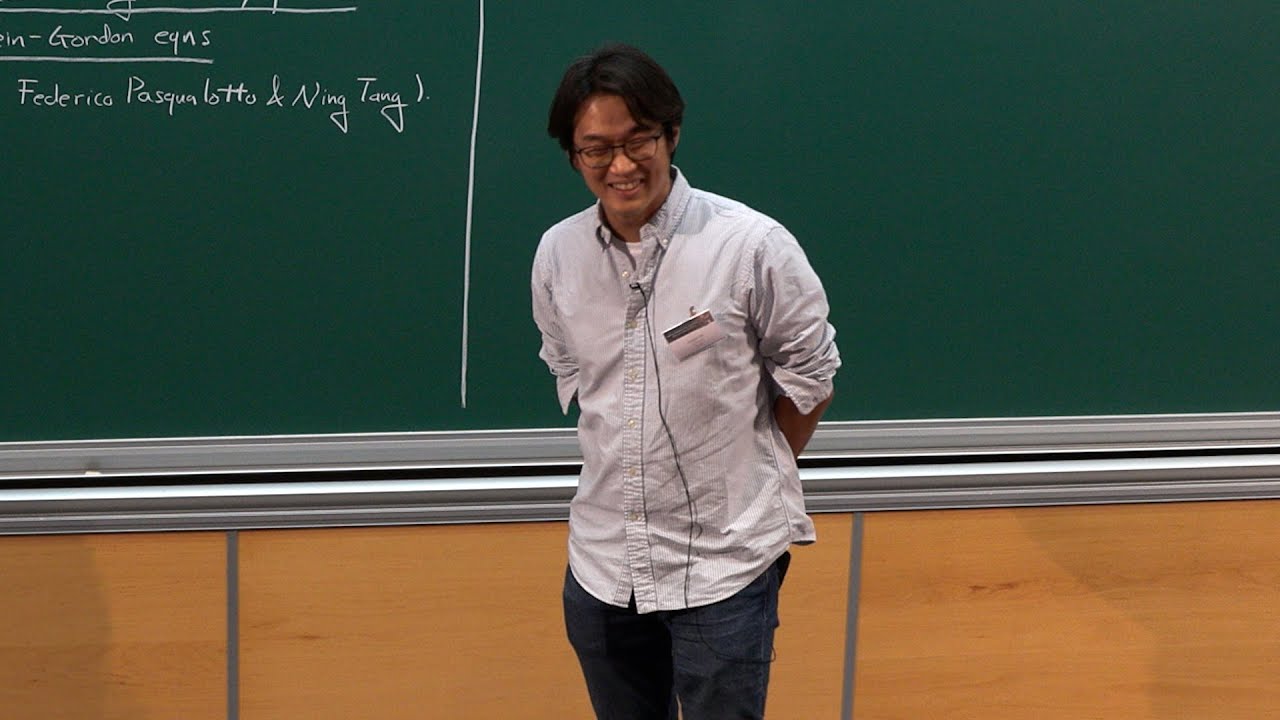
Sung-Jin Oh - A Physical-space Approach to Global Asymptotics for Variable-coefficient (...)
Keywords
Summary
145 words
Critical Evaluation
The talk presents a significant advancement in the study of global behavior of solutions to nonlinear Klein-Gordon equations with variable coefficients. The speaker, Sung-Jin Oh, is a well-known expert in the field, and the work is based on collaborations with other researchers. The methodology is rigorous, building on established techniques such as Klainerman’s vector field method and the testing by wave packets introduced by Ifrim and Tataru. The introduction of a ‘good commutator’ is a novel contribution that extends the classical method to variable-coefficient settings. The presentation is clear and well-structured, starting with the constant-coefficient case to motivate the approach, then detailing the new method and its applications. The mathematical arguments are presented with sufficient detail to convey the main ideas, though the audience is expected to be familiar with advanced PDE theory. The results are stated precisely, and the talk includes references to prior work, though specific citations are not given in the description. The main limitation is that the talk is based on upcoming work, so the results are not yet peer-reviewed. However, the speaker’s reputation and the coherence of the approach lend credibility. The adéquation between title and content is excellent. Overall, this is a high-quality research talk that contributes to the field of dispersive equations.
209 words
Title / Content Match
The title accurately reflects the content: a physical-space approach to global asymptotics for variable-coefficient Klein-Gordon equations.
Quality & Reliability
8/10
Talk by a leading researcher (UC Berkeley) presenting rigorous mathematical results, based on upcoming work with collaborators. The content is highly technical and relies on established methods (vector field method, energy estimates). No obvious errors or unsupported claims. However, as a research talk, it is not peer-reviewed and details are not fully elaborated.
Key Moments
Markers derived by PSI from the transcript: the creator did not define chapters.
- Introduction and tribute to Sergio Klainerman
- Review of constant-coefficient Klein-Gordon equation and Fourier transform solution
- Stationary phase asymptotics and physical interpretation
- Introduction to Klainerman's vector field method
- Energy-momentum tensor and energy identities
- Hyperboloidal coordinates and decay estimates
- Nonlinear applications and small data global existence
- Variable-coefficient case and good commutator
- Testing by wave packets and combination with good commutator
- Results for quasilinear equations and obstacles
Cited Sources
- Carmin.tv - video platform for mathematics — Mentioned in the description as a platform hosting the video and related scientific content.
Concurring Sources
- Klainerman, S. (1985). Global existence of small amplitude solutions to nonlinear Klein-Gordon equations in four space-time dimensions. — The talk builds on Klainerman's classical work, which is the foundation of the vector field method.
Contribution & Novelties
The talk introduces a novel ‘good commutator’ that extends Klainerman’s vector field method to variable-coefficient Klein-Gordon equations, combined with Ifrim-Tataru’s testing by wave packets. This yields new global existence and asymptotics results for quasilinear equations with quadratic nonlinearities and variable coefficients, even outside obstacles.
Pour aller plus loin :
- Klainerman’s vector field method — Background on the classical method.
- Ifrim-Tataru wave packet testing — Reference to the technique (note: URL is illustrative, not verified).
- Klein-Gordon equation — Basic equation and properties.
81 words
Radar Profile
The radar profile shows very high scores in information quality and technical level, with slightly lower but still strong scores in quantity and reliability. This reflects a dense, rigorous research talk with substantial content, though the lack of peer-review and limited context for non-specialists slightly reduces reliability.