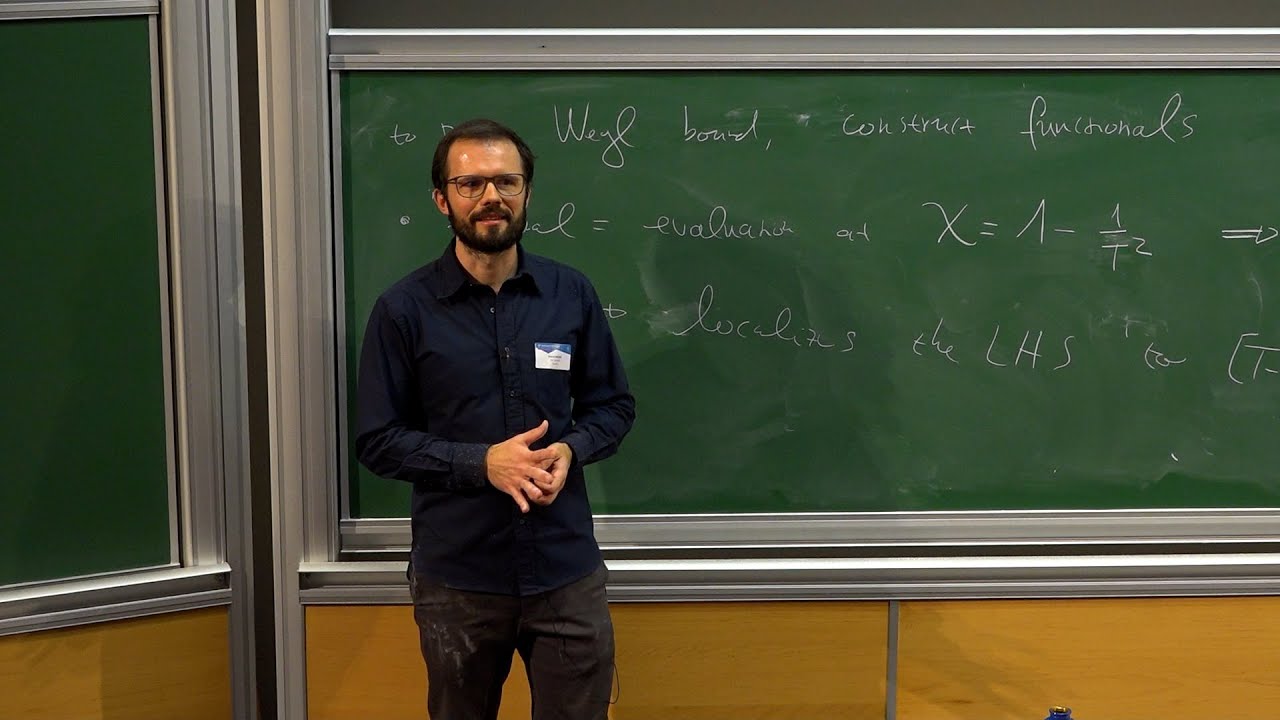
Mathematical Bootstrap: From Conformal Fields to L-Functions
Keywords
Summary
140 words
Critical Evaluation
The lecture provides a rigorous and insightful connection between two seemingly disparate fields: conformal field theory and number theory. The speaker, Dalimil Mazac, is a recognized expert, and the content is based on recent research papers, including his own work. The presentation is well-structured, starting with foundational material on hyperbolic surfaces and L-functions, then introducing the conformal bootstrap and its application to prove subconvex bounds. The mathematical rigor is high, with precise definitions and statements of theorems. The speaker is careful to distinguish between established results and conjectures, and he acknowledges prior work by others, such as Bonaf and the independent development by number theorists. The use of the bootstrap method to derive explicit bounds is a novel contribution, and the lecture highlights the potential for further cross-fertilization between physics and mathematics. The sources cited are arXiv preprints, which are appropriate for cutting-edge research, though they are not peer-reviewed. The lecture is technical and assumes a strong background in mathematics, but the speaker makes an effort to be pedagogical. The main strength is the clarity of the exposition and the depth of the content. The only minor weakness is that the lecture is quite long (over two hours), and some parts may be too detailed for a general audience. Overall, this is an excellent lecture that showcases the power of interdisciplinary approaches.
222 words
Title / Content Match
The title accurately reflects the content: the lecture connects conformal field theory (conformal bootstrap) to number theory (L-functions) through spectral theory of automorphic forms.
Quality & Reliability
9/10
The lecture is given by a researcher at IPhT Saclay and IHES, presenting rigorous mathematical results with references to arXiv papers. The content is technical and precise, with clear definitions and proofs outlined. The speaker is an expert in the field, and the presentation is part of an institutional lecture series.
Key Moments
Markers derived by PSI from the transcript: the creator did not define chapters.
- Introduction: overview of the connection between CFT and automorphic forms, and the plan of the course.
- Review of hyperbolic surfaces: definition, hyperbolic plane, Fuchsian groups, and examples like PSL2Z and triangle groups.
- Discussion of the Laplacian spectrum on hyperbolic surfaces, including the spectral gap and Weyl law.
- Introduction to L-functions: definition, properties, and connection to automorphic forms.
- Explanation of the conformal bootstrap method and its adaptation to number theory.
- Presentation of the main result: subconvex bounds on triple product L-functions using bootstrap techniques.
Cited Sources
- arXiv:2111.12716 — Paper by Mazac and collaborators on the connection between CFT and automorphic forms.
- arXiv:2308.11174 — Paper on spectral gaps of hyperbolic manifolds using bootstrap methods.
- arXiv:2508.20576 — Paper on subconvex bounds on L-functions using conformal bootstrap.
- Carmin.tv — Platform hosting the video and other scientific content.
Concurring Sources
- arXiv:2111.12716 — The paper by Mazac et al. establishes the analogy between CFT and automorphic forms, providing the foundation for the lecture.
- arXiv:2308.11174 — This paper applies bootstrap methods to spectral gaps, supporting the approach presented.
- arXiv:2508.20576 — The main result on subconvex bounds is detailed in this paper.
Contribution & Novelties
The lecture presents a novel connection between conformal field theory and number theory, specifically using conformal bootstrap techniques to prove new results on L-functions. This cross-disciplinary approach offers a fresh perspective on long-standing problems in spectral geometry and analytic number theory. The main contribution is the derivation of subconvex bounds for triple product L-functions, which are stronger than previous results. The method leverages the explicit computations possible in conformal bootstrap to go beyond what traditional number-theoretic techniques have achieved.
Pour aller plus loin :
- Conformal bootstrap — Overview of the method in physics.
- Automorphic forms — Background on automorphic forms and their role in number theory.
- L-functions — General introduction to L-functions and their properties.
- Subconvexity — Concept of subconvex bounds in analytic number theory.
125 words
Radar Profile
The radar profile shows high scores across all dimensions, indicating a lecture with substantial information content, high technical depth, and strong reliability. The balanced profile reflects the speaker's expertise and the rigorous nature of the material.