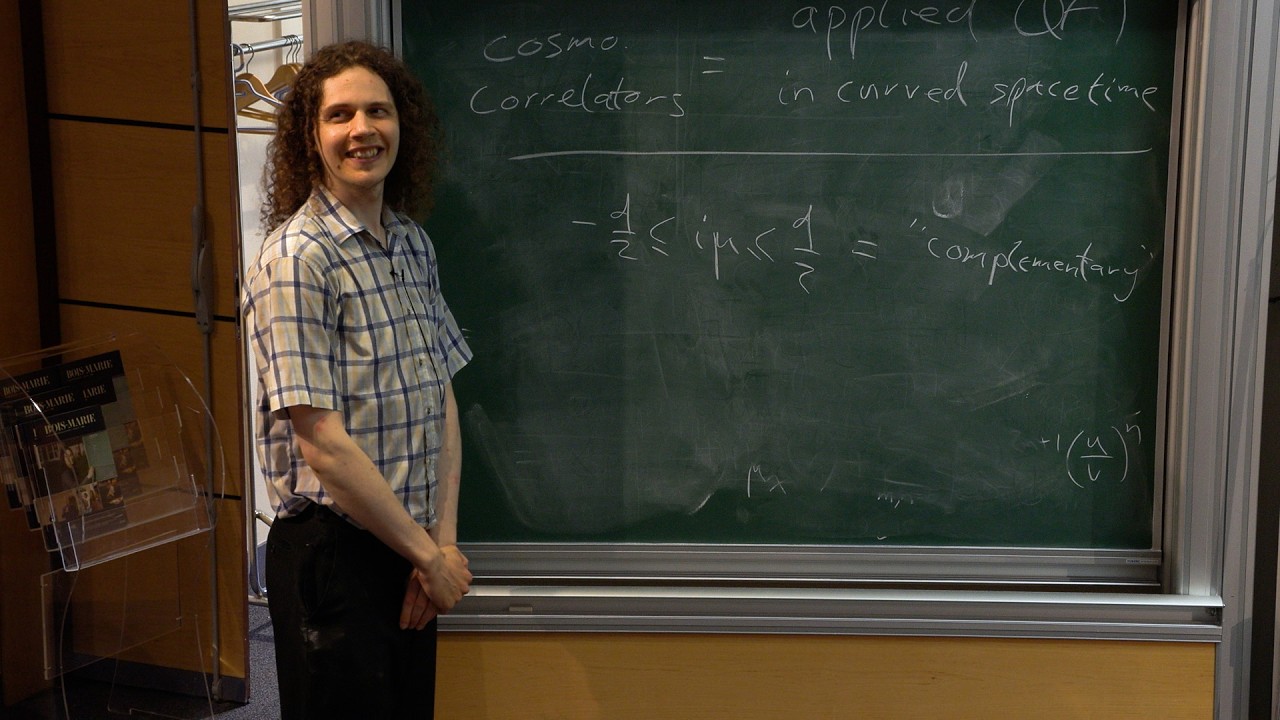
Scott Melville - 4/4 Introduction to Cosmological Correlators
Keywords
Summary
171 words
Critical Evaluation
This lecture provides a rigorous and detailed introduction to cosmological correlators, specifically focusing on the computation of the power spectrum and bispectrum in inflationary models. The content is highly technical and assumes a solid background in quantum field theory and general relativity, which is appropriate for the target audience of graduate students and researchers. The lecturer demonstrates a deep understanding of the subject, carefully deriving results from first principles and addressing subtle points such as gauge invariance and the conservation of adiabatic modes. The use of concrete examples, such as a scalar field with a potential, helps to illustrate the abstract framework. The lecture also includes valuable interactions with the audience, clarifying common misconceptions and providing additional insights. The sources cited, such as Weinberg’s paper on adiabatic modes, are authoritative and relevant. The presentation is well-structured, building on previous lectures and leading to a coherent conclusion. The main strength is the clarity of the derivations and the emphasis on physical interpretation. However, the lecture is quite dense and may be challenging for those not already familiar with the topic. The title accurately reflects the content, as it is indeed an introduction to cosmological correlators, with a focus on their analytic structure. Overall, this is an excellent lecture that provides a solid foundation for understanding the computation of cosmological correlators and their implications for inflationary cosmology.
225 words
Title / Content Match
The title accurately reflects the content: it is the fourth and final lecture introducing cosmological correlators, focusing on their analytic structure and applications.
Quality & Reliability
9/10
Lecture by a researcher at Queen Mary University of London, part of an IHES series. The content is mathematically rigorous, with derivations and references to standard literature (e.g., Weinberg's adiabatic modes). The presentation is clear and addresses student questions, indicating depth and expertise.
Key Moments
Markers derived by PSI from the transcript: the creator did not define chapters.
- Introduction and recap of previous lectures.
- Discussion on the conservation of adiabatic modes and large diffeomorphisms.
- Derivation of the power spectrum for a scalar field in slow-roll inflation.
- Explanation of the spontaneous breaking of time diffeomorphisms.
- Discussion on horizon crossing and the evaluation of correlators.
- Introduction of an interaction term and computation of the bispectrum.
- Derivation of the bispectrum shape and comparison with observational parameterization.
- Discussion on the physical interpretation of the results and implications for observations.
Cited Sources
- Carmin.tv — Video platform hosting the lecture.
Concurring Sources
- Carmin.tv — Platform hosting the lecture series.
Contribution & Novelties
This lecture provides a comprehensive and self-contained introduction to cosmological correlators, bridging the gap between theoretical formalism and observational predictions. It offers a clear derivation of the power spectrum and bispectrum for a simple inflationary model, highlighting the role of slow-roll parameters and the conservation of adiabatic modes. The lecture also clarifies common misconceptions, such as the spontaneous breaking of time diffeomorphisms and the evaluation of correlators at horizon crossing.
Pour aller plus loin :
- Weinberg’s paper on adiabatic modes — The original reference for the conservation of adiabatic modes.
- Cosmological perturbation theory — Provides background on the formalism used.
- Non-Gaussianity and the bispectrum — Overview of the observational implications of the bispectrum.
113 words
Radar Profile
The radar profile shows high scores across all dimensions, indicating a lecture that is rich in information, technically rigorous, and highly reliable. The balance between quantity and quality of information is excellent, with a strong emphasis on mathematical derivations and physical interpretation.