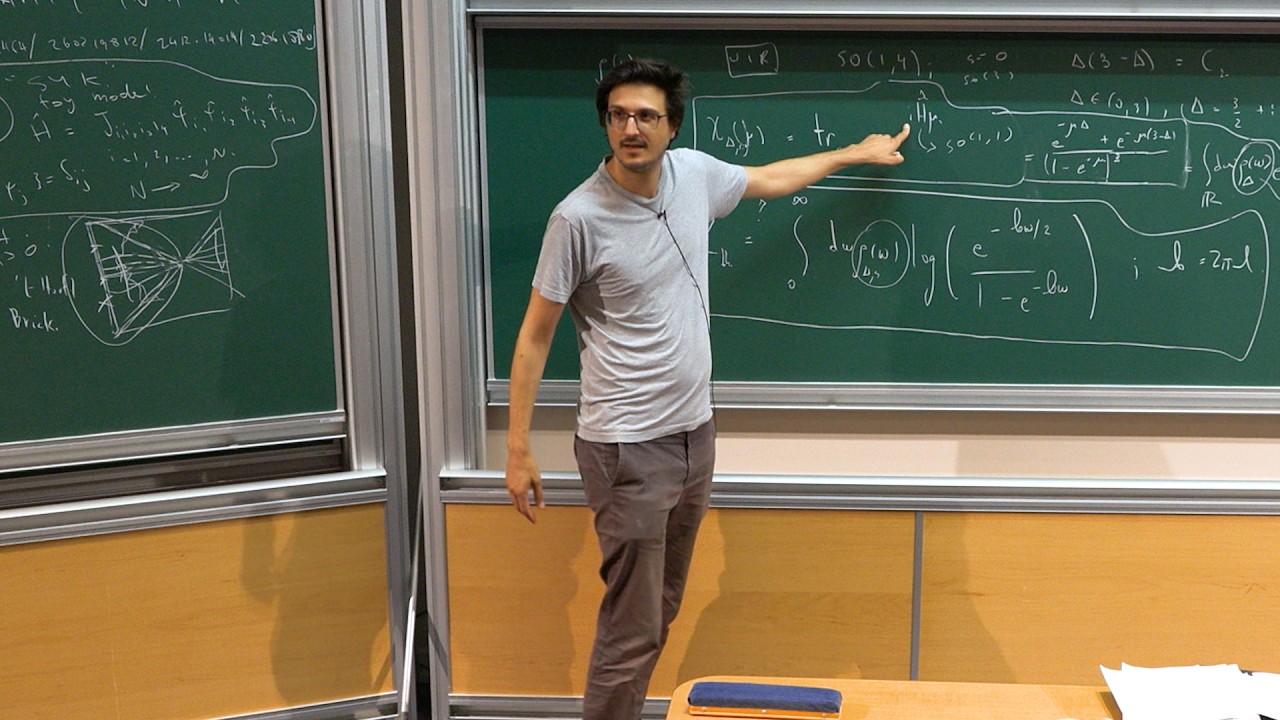
Dionysios Anninos - 2/3 Quantum Gravity in de Sitter Space
Keywords
Summary
175 words
Critical Evaluation
The lecture provides a rigorous and insightful overview of quantum aspects of de Sitter space, building on established results and current research. Anninos demonstrates deep expertise, clearly explaining the motivation and technical details. The comparison with black holes is illuminating, and the discussion of quasinormal modes and thermality is well-structured. However, the lecture assumes prior knowledge of quantum field theory in curved spacetime and general relativity, making it inaccessible to non-specialists. The argumentation is solid, but some steps are presented without full derivations, which is typical for a lecture. The sources are not explicitly cited within the talk, but the description links to Carmin.tv, a reputable platform for scientific videos. The title accurately reflects the content. Overall, this is a high-quality lecture for an expert audience, contributing valuable insights into the ongoing research on de Sitter quantum gravity.
138 words
Title / Content Match
The title accurately reflects the content: the lecture focuses on quantum gravity in de Sitter space, continuing a series.
Quality & Reliability
8/10
Lecture by a recognized expert in theoretical physics, presenting established results (Unruh effect, quasinormal modes) and current research directions. The content is technically rigorous, but as a lecture it does not provide full derivations or peer-reviewed references. The description links to a reputable platform (Carmin.tv) but no specific sources are cited.
Key Moments
Markers derived by PSI from the transcript: the creator did not define chapters.
- Recap of previous lecture and motivation for quantum gravity in cosmology.
- Discussion of SYK model as a toy model for black holes.
- Introduction to the static patch of de Sitter space and its properties.
- Analysis of quasinormal modes in de Sitter and comparison with black holes.
- Motivation for thermality of quantum fields in the static patch.
- Unruh effect adapted to de Sitter space and derivation of temperature.
- Discussion of Hilbert space factorization issues in quantum field theory.
Cited Sources
- Carmin.tv — Platform hosting the video and related scientific content.
Concurring Sources
- Carmin.tv — Platform hosting the video and related scientific content.
Contribution & Novelties
The lecture provides a clear synthesis of current understanding of quantum gravity in de Sitter space, emphasizing the static patch and its thermality. It highlights the distinction between de Sitter and black hole horizons, and the importance of toy models like SYK. The discussion of Hilbert space factorization issues is particularly insightful.
Pour aller plus loin :
- Unruh effect — Foundational concept for understanding thermality in curved spacetime.
- SYK model — Toy model for black holes and quantum chaos.
- de Sitter space — Geometry and properties relevant to the lecture.
90 words
Radar Profile
The radar profile shows high scores in technical level and information quality, reflecting the advanced and rigorous nature of the lecture. The moderate score in quantity of information is due to the focused scope, while the high reliability score is justified by the expertise of the speaker and the established concepts discussed.