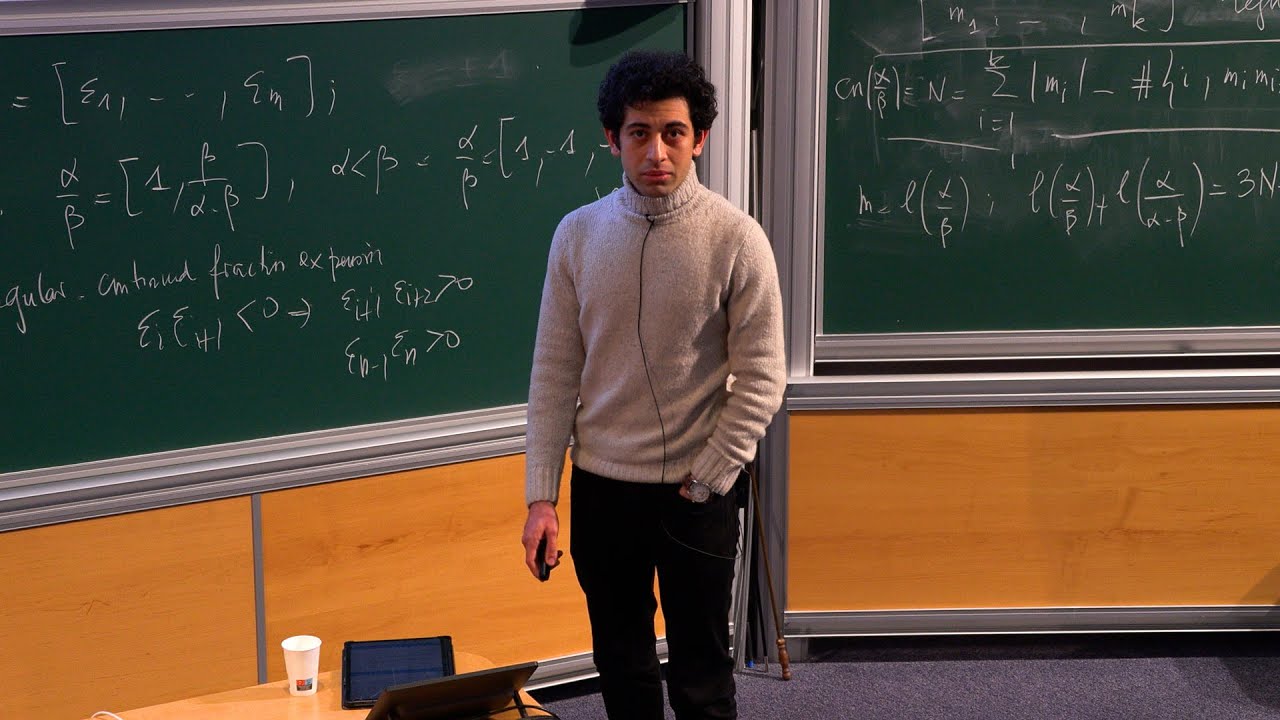
Parham Radpay - Renormalization group methods for quantum spin glasses
Keywords
Summary
128 words
Critical Evaluation
The talk provides a detailed and rigorous presentation of a research project on quantum spin glasses using functional renormalization group methods. The speaker clearly explains the model, the replica trick, and the diagrammatic techniques needed to handle the non-local interactions. The methodology is well-structured, with a clear progression from the classical action to the replicated partition function and the flow equations. The choice of truncation at the sextic level is justified by the symmetries of the model, and the speaker discusses the limitations of the approximation. The results are presented in both phases, and the comparison with previous work on 2+p spin glasses adds context. However, the talk lacks explicit references to published papers, which would enhance the verifiability of the claims. The presentation is dense and assumes a strong background in quantum field theory and renormalization group methods, but it is coherent and logically sound. The speaker’s explanations are clear, and the use of diagrams aids understanding. Overall, the talk is of high scientific quality, though it is not accessible to a general audience.
175 words
Title / Content Match
The title accurately reflects the content, which focuses on renormalization group methods applied to quantum spin glasses.
Quality & Reliability
8/10
The talk presents original research in theoretical physics, with a clear methodology and comparison to previous work. The speaker is affiliated with a recognized institution (Université Paris-Saclay) and the talk is hosted by IHES, a prestigious institute. The content is technical and appears rigorous, though the lack of published references in the description limits immediate verification.
Key Moments
Markers derived by PSI from the transcript: the creator did not define chapters.
- Introduction to spin glasses and their properties.
- Definition of the classical action and the disorder term.
- Introduction of the replica trick and the replicated partition function.
- Diagrammatic rules for the non-local interactions.
- Explanation of the functional renormalization group method.
- Truncation scheme and flow equations for the effective action.
- Results in the symmetric phase.
- Results in the symmetry-broken phase.
- Comparison with previous results on 2+p spin glasses.
- Conclusions and outlook.
Cited Sources
- Carmin.tv — Video platform hosting the talk.
Concurring Sources
- Carmin.tv — Platform hosting the talk, consistent with the content.
Contribution & Novelties
The talk presents a novel application of the functional renormalization group to quantum spin glasses, specifically addressing the non-local interactions arising from the replica trick. The approach uses two approximation schemes and provides results in both symmetric and symmetry-broken phases, offering new insights into the dynamics of these systems. The comparison with previous work on 2+p spin glasses highlights the differences and similarities between different coarse-graining schemes.
Pour aller plus loin :
- Wetterich equation — Overview of the functional renormalization group and the Wetterich equation.
- Replica trick — Explanation of the replica method used for disordered systems.
- Spin glass — General introduction to spin glasses and their properties.
108 words
Radar Profile
The radar profile shows high scores in technical level and information quality, reflecting the advanced and rigorous nature of the talk. The quantity of information is also high, but the overall accessibility is limited due to the specialized topic.