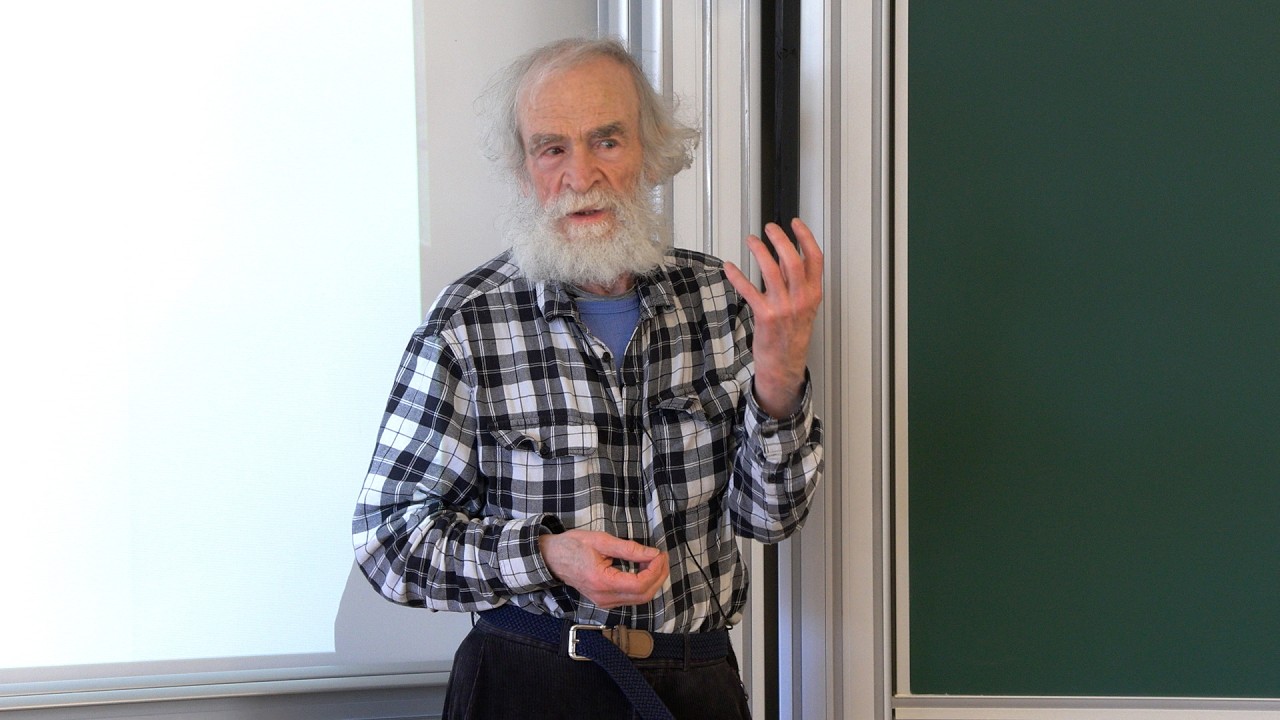
Mikhail Gromov - 1/4 Generation, Transformation, Transmission, Memorization, Storage and (...)
Keywords
Summary
192 words
Critical Evaluation
Mikhail Gromov’s lecture is a profound and thought-provoking exploration of information across biological and artificial systems, delivered with the intellectual depth expected from a mathematician of his caliber. The value of the information lies in its interdisciplinary synthesis, connecting molecular biology, neuroscience, linguistics, and artificial intelligence through the lens of information theory and mathematics. Gromov’s argumentation is solid in its logical structure; he carefully builds a case for the centrality of digital encoding in life and language, and he raises compelling questions about the nature of understanding and the limitations of current mathematical frameworks. However, the lecture is highly speculative, and Gromov himself acknowledges his lack of expertise in many areas, which introduces a degree of uncertainty. The scientific rigor is moderate: while he references established concepts like the central dogma and Kanerva’s sparse distributed memory, he does not provide formal citations or empirical evidence, relying instead on his authority and reasoning. The sources cited are minimal, with only a link to Carmin.tv, which hosts the video, and no direct references to the works he mentions. The adéquation between the title and content is good, as the title’s broad scope matches the lecture’s wide-ranging topics. The lecture’s strength lies in its ability to provoke new ways of thinking about information and life, but its speculative nature and lack of formal references prevent it from being a definitive scientific resource. The audience appears to be researchers and graduate students, as indicated by the channel’s keywords, and the content is appropriately challenging. Overall, the lecture is intellectually stimulating and offers valuable insights, but it should be viewed as a starting point for further exploration rather than a comprehensive, rigorously sourced analysis.
279 words
Title / Content Match
The title is incomplete but accurately reflects the broad scope of the lecture, which covers generation, transformation, transmission, memorization, and storage of information in biological and artificial systems.
Quality & Reliability
8/10
Gromov, a renowned mathematician, provides a speculative and interdisciplinary lecture, drawing on his expertise but not presenting original experimental data. The content is intellectually stimulating and grounded in established concepts, but the speculative nature and lack of formal citations lower the score.
Key Moments
Markers derived by PSI from the transcript: the creator did not define chapters.
- Introduction: Gromov sets the stage, discussing the mystery of large language models and the historical non-understanding of life.
- Discussion of Buffon and Laplace's views on understanding the universe, and the limitations of classical mathematical intelligence.
- Gromov mentions Chomsky's articulation of non-understanding of language and Pauli's emphasis on not understanding reality.
- Introduction of the concept of information and the difficulty of defining it without a broader context.
- Discussion of Weismann's information-theoretic critique of Lamarckian inheritance and the impossibility of life from a logical standpoint.
- Gromov describes the digital encoding of information in cells, mentioning viroids as the smallest entities with this property.
- Exploration of metastability in life, where negligible energy can trigger large-scale effects, and its physical indescribability.
- Discussion of the central dogma and protein folding, highlighting the arbitrary mapping between codons and amino acids.
- Gromov notes the peculiar appearance of digital encoding twice in history: in early life and in human language, with a 3.5 billion year gap.
- Introduction of concepts like information reduction in development, modularity in neural circuits, and stochastic generative combinatorics in languages.
Cited Sources
- Carmin.tv — Video platform hosting the lecture and related scientific content.
Concurring Sources
- Central dogma of molecular biology — Gromov references the central dogma as a key information flow in cells, aligning with established biological knowledge.
- Sparse distributed memory — Gromov mentions Kanerva's model as a potential framework for understanding information storage, consistent with existing literature.
Dissenting Sources
- No discordant sources identified — The lecture is speculative and does not directly contradict established scientific findings, but it presents personal interpretations that may not be universally accepted.
Contribution & Novelties
Gromov’s lecture provides a unique mathematical perspective on the role of information in biological and artificial systems, synthesizing concepts from molecular biology, neuroscience, and AI. He introduces the idea of metastability as a key feature of life and draws parallels to information processing in brains and large language models. The lecture also highlights the historical gap in digital encoding between early life and human language, prompting questions about the evolution of information systems.
Pour aller plus loin :
- Central dogma of molecular biology — Foundational concept in molecular biology, directly relevant to Gromov’s discussion of information flow in cells.
- Sparse distributed memory — Kanerva’s model, which Gromov mentions as a potential framework for understanding information storage.
- Information geometry — Mathematical framework used in AI and statistics, relevant to Gromov’s discussion of artificial neural networks.
- Metastability — Physical concept central to Gromov’s argument about the nature of life.
- Large language model — AI systems that Gromov discusses as a new class of problems.
162 words
Radar Profile
The radar profile shows high scores in quantity and quality of information, reflecting the lecture's rich content and intellectual depth. The technical level is moderately high, suitable for an expert audience. The overall reliability is slightly lower due to the speculative nature and lack of formal citations.