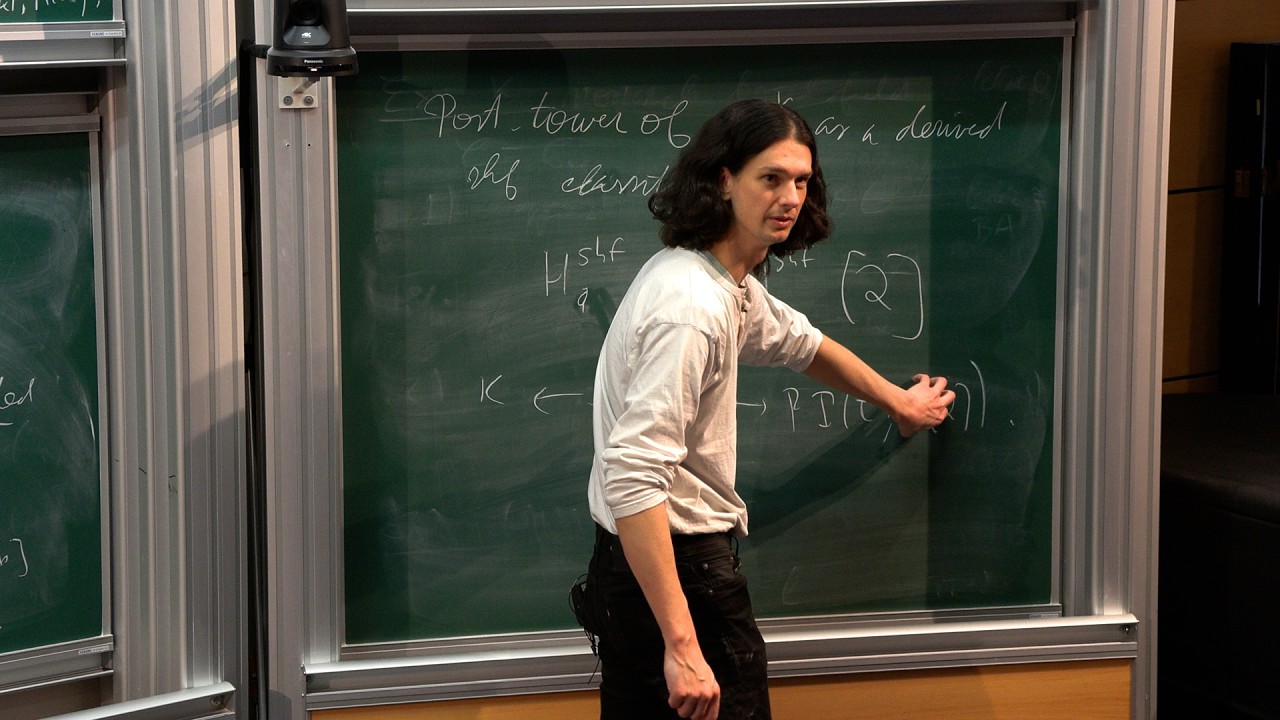
Dustin Clausen - 2/4 Weil Anima
Keywords
Summary
140 words
Critical Evaluation
The lecture provides a rigorous and detailed exposition of classical class field theory from the perspective of class formations, with an eye towards modern homotopy-theoretic refinements. The speaker, Dustin Clausen, is a leading expert in condensed mathematics, and his expertise is evident in the careful treatment of canonicality and the hints at the upcoming ‘anima’ perspective. The content is mathematically sound, building on well-established results such as the Nakayama-Tate lemma and the theory of Tate cohomology. The argumentation is clear, though the lecture is dense and assumes a strong background in algebra and cohomology. The sources cited are minimal, but the lecture is part of a series at IHES, a prestigious institution, and the speaker is a recognized authority. The title accurately reflects the content, and the lecture fulfills its promise to review classical material while setting up for modern refinements. The main limitation is the lack of explicit references to the literature, but this is common in lecture courses. Overall, the lecture is of high quality and provides valuable insights for researchers in number theory and related fields.
179 words
Title / Content Match
The title accurately reflects the content: the second lecture in a series on the Weil group and its refinements, with a focus on 'anima' (condensed mathematics).
Quality & Reliability
8/10
Lecture by a leading mathematician at IHES, based on classical results (Nakayama-Tate, class formations) and recent developments (condensed mathematics). The content is rigorous and well-structured, though the video is a recording of a live lecture with some informal interactions.
Key Moments
Markers derived by PSI from the transcript: the creator did not define chapters.
- Introduction and overview of the lecture.
- Definition of a class formation and its axioms.
- Statement and proof sketch of the Nakayama-Tate lemma.
- Application of Nakayama-Tate to class formations, construction of the Artin map.
- Discussion of how to verify the axioms, reduction to cyclic extensions, Herbrand quotient.
- Transition to the modern perspective, emphasis on canonicality and homotopy-theoretic ideas.
Cited Sources
- Carmin.tv — Video platform for mathematics, where the lecture is also available.
Concurring Sources
- Class field theory (Wikipedia) — General reference for the classical theory that the lecture reviews.
- Tate cohomology (Wikipedia) — Background on the cohomological tools used in the lecture.
Contribution & Novelties
The lecture provides a clear and rigorous review of classical class field theory via class formations, with an emphasis on canonicality that sets the stage for the speaker’s recent work on condensed mathematics and the Weil group. The discussion of the Nakayama-Tate lemma and the Artin map is standard, but the perspective of making everything as canonical as possible is a motivating theme for the series.
Pour aller plus loin :
- Class formation (Wikipedia) — Provides an overview of the concept and its role in class field theory.
- Nakayama-Tate lemma (nLab) — A concise reference for the lemma and its proof.
- Condensed mathematics (nLab) — Introduces the framework that motivates the ‘anima’ perspective in the lecture.
- Weil group (Wikipedia) — Background on the Weil group, the central object of the series.
131 words
Radar Profile
The radar profile shows high scores in quantity and quality of information, as well as technical level, reflecting a dense and rigorous lecture. The reliability score is slightly lower due to the lack of explicit citations, but the speaker's authority and institutional backing support the overall credibility.